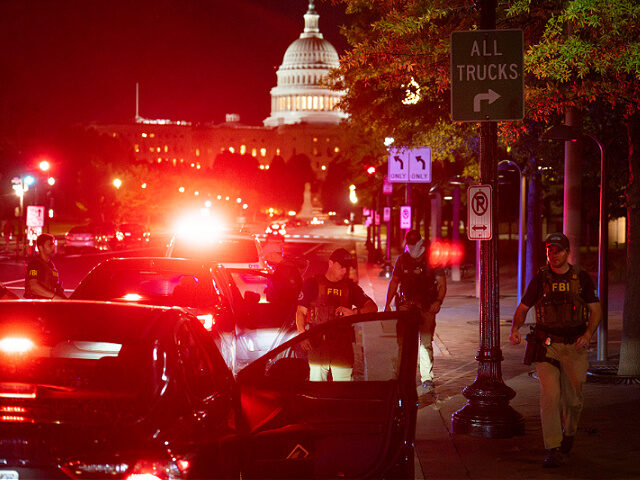

Two former Obama administration officials argue that President Donald Trump’s deployment of 800 National Guard troops to Washington shows the U.S. military will follow lawful orders rather than resist their commander-in-chief, writing, “it now seems clear to us that the military will not rescue Americans from Mr. Trump’s misuse of the nation’s military capabilities.”
Steven Simon and Jonathan Stevenson, both veterans of the Obama-era National Security Council, outline their grievances in Wednesday’s New York Times op-ed, “We Used to Think the Military Would Stand Up to Trump. We Were Wrong,” expressing outrage that military officers no longer act as independent guardians of the Constitution.
They claim the Guard deployment occurred “on the pretext of an illusory crime wave” and argue Trump has “further dragged the U.S. military into domestic law enforcement, in what they claim is an ominous ‘test case,’” continuing what they say the administration started in California “as part of its deportation efforts.”
The authors claim that “recent changes to the terms of the military’s employment by the Pentagon and its members’ incentives to career advancement will ultimately overcome any constitutional and moral qualms about their conduct.” They argue that while “democratic civilian control and the apolitical professionalism of military officers have long been bulwarks against authoritarianism,” Trump “has challenged this civil-military calculus.”
Simon and Stevenson acknowledge their political lens: “Since the military resisted his efforts to use active-duty personnel against Black Lives Matter protesters in 2020, liberals have put their faith in the military as a last line of defense against a rogue executive branch.”
The former officials criticize Trump’s personnel decisions, claiming he has “incentivized loyalty over legality and professional competence in administering military promotions,” “dismissed top military personnel without cause and promoted supporters (like former National Guard three-star Gen. Dan Caine) to leadership positions,” and faulted Secretary of Defense Pete Hegseth for firing “the military’s top Judge Advocates General, even though Pentagon lawyers see their job as facilitating policy objectives, not impeding them.”
Simon and Stevenson argue Trump “has insidiously militarized domestic law enforcement by bureaucratic means,” noting the Pentagon redesignated a change of duty status to allow troops “direct interaction with individuals in ICE custody,” and that ICE “may now utilize the National Guard in 20 states for ‘alien processing.’” They claim Trump “is effectively fusing Northern Command … and the Department of Homeland Security into a cooperative internal security body,” originally designed to counter external threats.
They invoke historical precedent, comparing it to “the Army’s internment of Japanese Americans in 1942,” carried out by officers “well aware that there was no serious security rationale to justify corralling these Americans into camps.” They argue “broader military culture favors the administration’s position” because “reinforced by civilian control, military officers will generally adapt to new missions even if they depart from tried-and-true practices.”
Simon and Stevenson claim that “if the highest-ranked officers taking their cue from the White House decide that military operations on American soil are necessary, career officers will get the message … but few would act on them.” They note that top officers “have registered no public objection” to dismissals or deployments, and that the National Guard and Marines “have faced no meaningful pushback.”
The authors assert that “in the context of domestic theaters, the military cannot be a politically neutral tool,” emphasizing that the Marines in Los Angeles and National Guard troops in Washington “will not be wearing blue helmets and thinking of themselves as a United Nations peacekeeping force,” and claiming Northern Command’s “commander’s job is to use U.S. air, ground and naval forces … to defeat enemies — even if those ‘enemies’ are U.S. citizens.” They add that Trump “has cast immigration and political forces ‘from within’ as threats.”
They warn that “expecting military personnel to shift seamlessly from destroying an enemy on the battlefield to law enforcement is asking for trouble,” predicting deployments could “provoke clashes with citizens who may be motivated to pick up a gun,” and that such operations “stealthily routinizes the fusion of executive and military power,” though they concede, “this might sound far-fetched, but it can spin out of control.”
The op-ed concludes with hope in judicial intervention: “It may be left to the Supreme Court to enforce constitutional discipline on the U.S. armed forces,” referencing Gov. Newsom’s California challenge, warning that the Court “has shown scant enthusiasm for curbing presidential power,” and noting that the military “would be unlikely to challenge the president, and his power would become that much more entrenched,” though they hope for “a broadly applicable unanimous decision … that even Mr. Trump would feel compelled to respect.”
Throughout the piece, Simon and Stevenson characterize lawful obedience as a constitutional failure, lamenting that officers will not act as independent political actors and concluding that “democratic civilian control and the apolitical professionalism of military officers” may no longer serve as “bulwarks against authoritarianism” when officers follow orders they politically oppose.
Joshua Klein is a reporter for Breitbart News. Email him at jklein@breitbart.com. Follow him on Twitter @JoshuaKlein.
COMMENTS
Please let us know if you're having issues with commenting.