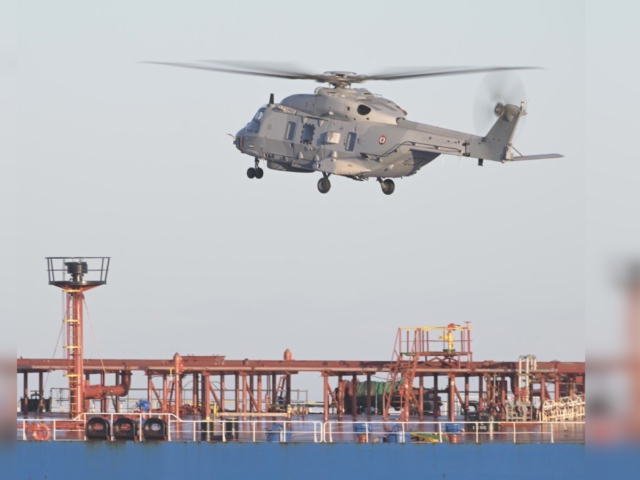
The French armed forces used helicopters to board and capture a Russian ‘shadow fleet’ oil tanker transiting the Mediterranean on Thursday with the assistance of allies, including the United Kingdom.
President Emmanuel Macron declared “we will not tolerate any violation” as he announced the capture of oil tanker Grinch in international waters in the Mediterranean between Spain and North Africa that had taken place on Thursday morning. Two French Navy NH-90 helicopters delivered marines to the ship, which France accused of flying a false flag — an acceptable legal pretext to board any ship — and of violating the anti-Russian sanctions regime.
Perhaps understandably for a European leader during a time of moral panic about the rules based international order, much of Macron’s statement on the seizure was concerned with asserting the legality of the military action. Stating the ship was “subject to international sanctions and suspected of flying a false flag”, President Macron stated the seizure took place on the high seas and “in strict compliance with the United Nations Convention on the Law of the Sea”, to uphold “international law”, and that a “judicial investigation has been opened”.
French newspaper Le Figaro states further details came from French authorities who stated the operation was “carried out in cooperation with our allies including the United Kingdom” and that it “aimed to verify the nationality of the ship”. They stated the initial inspection of the ship’s paperwork gave enough grounds for it to be redirected and escorted by the French navy to an anchorage for “further checks”.
The Daily Telegraph states the British involvement was intelligence sharing and unlike other recent seizures of Russian shadow-fleet tankers, such as by the United States, support from London did not go so far as the involvement of British ships and aircraft.
Moscow responded by complaining they had not been notified of the capture of the tanker. The Russian Embassy said, per Kremlin media: “French authorities have not shared any information with the Russian embassy either about the boarding of the tanker or the composition of its crew. Jointly with diplomats from the consulate general in Marseilles, we are currently looking into whether there may be Russian citizens among the crew so we can render any necessary assistance”.
Grinch had departed Murmansk, a Russian Arctic port, and was flying the Comoros flag. The ship is known on international sanctions lists as either the Grinch or the Carl. Changing names is not unknown for so-called shadow fleet tankers to conceal their identity. As previously reported on Russia’s shadow fleet:
“There are hundreds of flagless, stateless tankers that have been a lifeline for revenues, sanctioned oil revenues, for regimes like Maduro’s, Iran and for the Kremlin. They can no longer operate unchallenged,” Windward analyst Michelle Weise Bockmann said in December, after [a tanker] was captured… flagless ships have effectively zero legal protection against boarding and seizure, since they are violating maritime law, but hoisting virtually any national flag gives the sanctions-busting smugglers some legal defense, because the country whose flag they are flying must grant permission for them to be boarded. Russia has been successfully abusing that custom to protect ghost ships – until now.
Tufts University Center for International Law and Governance senior fellow John Burgess told RFE that the Marinera was a fringe case, since its change of convenience to the Russian flag while at sea was such a transparently obvious ploy. The White House dismissed perfunctory complaints from Moscow by declaring the ship was “stateless after flying a false flag.” Analysts expect Russia’s objections to grow louder if any Russian citizens aboard the ship are put on trial in the United States.
Windward analyst Bockmann said on Wednesday the Baltic Sea nations would be especially interested in the precedent set by the Marinera seizure, since ghost ships are a major threat to “maritime safety, maritime security, and the environment” in their relatively cramped waters. “The U.S. has shown that it is possible to interdict and to seize and to deal with tankers,” she said.
COMMENTS
Please let us know if you're having issues with commenting.