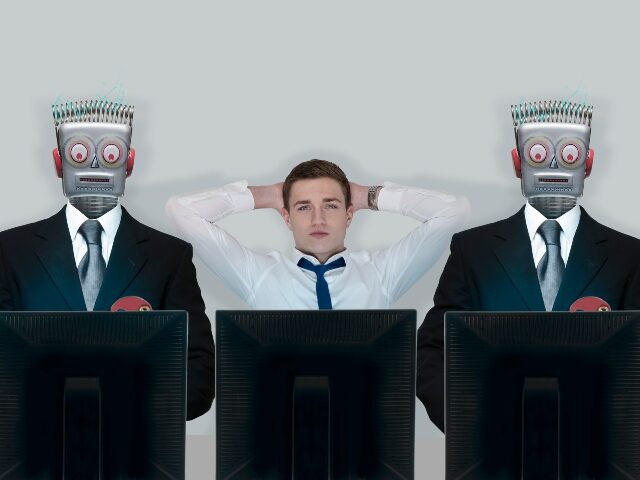

Major corporations are increasingly attributing layoffs to AI, but skeptics question whether these explanations tell the complete story behind recent job cuts.
The New York Times reports that companies have traditionally attributed layoffs to various business factors including missed financial targets, pandemic-era overhiring, tariff impacts, or the loss of major clients. However, a new trend has emerged where corporate executives are increasingly pointing to AI as the primary driver behind workforce reductions, claiming they need to make cuts now in anticipation of technological changes.
According to research firm Challenger, Gray & Christmas, artificial intelligence was mentioned in announcements for over 50,000 layoffs during 2025. This marks a significant shift in how companies frame their workforce reduction decisions to employees, investors, and the public.
Among the most prominent examples is Amazon, which recently announced it would eliminate 16,000 corporate positions, adding to the 14,000 cuts announced in the fall. Andy Jassy, Amazon’s chief executive, wrote in a June blog post: “As we roll out more generative AI and agents, it should change the way our work is done,” and projected that “in the next few years, we expect that this will reduce our total corporate workforce.” However, Jassy later walked back the direct connection between layoffs and artificial intelligence. The company subsequently stated that most cuts were aimed at reducing bureaucracy, though analysts widely believe Amazon is freeing up financial resources for artificial intelligence investments such as data centers.
Pinterest announced last month it would cut approximately 15 percent of its workforce, partially attributing the decision to “reallocating resources to A.I.-focused roles.” Similarly, Hewlett-Packard’s chief executive, Enrique Lores, stated during a November investor call, “We see a significant opportunity to embed A.I. into HP,” indicating this would result in up to 6,000 job cuts over the coming years.
While investors may view such proactive measures favorably, a growing number of skeptics suggest corporations are engaging in what has become known as “AI-washing” — disingenuously blaming AI for layoffs. Market research firm Forrester addressed this phenomenon in a January report, stating: “Many companies announcing A.I.-related layoffs do not have mature, vetted A.I. applications ready to fill those roles, highlighting a trend of ‘A.I.-washing’ — attributing financially motivated cuts to future A.I. implementation.”
The term “AI-washing” follows in the tradition of other phrases describing misleading marketing practices, such as greenwashing and ethics washing. While the term emerged several years ago primarily to call out companies falsely claiming to use artificial intelligence when they were not, it has recently evolved to encompass a broader critique of companies emphasizing artificial intelligence to explain decisions like layoffs when the underlying reasons may be more complex.
Peter Cappelli, a professor at the Wharton School, explained the basis for skepticism: “Companies are saying that ‘we’re anticipating that we’re going to introduce A.I. that will take over these jobs.’ But it hasn’t happened yet. So that’s one reason to be skeptical.”
Molly Kinder, a senior research fellow at the Brookings Institution who studies artificial intelligence and work, characterized this type of anticipatory layoff as a strategic communication move. She said it allows executives to signal to the market: “I’m cutting-edge, I’ve adopted A.I., and I’ve figured out savings.” According to Kinder, this represents a “very investor-friendly message,” which contrasts sharply with admitting “the business is ailing.”
The actual impact of artificial intelligence on employment remains uncertain. While the technology may eventually transform the job market across various sectors, recent research indicates it has not yet produced significant shifts in the overall employment landscape. A study Kinder worked on for the Yale Budget Lab found that artificial intelligence has not meaningfully altered the broader job market to date.
Read more at the New York Times here.
Lucas Nolan is a reporter for Breitbart News covering issues of free speech and online censorship.
COMMENTS
Please let us know if you're having issues with commenting.