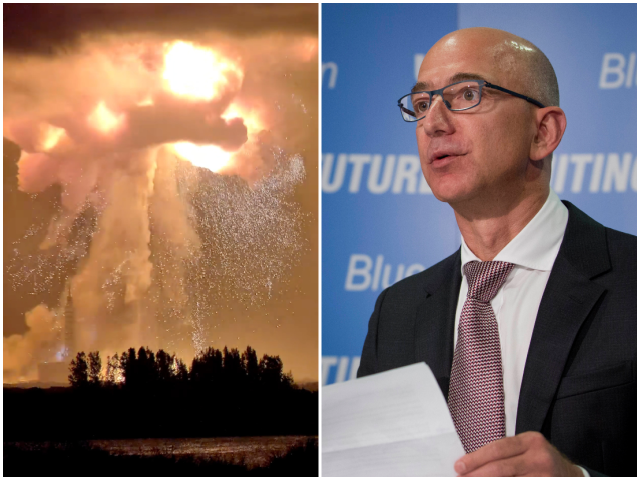

Blue Origin’s massive New Glenn rocket exploded during a static fire test at Cape Canaveral, Florida, marking the most severe setback in the history of Jeff Bezos’ SpaceX competitor.
TechCrunch reports that the explosion occurred as Jeff Bezos’ space company was conducting a static fire test in preparation for the rocket’s anticipated fourth launch, which was scheduled to carry Amazon Leo internet satellites into orbit in the coming weeks. The incident was captured on live streams by NASASpaceFlight.com and SpaceFlight Now before Blue Origin officially confirmed the explosion.
Because the rocket was likely fully fueled for the static fire test, the explosion ranks among the largest rocket failures in United States history. Blue Origin released a statement on X confirming that all personnel had been accounted for and were safe. Bezos himself addressed the incident directly, stating the cause remained unknown but investigations were already underway.
“It’s too early to know the root cause but we’re already working to find it. Very rough day, but we’ll rebuild whatever needs rebuilding and get back to flying. It’s worth it,” Bezos wrote.
NASA Administrator Jared Isaacman responded to the incident, saying the agency will “work with our partners to support a thorough investigation of this anomaly, assess near-term mission impacts, and get back to launching rockets.”
The Federal Aviation Administration confirmed awareness of the explosion and reported no impact to air traffic operations. NASA and the Space Force had not provided comments at the time of the initial reports.
The explosion will almost certainly force Blue Origin to suspend the New Glenn rocket program for an extended duration while engineers determine what caused the failure. The company had ambitious plans to conduct up to 12 New Glenn launches throughout the year, following approximately a decade of development work aimed at competing with Elon Musk’s SpaceX.
Blue Origin’s role extends beyond commercial satellite launches. The company is contracted to support NASA’s Artemis lunar missions, with the agency having highlighted Blue Origin’s expected contributions to the program earlier in the week. Isaacman indicated that NASA would provide updates on impacts to the Artemis and Moon Base programs as information becomes available. Additionally, Blue Origin has been working toward launching national security missions for the Pentagon.
Even competitor Elon Musk acknowledged the severity of the setback. “Most unfortunate. Rockets are hard,” Musk wrote on X shortly after the explosion. “I hope you recover quickly.” Musk’s SpaceX has had its own share of spectacular explosions in recent years.
The explosion occurred just weeks after New Glenn’s third flight in April, which itself experienced a significant failure when the upper stage failed to deliver an AST SpaceMobile satellite to orbit, resulting in complete mission loss. The FAA had cleared New Glenn to resume flights only the previous week after Blue Origin completed an investigation into that failure.
Blue Origin spent years developing New Glenn while operating its smaller New Shepard program for suborbital flights. New Shepard conducted regular missions carrying paying passengers and celebrities to the edge of space, along with scientific payloads, while New Glenn development continued behind the scenes.
The New Glenn rocket first flew in January 2025, successfully reaching orbit although the booster stage exploded before landing attempts on an ocean-based drone ship could be completed. The second flight in November 2025 proved more successful, launching twin spacecraft to Mars for NASA and successfully recovering and landing the first stage booster.
That recovered booster was refurbished and reflown on the third mission, demonstrating critical reusability capabilities essential for reducing launch operation costs. The booster performed well and landed successfully a second time, though the mission failed due to a malfunction in the upper stage.
The planned fourth mission was intended to mark the beginning of 24 contracted launches that Amazon has arranged with Blue Origin to build its Leo satellite internet network, a competitor to SpaceX’s Starlink system. Amazon had publicly emphasized its partnership with Blue Origin just one day before the explosion, calling New Glenn a “reusable, heavy-lift rocket.” Amazon confirmed that no Leo satellites were aboard for the test.
Read more at TechCrunch here.
Lucas Nolan is a reporter for Breitbart News covering issues of AI, free speech, and online censorship.
COMMENTS
Please let us know if you're having issues with commenting.