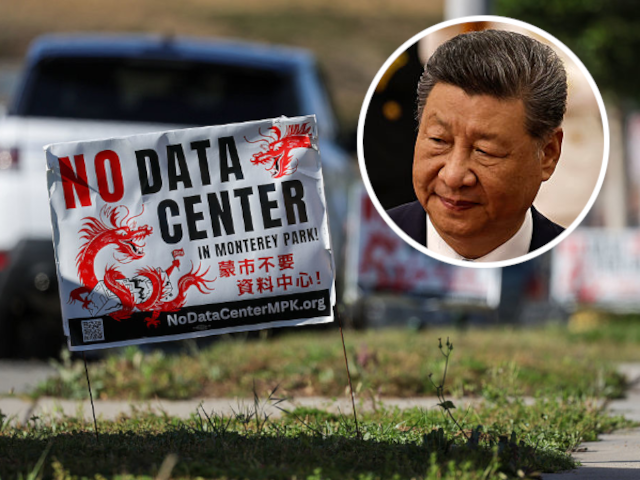

State Armor founder and CEO Michael Lucci is calling on leaders of three congressional committees to investigate whether China and other foreign interests are attempting to impede the development of infrastructure essential to America’s artificial intelligence capabilities.
In a letter sent the morning of July 14 and obtained exclusively by Breitbart News, Lucci asks the chairmen and ranking members of the House Permanent Select Committee on Intelligence, Senate Select Committee on Intelligence, and House Committee on Ways and Means to investigate what he describes as growing evidence of foreign-backed efforts to amplify opposition to data center projects across the United States.
Lucci told Breitbart News:
The Chinese Communist Party has repeatedly demonstrated its willingness to use influence operations to advance Beijing’s strategic interests at America’s expense. As artificial intelligence emerges as the defining geopolitical competition of the 21st century, we should expect the CCP to target the infrastructure that will determine who wins that race. Reports of PRC-linked campaigns amplifying opposition to American data centers should serve as a serious warning.
Beijing understands that America’s leadership in AI depends on our ability to build the computing infrastructure these systems require, and it has every strategic incentive to slow that progress. Congress must immediately investigate whether foreign adversaries are manipulating those debates through propaganda, covert influence, or coordinated information operations. If foreign governments or their affiliated networks are working to impede America’s AI buildout, those efforts should be exposed and countered before they undermine our economic strength and national security.
The letter is addressed to House Intelligence Committee Chairman Rick Crawford (R-AR) and Ranking Member Jim Himes (D-CT), Senate Intelligence Committee Chairman Tom Cotton (R-AR) and Vice Chairman Mark Warner (D-VA), and House Ways and Means Committee Chairman Jason Smith (R-MO) and Ranking Member Richard Neal (D-MA).
“I write to urge your committees to investigate growing evidence that foreign actors and foreign-linked influence networks are seeking to undermine American AI infrastructure by amplifying opposition to data center projects across the United States,” Lucci wrote.
He cited a request from members of the House Energy and Commerce Committee for the administration to investigate links between foreign governments, particularly China, and anti-AI propaganda campaigns in the United States.
“That request reflects an important recognition that foreign adversaries increasingly view America’s technological leadership as a target for strategic influence operations,” Lucci wrote. “Congress has a critical role in exposing and countering those efforts.”
Lucci said he testified last month before the Texas House Committee on Natural Resources about evidence that foreign actors, particularly the Chinese Communist Party and affiliated influence networks, are amplifying opposition to data center development.
Although that testimony focused on Texas because of the state’s importance to the expansion of American AI infrastructure, Lucci said that the issue is national and falls within the oversight responsibilities of congressional intelligence committees.
Data centers are essential to the computing capacity required by AI systems and, according to the letter, consequently affect America’s economic strength, military advantage, and national security. Lucci noted that the United States and China have each publicly identified AI leadership as a national security priority.
“China has every strategic incentive to delay or complicate America’s ability to build the computing infrastructure necessary to maintain that lead,” he wrote.
The letter says that the effort extends beyond traditional espionage into information warfare and malign foreign influence.
Lucci wrote that Americans should continue to debate data center projects openly and that concern about foreign influence should not be used to discount organic resistance to data center development.
“But Congress must also ensure those debates are not being manipulated by hostile foreign governments,” he wrote. “In fact, the best way to protect our civil society and ensure a good-faith domestic debate is to exclude malicious adversaries who seek not only to arrest our infrastructure development, but also to enhance our political divisions and sow discord in our domestic debates.”
The letter points to several reports alleging overlapping foreign influence efforts directed at American AI infrastructure.
An April 2026 American Energy Institute report documented more than $39 million in foreign funding flowing to organizations opposing American AI infrastructure projects, according to the letter.
A subsequent Bitcoin Policy Institute report described several foreign influence networks converging around attempts to block U.S. data center construction. The entities identified included Chinese propaganda outlets, organizations linked to Neville Roy Singham, and European-funded activist networks.
The Bitcoin Policy Institute later released a second installment documenting additional alleged ties to Chinese influence operations.
Lucci also cited OpenAI’s recent disclosure of a People’s Republic of China-linked influence operation that generated social media posts, comments, memes, and political cartoons opposing the construction of U.S. data centers.
According to the letter, the campaign promoted narratives involving electricity costs, grid reliability, and environmental impacts in an apparent attempt to shape American public opinion.
Lucci wrote that Chinese state media have promoted similar English-language messages aimed at American audiences. He said that state media are also used to transmit talking points to “united front” organizations operating in the United States and tasked with advancing Chinese Communist Party objectives.
“Together, these activities suggest a coordinated effort to influence domestic debate surrounding infrastructure that is central to America’s AI competitiveness,” he wrote.
The letter also identifies organizations tied to the Singham network, including CODEPINK, as increasingly active participants in anti-data-center campaigns across the country.
According to the letter, CODEPINK characterizes data centers as part of a broader “war economy” and connects opposition to AI infrastructure with resistance to what the organization calls a “new Cold War on China.”
Lucci also cited Interior Secretary Doug Burgum’s recent acknowledgment that foreign money is helping fuel misinformation related to data center development.
“The United States should welcome public debate over data centers, energy policy, and AI development,” Lucci wrote. “Our open society is one of our greatest strengths. But openness also creates opportunities for authoritarian governments to exploit democratic debate through propaganda, covert influence, foreign-funded advocacy, and coordinated information operations.”
Lucci is asking Congress to conduct a comprehensive counterintelligence review to determine whether foreign governments and foreign-backed networks are attempting to impede the infrastructure underpinning American AI leadership.
“Where foreign influence operations are identified, they should be exposed and countered,” he wrote.
A previous State Armor report accused the Environmental Law Institute of maintaining extensive relationships with Chinese government-linked institutions while supporting legal efforts that restrict American energy production. State Armor said ELI’s nearly 30-year China Program worked with Chinese regulators, judges, universities, and other entities, while its Climate Judiciary Project trained more than 2,000 American judges. State Armor described the arrangement as an “asymmetric pursuit” that pressures U.S. energy producers while failing to impose comparable pressure on Chinese producers. Lucci separately accused ELI of giving China “a free pass” and urged Congress to investigate its China operations and examine whether foreign-connected judicial education initiatives could affect the perception or reality of judicial impartiality.
COMMENTS
Please let us know if you're having issues with commenting.