'They're On To Us': Gaming Journalists Respond to Critics in Newly Revealed GameJournoPros Emails
A second tranche of leaked emails from the secret GameJournoPros mailing list, dated September 2014 and published today by Breitbart London, reveals video game journalists insulting popular YouTubers and laughing off the prospect of readers challenging them about ethical violations.
This new leak follows an earlier release of emails dated August, which showed games journalists joking about having sex with public relations executives and game developers.
It was an unfortunate choice of topic given that the video game journalism industry had just been rocked by revelations that developer Zoe Quinn -- allegedly according to her ex-boyfriend -- had enjoyed five sexual relationships in quick succession with industry figures, including a journalist, while receiving lavish praise for her Depression Quest game and being in receipt of financial support from journalists who reported on her.
In these new emails, from September, discussing journalist Jenn Frank's good-bye letter to the industry, which was swiftly rescinded last week when she began to once again write for the Guardian newspaper, the denizens of GameJournoPros can be seen alternately considering their position in the industry and dismissing their critics.
Frank announced her departure from games journalism after readers pointed out that an opinion piece of hers, published by that newspaper, originally failed to include a disclaimer that she knew one of the subjects of her piece, Zoe Quinn.
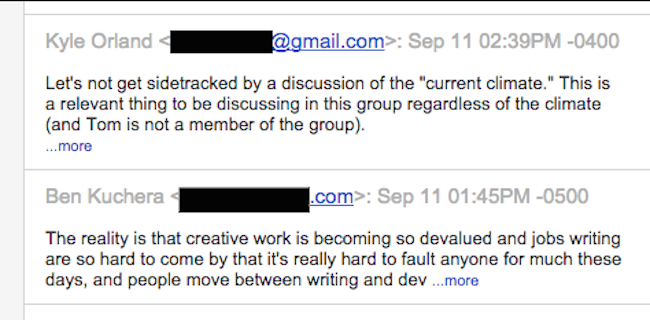
In response to what some readers will consider an appropriate move after the exposure of professional failures, Ben Kuchera, an opinion editor at Vox Media-owned Polygon, defended Frank, writing on 11 September: "If I were freelance these days I'd leave game writing so quickly your head would spin."
NOTHING TO SEE HERE
James Fudge, managing editor of GamePolitics.com, wrote: "[N]one of us have received angry emails from readers about GamerGate. Most people have no idea that it is even happening."
The #GamerGate hashtag, which has swept social media in recent weeks, has been used by gamers to express their disappointment in widespread ethical failures by video game journalists, who have allowed far-Left feminist campaigners to saturate the news agenda with allegations of "misogyny" and sexism directed not just at games studios but at ordinary gamers themselves.
But it's not just GamerGaters who are capable of ugly behaviour. Reporters sympathetic to the #GamerGate movement have had their home addresses and phone numbers published online and have been sent toilet rolls and unsheathed syringes containing unknown liquids via ordinary mail.
On the same date in September, senior video game journalists were engaged in a lengthy, sneering thread about popular YouTube personality TotalBiscuit, who reviews games. Some professional bloggers resent the popularity of YouTubers, say insiders, because YouTubers have large, engaged fan bases, whereas journalists are often the subject of ridicule and tough questioning from readers.
But only now can we see how they speak about such reviewers behind closed doors - in a forum that list founder Kyle Orland was proud remained unknown about by the wider public.
PLAYGROUND BULLIES
In a thread sarcastically titled, "The time TotalBiscuit told on me," Dan Stapleton, reviews editor at IGN, says: "I have some experience picking fights with egotistical YouTube personalities who label themselves as ill-tempered in some fashion. Not something I recommend."
Susan Arendt, managing editor of Joystiq, adds: "TotalBiscuit has an insanely thin skin. Speaking from personal experience."
Other journalists can be seen complaining about the "abuse" they receive at the hands of gaming punters. Further reading suggest the definition of "abuse" meant is tweets and Facebook statuses critical of mainstream coverage, rather than actual threats or foul language.
Writer and editor Chris Dahlen calls #GamerGate supporters "knuckleheads," while Polygon's Kuchera mocks the #notyourshield hashtag, which was started to draw attention to women and other minorities who do not support the radical feminist agenda of the mainstream gaming publications.
CRYSTAL BALLS
An earlier private email thread, dated 7 September 2014, is entitled, "Putting Gamergate behind us?" In light of the continuing controversy surrounding press ethics in the gaming industry, that subject line will strike many readers as comically hopeful. Some of the following emails come from abridged summaries sent by Google to one member of the list.
But in emails that will infuriate readers, many of whom believe the elite bloggers of publications such as Vox Media-owned Polygon, Gawker-owned Kotaku and Conde Nast-owned Ars Technica are hopelessly out of touch with ordinary gamers, journalists can be seen further insulting and denigrating their own constituencies.
For example, Michael Futter, news editor at Games Informer, describes questioning by gamers as "crackpot," urging his colleagues to avoid engaging with readers on social media.
There is evidence on the list that some writers, particularly those in more regular contact with games companies and gamers themselves, did foresee the coming drama.
Michael Zenke, a video game content writer who is currently working on Elder Scrolls Online, responds that, "There are people in the industry that care about this. A lot."
Zenke is backed up by Matt Hawkins, who writes: "I'll echo Michael's sentiments, primarily on the indie side of the spectrum."
That conversation peters out, before being taken to private emails.
What will strike many readers as remarkable is how ill-prepared senior editors on the GameJournoPros list were for the controversy that arrived when questions began to be asked openly about their closeness to their subjects and the general standards of ethics in video game journalism.
For the most part, the latest batch of emails leaked to Breitbart show widespread denial on the part of video games journalists that there is any problem at all. Dahlen is seen at one point to say: "This is a good time to point out that #gamergate was never about 'corruption'" - something with which many tweeters will not agree.
"This is a big topic and it's leading to people being hurt. I don't want to minimize that, concedes Kuchera, before adding: But I don't think your average reader of online gaming news has been affected much."
Kuchera, writing on 7 September, could not have been more wrong. Then again, the Polygon editor has a special talent for saying the unsayable: in conversation on 11 September 2014, he wrote: "Jobs writing are so hard to come by that it's really hard to fault anyone for much these days."
Unluckily for Kuchera, readers in the weeks since then have made it clear that they expect much, much higher standards.