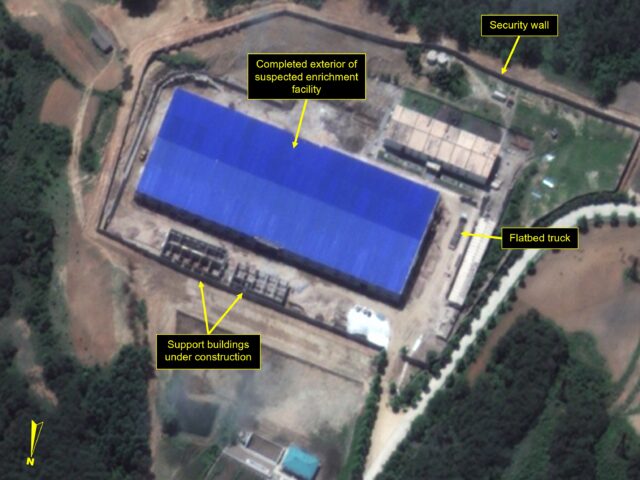

- An assessment of satellite images suggested North Korea may be generating more weapons-grade uranium.
- The U.N. nuclear agency revealed in mid-November that North Korea had expanded the site of a key nuclear facility.
- Kim Jong-un has repeatedly vowed to “exponentially” increase the number of nuclear weapons in his possession.
A D.C.-based institution suggested that the rogue communist government of North Korea may be expanding its capacity to generate weapons-grade uranium at its Yongbyon nuclear complex, citing satellite images of new construction there since September.
The Institute for Science and International Security (ISIS) published some of these images on November 19, following a warning from United Nations nuclear chief Rafael Grossi that North Korea was engaging in a “deeply regrettable” nuclear weapons buildup and that the International Atomic Energy Agency (IAEA) was aware of expansions of facilities at Yongbyong.
The images published were from October, and the assessment this week represents a deeper look at what the images could mean for the future of the North Korean nuclear program.
Noting that Grossi, in his statement to the IAEA, did not speculate on what exactly the expansions were for, the ISIS suggested that, based on the shapes of the new buildings, the facilities could be used for either expanding supply of low enriched uranium, presumably for civilian nuclear energy purposes, or weapons-grade uranium.
The report observed that the expansion in question appeared somewhat similar to a facility at another nuclear complex, Kangsong, that is known to have been build for low enrichment uranium procurement. On the other hand, ISIS observed, Pyongyang had already been transparent about building a new enrichment facility for low enriched uranium at Yongbyong.
“Why would North Korea build this seemingly ad hoc expansion at the original plant to make more low enriched uranium after building a whole new separate plant nearby that appears designed to make many tonnes of LEU per year?” the researchers asked.
North Korea’s communist government has been notoriously uncooperative with the IAEA, which is tasked with ensuring that countries abide by international law on nuclear development, and enthusiastic about building nuclear weapons. Communist dictator Kim Jong-un announced a plan in 2023 for an “exponential” increase in the number of nuclear warheads his military possesses, calling it necessary to prevent an American invasion or world war. He has since repeatedly used the word “exponentially” in state media translated into English to describe the pace of development on the nuclear weapons from that he expects.
Two years later, a study by the Congressional Research Service estimated that North Korea has produced enough fissile material to build up to 90 nuclear warheads – 50 believed to have already been constructed and loose material to build another 40. The country is not believed to have conducted a nuclear weapons test in nearly a decade, however – since September 2017 – and subsequently claimed to have shut down its Punggye-Ri nuclear test site. In 2022, some reports surfaced of evidence that the North Korean regime may be rehabilitating Punggye-Ri, long speculated to be in dire shape after six nuclear tests, but these reports did not ultimately conclude with any revelation of an official or believed reopening.
Kim repeated his promise to “exponentially” increase nuclear weapons development in June at an event to announce the launch of a new nuclear facility. The South Korean Yonhap News Agency observed at the time that North Korean state media did not explain if this facility was at Yongbyon, Kangson, or an entirely new enrichment site.
“Potential threats and unpredictable long-term crises further highlight the urgency,” Kim was quoted as saying of the event, referring to the need for more nuclear material. He reportedly boasted that “weapons-grade nuclear material production capacity more than doubled” in North Korea over five years and that he would continue to “beef up our state’s nuclear forces at an exponential rate.”
Grossi, in his address on November 18 regarding North Korea, described this attitude as illegal and lamentable.
“Since mid-September 2026, a further extension to the original Yongbyon enrichment facility has been under construction with the new extension externally complete by late-October 2026,” Grossi explained to the IAEA Board of Governors. “The ongoing expansion of the DPRK’s uranium enrichment programme remains a cause for serious concern.”
“The continuation and further development of the DPRK’s nuclear programme are clear violations of relevant UN Security Council resolutions and are deeply regrettable,” he continued. “The Agency continues to maintain its enhanced readiness to play its essential role in verifying the DPRK’s nuclear programme.”
Grossi described the new construction at Yongbyon as an “enrichment facility,” but offered no other details on what kind of enrichment or if this is related to the observed expansion in satellite images.
Follow Frances Martel on Facebook and Twitter.
COMMENTS
Please let us know if you're having issues with commenting.