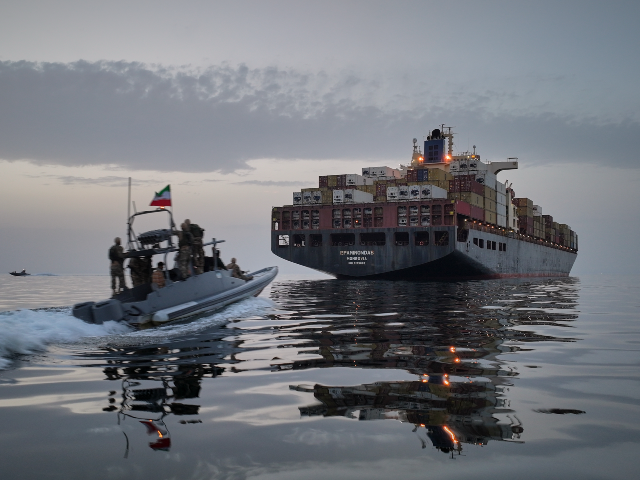

German shipping giant Hapag-Lloyd said on Sunday that chaos is the “new normal” in the Strait of Hormuz, with the constant threat of Iranian attacks looming even though the regime in Tehran supposedly agreed to reopen the strait in the Memorandum of Understanding (MOU) it signed with the United States.
“The situation has been fluid for us since the beginning of the conflict,” Hapag-Lloyd spokeswoman Hanja Maria Richter told Fox News Digital on Sunday.
“We have been making and still make regular risk and situation assessments with our security partners, all relevant authorities and our people on shore and, of course, on the vessels. It is a region in conflict, so we consider this with every single ship we move in the region and assess the risks for every vessel and its crew individually,” she said.
Lloyd’s List offered an even gloomier assessment of the “confused, two-tier system now operating in the strait, which remains split between the Iran-controlled northern route and a U.S.-protected southern ‘highway.’”
WATCH — Prepare to Be Boarded! Vessel Possibly Tied to Iran Intercepted:
Lloyd’s List added that pre-war routes through the Strait of Hormuz have been “rendered unusable” by Iran’s deployment of mines.
Bloomberg News reported that commercial traffic through the strait fell by about 80 percent after Iran attacked two commercial vessels, and the U.S. responded with strikes against Iranian military targets.
Traffic through the “re-opened” strait peaked at 58 ships on June 24, still a far cry from the 120 or more ships that used the strait each day before Operation Epic Fury began at the end of February. Traffic was down to 24 ships on Saturday, and just 12 on Sunday, following Iran’s latest terrorist attacks on ships.
“Shipping is literally caught in the crossfire as the U.S. and Iran battle for control of Hormuz strait. This does little to restore confidence that security and safety can be guaranteed to get stranded ships out,” Windward maritime intelligence analyst Michelle Wiese Bockmann told the leftist publication New York Times on Saturday.
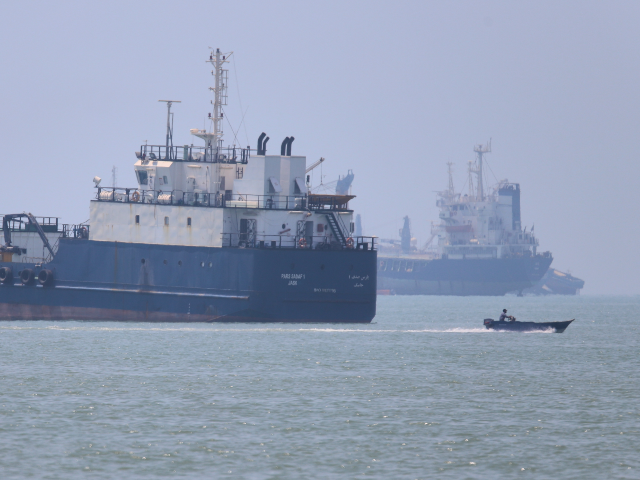
A small motorboat passes anchored vessels in the Strait of Hormuz off Bandar Abbas, Iran, Wednesday, June 17, 2026. (Amirhosein Khorgooi/ISNA via AP)
Windward said on Monday that Iran’s terror tactics appeared to be working, as the U.N. International Maritime Organization’s (IMO) plan for evacuating ships from the Persian Gulf “remains suspended with no restart date.”
“The separate U.S.-assisted southern corridor keeps running, but most traffic has shifted north under Iranian coordination. Daily transits sit near 13, roughly 90% below pre-war levels,” the intelligence firm added.
Windward said Iran is loading its own oil tankers at its Kharg Island terminal and appears to be having little difficulty moving those tankers past the former U.S. blockade line. The U.S. agreed to lift its blockade of Iranian ports, and lift sanctions against Tehran’s oil trade, in the MOU.
“At Kharg, the T-Jetty and Western Terminal loaded simultaneously for the first time in days; the East Waiting Area holds 28 tankers, 27 dark, signaling the Iranian crude export cycle restarting,” Windward said on Sunday.
WATCH — Trump to Hormuz Strait Dependent Nations: Buy U.S. Oil or Find Some Courage and Open It Yourselves:
Iranian Foreign Minister Abbas Araghchi made a confusing statement on Sunday that began with promises to uphold Tehran’s obligations to reopen the strait under the MOU, but then seemingly asserted that “reopening the strait” means putting it under Iran’s iron-fisted control.
“Based on the memorandum of understanding, the Strait of Hormuz, under the management that Iran will adopt, will return to its pre-war capacity within 30 days, after the obstacles are removed by the Islamic Republic of Iran,” Araghchi said at a press conference with Iraqi Foreign Minister Fuad Hussein in Baghdad.
It would seem easy enough for Iran to “remove” some of those obstacles by not sending kamikaze drones to attack civilian vessels, but Araghchi claimed those attacks were somehow justified because the U.S. was interfering with Iran’s plans to “reopen” the Strait of Hormuz on its own terms.
“I ask all parties not to interfere in the issue of managing the Strait of Hormuz and the arrangements adopted by the Islamic Republic of Iran for reopening the Strait of Hormuz, to adhere to the signed memorandum of understanding, and not to allow this memorandum of understanding to deviate from its course,” he said.
“Any intervention or attempt to create arrangements contrary to the existing understandings will only complicate the situation, delay the return of normalcy to the Strait of Hormuz, and increase tension,” he said.
COMMENTS
Please let us know if you're having issues with commenting.