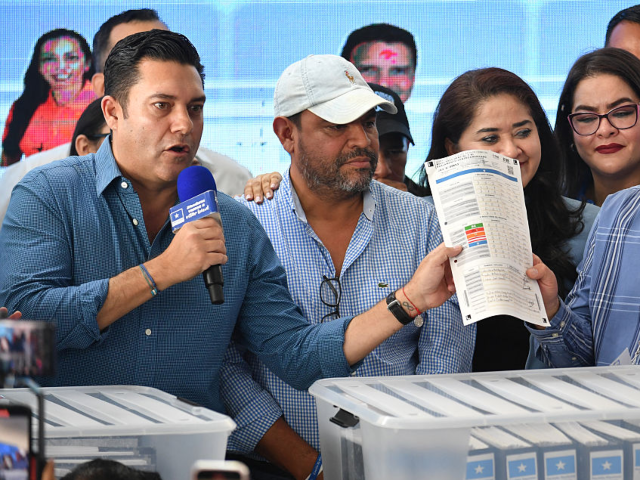
Honduras reached its second week on Monday without final results from the National Electoral Council (CNE) officially determining who won on November 30.
The extremely slow vote count resumed on Sunday after a new 135 hour-long pause amid accusations of fraud and alleged “interference” from President Donald Trump, levied by the ruling socialist government of President Xiomara Castro. Conservative candidate Nasry Asfura, who received President Trump’s endorsement, remains in the lead at press time.
Honduras’ 2025 presidential election has been widely marked by an extremely long vote counting process that, two weeks after the election, still has not finished.
Out of several competing candidates, the November 30 election mainly saw a three-way race between politician Nasry Asfura of the conservative National Party of Honduras (PNH), former vice president Salvador Nasralla of the Liberal Party, and former Defense Minister Rixi Moncada of the currently ruling far-left Liberty and Refoundation (Libre) party.
Although there are no definitive results at press time, all preliminary results published by CNE over the past two weeks indicate that the election is an extremely narrow competition between Asfura and Nasralla, with Moncada in a long-distant third place and with no possibility of overtaking either opposing candidate. Over the past two weeks, the extremely narrow vote difference between Asfura and Nasralla has progressively widened, with the difference being as narrow as some 500 votes at one point and Nasralla briefly overtaking Asfura before new updated vote counts placed the conservative candidate back in the lead.
CNE’s most-recent update, dated December 9, indicates that Asfura has a 43,184 vote lead over Nasralla. Asfura, a longtime conservative politician and former Mayor of Tegucigalpa, received President Donald Trump’s endorsement days before the November election — an act that appeared to offend both Nasralla and Moncada.
At press time, the December 9 vote update stands as the most recent count published by CNE, who once again suspended the vote count process after the update, resuming it once more after 135 hours on Sunday, December 14.
The newspaper El Heraldo pointed out that the December 9 update does not reflect the results of a special vote count of 2,700 vote tallies flagged with “inconsistencies.” The special count was reportedly scheduled for Sunday but, at press time, has not taken place and was delayed due to various “administrative obstacles.”
One of the main obstacles, local outlets pointed out, involves CNE councilwoman Marlon Ochoa, who represents Libre at the electoral authority. Ochoa has reportedly refused to sign the authorization to start the special vote count following orders of the ruling socialist party.
On Saturday, Asfura called for a public, televised review of the vote tallies that includes the participation of civic society, international organizations, and observers.
“May the delegates of the three political parties do their work in accordance with the law. So that there is no doubt about the results and the next government can work in peace and tranquility for Honduras,” Asura wrote on social media.
Current socialist President Xiomara Castro, and the ruling Libre party, have repeatedly claimed over the past weeks that “fraud” was committed against their candidate Rixi Moncada, and have expressed that they do not recognize the preliminary results suggesting an overwhelming defeat for the ruling socialists — disavowing any government official that facilitates a presidential transition regardless of an official Asfura or Nasralla victory.
Europa Press reported on Saturday that the Honduran government issued formal complaints to the United Nations, the Organization of American States (OAS), and the CELAC regional block denouncing alleged “interference” committed by President Trump in the Honduran presidential election. According to Castro, Trump allegedly “violated the most sacred principle of our Constitution: sovereignty resides in the people, exclusively in the Honduran people,” and accusation she presumptively levied in response to Trump’s endorsement of Asfura in the race.
Despite the slow vote count process and President Castro’s assertions of electoral “fraud” and Trump’s alleged “interference,” an electoral mission from the Organization of American States (OAS) presented its report on the election on Monday and said that it did not find evidence that fraud was committed in the presidential elections on November 30 — but pointed out that the delays are “not justifiable,” especially in the current context in Honduras.
“The observers and the [electoral mission’s] team of engineers have noted delays in the management of electoral material during its withdrawal and a marked lack of expertise in the design, development, and implementation of technological solutions for processing election results, but they have not observed any evidence of fraud or manipulation of electoral material or computer systems,” OAS mission chief Eladio Loizaga said.
Loizaga stressed that although technological solutions are “extremely useful” for streamlining counting and tallying results, they do not constitute the core of the electoral system, as physical records are what contain the results.
“In this regard, the Mission considers that the poor functioning of these tools does not in itself imply fraudulent action, although it does reflect technical and political incompetence on the part of the electoral authority,” Loizaga said.
OAS’s electoral mission called upon parties and authorities to wait for the official results and actively monitor the ongoing vote counting” to ensure that the “final stages of the process are conducted in accordance with the law and reflect the will of the people.”
Christian K. Caruzo is a Venezuelan writer and documents life under socialism. You can follow him on Twitter here
COMMENTS
Please let us know if you're having issues with commenting.