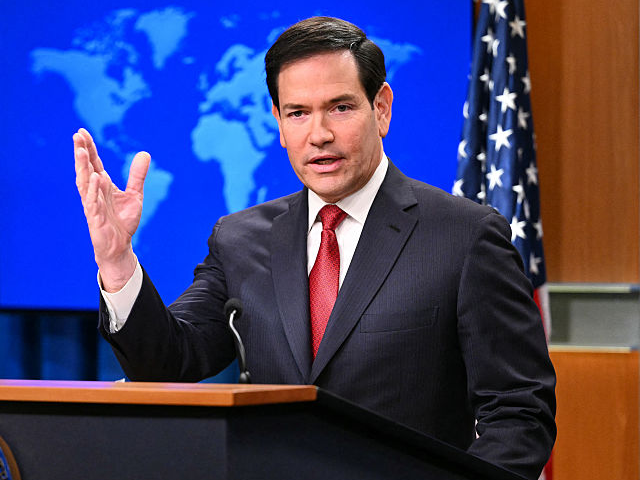
Secretary of State Marco Rubio said at a press conference in Washington, DC, on Wednesday that Venezuela’s economy must be stabilized, and a process of political reconciliation completed, before a successor to deposed narco-terrorist dictator Nicolás Maduro can be chosen through free and fair elections.
Speaking alongside Secretary of War Pete Hegseth, Rubio laid out a three-step process of “stabilization, recovery, and transition” for Venezuela.
“Step one is the stabilization of the country. We don’t want it descending into chaos. Part of that stabilization, and the reason why we understand and believe that we have the strongest leverage possible, is our quarantine,” he said.
Rubio pointed to Wednesday’s dramatic seizure of two “shadow fleet” sanctions-evading oil tankers – one of them attempting to elude arrest by flying a Russian flag – as evidence that America’s “quarantine” of sanctioned oil provided enough leverage to begin the restoration of Venezuela. He said the U.S. would be very careful to ensure the proceeds from oil sales did not fall into the hands of Maduro’s cronies.
“We are going to take between 30 and 50 million barrels of oil. We’re going to sell it in the marketplace – at market rates, not at the discounts Venezuela was getting. That money will then be handled in such a way that we will control how it is disbursed in a way that benefits the Venezuelan people – not corruption, not the regime,” he said.
Having stabilized the Venezuelan economy by returning its oil wealth to the people, Rubio said the next phase would be “recovery” — building a stable, secure political environment that was safe for the investments needed to repair the damage from Maduro’s socialism.
Rubio said the recovery phase would include “ensuring that American, Western, and other companies have access to the Venezuelan market, in a way that’s fair,” and beginning a process of political reconciliation, “so that the opposition forces can be amnestied and released from prisons, or brought back to the country, and begin to rebuild civil society.”
“And then the third phase, of course, will be one of transition,” he said.
Rubio said the three-phase process has been meticulously planned, and indeed is already underway, as evidenced by Venezuela’s agreement to sell up to 50 million barrels of oil to the United States at market prices, with the proceeds to be carefully protected against corruption.
“We feel very positive that not only will that generate revenue that will be used to the benefit of the Venezuelan people – and we’ll ensure that that’s what the case is – but it also gives us an amount of leverage and influence and control over how this process moves forward,” he said.
Responding to a question about European warnings that aggressive efforts by the Trump administration to annex Greenland could destroy the NATO alliance, Rubio said it was simply a truism that every American president “retains the option” to address threats to American security by military means, but President Donald Trump prefers negotiations.
“That included in Venezuela,” he said. “We tried repeatedly to reach an outcome here that did not involve having to go in and grab an indicted drug trafficker. Those were unsuccessful, unfortunately.”
Rubio argued that leaving elements of the Maduro regime in place to manage Venezuela’s short-term affairs – subject to “tremendous control and leverage” from the United States – was the only way to complete the first two phases of Venezuela’s transformation. He said it was difficult to predict exactly how long it would take to reach the final phase of demographic transition.
“I understand that in this cycle in society we now live in, everyone wants instant outcomes; they want it to happen overnight. It’s not going to work that way,” he said.
When reporters pestered Rubio with questions about the exact cost of the Venezuela operation, and whether it would involve American “boots on the ground,” Hegseth cut in to point out that the media’s sudden interest in the nickels and dimes of military deployment was disingenuous.
“You’re trying to find any angle possible to undermine the success of one of the most historic military missions the world has ever seen,” Hegseth said.
“The level of sophistication that the Senate just was briefed on and the House was briefed on, a classified level, is something only the United States of America can accomplish. The world is taking notice of that,” he said.
Rubio pointed out that Venezuela’s interim government has asked for the oil from one of the tankers seized on Wednesday to be part of the first big oil deal with the United States.
“They understand that the only way they can move oil and generate revenue and not have economic collapse is if they cooperate and work with the United States,” he said.
COMMENTS
Please let us know if you're having issues with commenting.