Newly declassified FBI emails show that officials expressed concern about a lack of probable cause for the 2022 search of President Donald Trump’s Mar-a-Lago estate, but the operation proceeded after the Justice Department asserted that the legal standard had been met, revealing internal disagreement over whether a search warrant was justified at the time.
Fox News Digital has obtained and reviewed internal FBI and DOJ emails showing internal concerns and disagreements within the Bureau in the lead-up to the August 2022 raid of Donald Trump’s Mar-a-Lago residence. Despite agents raising doubts about corroborated evidence and the strength of probable cause, the Department of Justice moved forward with the search.
In an email, one assistant special agent in charge wrote that “very little has been developed related to who might be culpable for mishandling the documents.” The agent noted concerns that the draft search warrant affidavit was based on “single source” information that had “not been corroborated” and “may be dated.” While recommending that a conversation with Trump’s attorney “ought not to be discounted,” the agent also noted that the DOJ’s Criminal Enforcement Section believed the affidavit met the probable cause standard.
This internal uncertainty was echoed by other agents who questioned the evidentiary strength supporting the search. One FBI official candidly asked, “Absent a witness coming forward with recent information about classified on site, at what point is it fair to table this?” They further added that the process was becoming “time consuming” and not yielding “new facts supporting PC.”
Despite the concerns, DOJ leadership continued to press for the search. In an Aug. 4, 2022, email, one agent referenced Deputy Assistant Attorney General George Toscas as saying he “frankly doesn’t give a damn about the optics.” The agent warned that without effective coordination and consideration of law enforcement safety, the raid risked escalating tensions unnecessarily. Still, the execution went forward days later, with FBI agents arriving at Mar-a-Lago on Aug. 8.
Breitbart News had reported that the search warrant, signed by Judge Bruce Reinhart on Aug. 5, allowed up to two weeks for execution. The decision to delay until Aug. 8, despite alleged national security concerns, raised additional questions about the urgency of the DOJ’s actions. The warrant did not permit access to areas used by third parties, and agents had discretion to search areas tied to Trump and his staff, including private offices and storage rooms.
The operation order included standard DOJ language authorizing the use of deadly force if necessary, a fact that became publicly known through 2024 court filings. According to those documents, FBI agents were instructed to conceal weapons and equipment, wear unmarked clothing, and arrive prepared with bolt cutters, handcuffs, and a medic in case of conflict. This use-of-force policy language was also applied in the DOJ’s search of President Joe Biden’s residence in 2023 for classified materials.
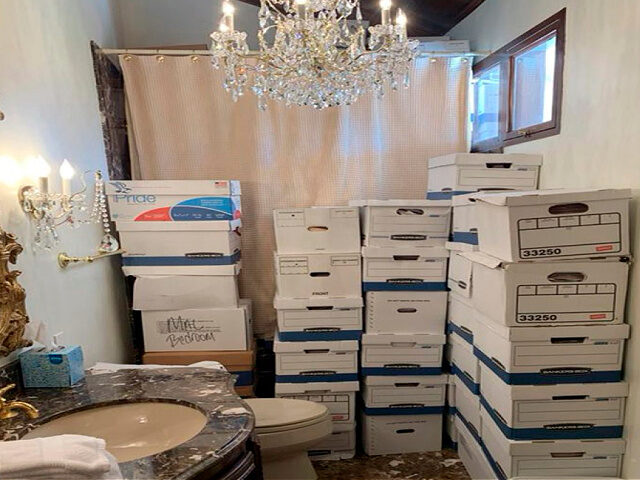
The documents also reflect the FBI’s intent to execute the warrant in a “low key” and “professional” manner. However, Trump attorneys were not allowed inside the premises during the search, and Republican-aligned figures cited in Breitbart News coverage raised concerns about the raid’s scope, execution, and the staging of evidence, including a now widely circulated photo of classified-marked folders on the floor, which Trump’s legal team and allies suggested had been intentionally arranged for visual effect.
The FBI is said to have combed through first lady Melania Trump’s wardrobe and conducted what Trump described as a “deep and ugly search” of his son Barron’s room. Over 30 agents spent approximately nine hours inside the 128-room estate, removing numerous boxes. Among the seized items were allegedly empty folders marked “classified,” mixed with personal materials and letters from foreign leaders. FBI receipts showed Trump’s passports were also taken, despite no warrant language authorizing their seizure.
Some DOJ and FBI officials, according to Newsweek reporting, blamed each other for the decision-making surrounding the raid. DOJ sources suggested FBI Director Christopher Wray had the final say. The raid was characterized by one DOJ official as a “spectacular backfire,” noting that efforts to minimize media attention failed and instead created the opposite effect.
Trump’s legal team and supporters have consistently maintained that the president had declassified the documents in question. The raid, they argue, was unnecessary and politically motivated. Trump referred to the event as an “assault on a political opponent at a level never seen before in our Country.” He later described it as a “break-in” and stated the FBI had been cooperating with his team prior to the search.
After Special Counsel Jack Smith brought 37 felony charges related to classified materials, Trump pleaded not guilty. Additional counts were added in a superseding indictment, but all charges were dropped after Trump won the 2024 presidential election.
The role of the Biden White House in the lead-up to the raid also remains a matter of ongoing scrutiny. Documents obtained by America First Legal suggest the White House initiated a “special access request” that facilitated the DOJ’s retrieval of documents, contradicting public statements from both the Archives and White House officials at the time.
COMMENTS
Please let us know if you're having issues with commenting.