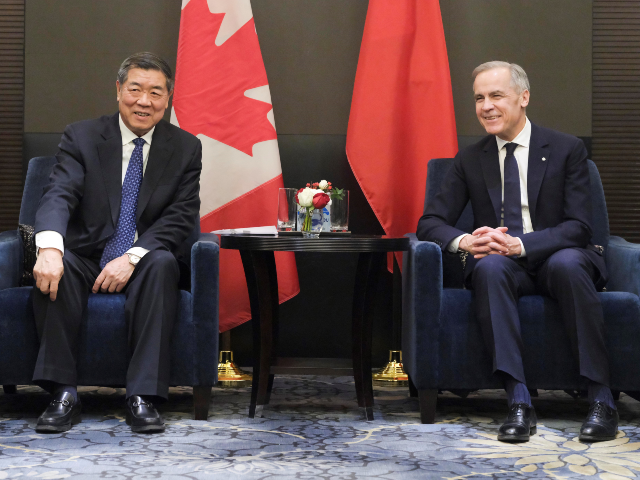

Far-left Canadian Prime Minister Mark Carney said on Monday that his country could turn to Chinese automakers for both vehicles and jobs if trade talks currently underway with the United States do not reach a satisfactory outcome.
“We have the best auto workers in the world, and we want them fully deployed, full opportunity, in an integrated North American market. That market has become less integrated because of U.S. trade actions,” Carney said at a press conference in Cambodia.
Carney was in Cambodia for the Francophonie Summit, an annual meeting of about 90 member states who have cultural, linguistic, or historic ties to France. Cambodia, which has never hosted the summit before, was a French protectorate from 1863 to 1953.
Carney visited the Philippines on Saturday to conclude discussions on a free trade agreement, and he is due to meet with Chinese dictator Xi Jinping on the sidelines of the Asia-Pacific Economic Cooperation (APEC) summit in Shenzhen, China on Tuesday and Wednesday this week.
The Canadian prime minister denied he was using the threat of turning to China as leverage against the United States in trade negotiations.
“It’s not leverage. But action, reaction,” he said. “If [Canadian auto workers] are not fully utilized in a North American context, that provides other opportunities. Canada is going to move forward either way.”
Carney said that if Canada does turn away from the United States to embrace Communist China, it will expect the Chinese to make substantial manufacturing investments on Canadian soil, using Canadian supply chains for parts and critical minerals.
“It’s not just about kit cars. There has to be a manufacturing aspect involved,” he insisted.
Canada imposed a 100 percent tariff on Chinese electric vehicles (EVs) in 2024, along with a 25 percent tariff on Chinese steel and aluminum, following similar actions taken by the U.S. to protect its EV market against a flood of cheap Chinese imports. China retaliated with steep tariffs on Canadian canola oil, pork, seafood, and other agricultural products.
In January 2026, Canada broke with the U.S. policy approach by agreeing to dramatically reduce its tariffs on Chinese EVs in exchange for China lowering its retaliatory tariffs on Canadian food exports. Carney said the deal showed China has become a “more predictable” trade partner than the United States.
Carney’s loosened trade terms with China did not go over well in Ontario, the heart of the Canadian automobile industry. Ontario Prime Minister Doug Ford, furious that Carney did not consult him before opening the floodgates to Chinese imports, urged Canadians to “boycott the Chinese EV vehicles” and to “support companies that are building vehicles here.”
China’s actual penetration of the Canadian market turned out to be underwhelming, at least so far. The January 2026 agreement allowed Canada to import up to 49,000 Chinese EVs, but the actual number of imports was only about 16,200 by the end of September. A good deal of the quota was taken up by Teslas, produced at the American company’s “Gigafactory” in China.
Also, contrary to Carney’s confident predictions in January, China has yet to make any substantial investments in Canadian auto manufacturing. Four Chinese automakers met with Canadian Industry Minister Melanie Joly in June to discuss building their EVs in Canada, but nothing has come from those discussions yet, possibly because the Chinese companies are not eager to utilize Canada’s more expensive labor and supply chains.
China does seem interested in precisely the sort of “kit” manufacturing Carney promised to avoid. Last week, Doug Ford sent Carney a letter urging him not to allow “the introduction of Chinese-made knock-down kits” at the Stellantis Brampton auto assembly plant, which was recently purchased by Canadian armored vehicle manufacturer Roshel.
Roshel, in turn, said it plans to lease back 25 percent of the factory to original owner Stellantis — which would use the facility to assemble Chinese EVs from prefabricated kits that were manufactured in China. The proposal would wipe out hundreds, or even thousands, of jobs at the Brampton facility.
“We must remain aligned in our efforts to protect and expand Ontario and Canada’s automotive footprint. Fortifying Ontario and Canada’s industrial base, including a strong and growing automotive sector, is foundational to creating and realizing generational economic opportunities,” Ford wrote to Carney.
The Carney administration responded that it was “not considering any proposal to replace full vehicle manufacturing and assembly with Chinese-made kit cars,” and would continue to insist that Chinese investment in Canadian auto manufacturing “must use Canadian parts, Canadian labor, and a Canadian supply chain.”
As he was preparing to depart for Europe and Asia on Saturday, Carney said he had a “long, substantive conversation” with President Trump, and “we are making progress.”
“There is the possibility of a deal, a bilateral deal, but we’re not there yet,” he said.
COMMENTS
Please let us know if you're having issues with commenting.