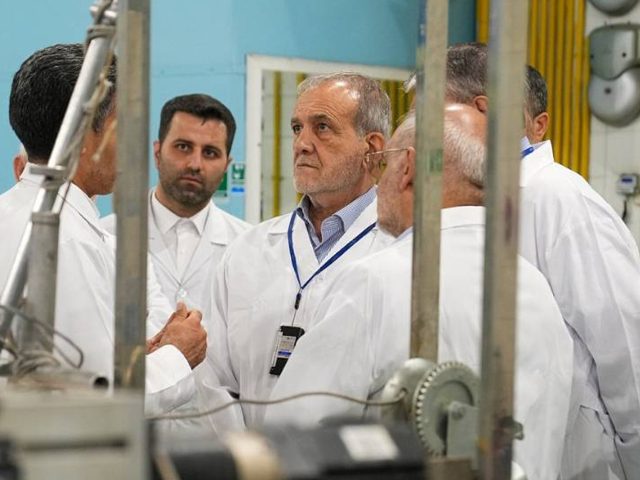

The Atomic Energy Organization of Iran (AEOI) announced on Sunday that it is preparing to bring a homemade nuclear energy system online, offering no timeline for such a historic development but insisting that Iran is competing at the highest levels in the nuclear sphere.
Nuclear fusion is a process by which light atoms merge into one, releasing tremendous amounts of energy. It is a separate process from nuclear fission, in which heavy radioactive atoms, such as those of enriched uranium or plutonium, break down and release energy. Fusion is the process by which the sun generates energy and requires plasma, the rare fourth state of matter. As such, it has yet to be used for the commercial generation of energy and remains an experimental possibility.
Fusion research, in theory, would not have any relationship to the AEOI’s fission activities, particularly its prolific uranium enrichment that has alarmed much of the free world. The message that Iran is allegedly on the cusp of a nuclear fusion breakthrough is clearly meant to defy calls from the United States that any agreement to end the current military conflict would require Iran to stop its uranium enrichment and guarantee that it will not pursue the development of a nuclear weapon. Prior to the destruction of its three best-known enrichment facilities by American airstrikes in 2025, Iran was believed to have enriched much more uranium that what is necessary for any known civilian use, prompting the American action.
Mohammad Eslami, the head of the AEOI, said on television on Sunday that his scientists had made “significant progress” on fusion, such that they would soon bring a fusion system online in an experimental capacity. He emphasized that the project was being pioneered exclusively by Iranian scientists with Iranian technology. The Russian news agency Tass shared that Eslami described the system as a tokamak, a machine developed in the Soviet Union in the 1950s that creates a complex system of magnetic fields that traps plasma and allows for continuous fusion to produce energy.
“We hope that Iran’s first tokamak, which is being built on the basis of Iranian expertise, will be commissioned as scheduled and we will show the world that Iranians deserve better,” Eslami was quoted as saying.
Nuclear fusion, which typically requires heavy hydrogen atoms, necessitates the presence of plasma to keep chain reactions going. While plentiful on the sun and in many regions of space, plasma is highly uncommon on earth, appearing momentarily in phenomena such as lightning and the aurora borealis and australis. The ability of the tokamak “donut” to keep plasma contained and hot enough to maintain its state of matter has long made it a promising option for a nuclear fusion breakthrough, though scientists have yet to achieve it at press time.
Many nuclear scientists believe that a fusion breakthrough would dramatically change the world’s energy landscape. Unlike fission, fusion would not require dangerous radioactive substances such as uranium or create the same amount of nuclear waste. Fusion would also, in theory, not produce any carbon or greenhouse gases.
Iranian political and scientific leaders have insisted that nuclear development is essential to the nation’s progress and refused any curbs on their activities following the collapse of the 2015 Joint Comprehensive Plan of Action (JCPOA), known commonly as the Obama nuclear deal. Speaking this month, Foreign Ministry spokesman Esmaeil Baqaei asserted that any nuclear discussions prior to the signing of an agreement to end the war with America were strictly “off the table.” While Iran’s uranium enrichment reached a scale prior to American airstrikes incompatible with civilian use, Iranian officials have insisted that they are not pursuing a weapon but, rather, humanitarian uses for nuclear technology.
The United Nations’ International Atomic Energy Agency (IAEA) has repeatedly expressed concern about Iran’s nuclear activities, most recently complaining in a leaked report last week that Tehran still has not allowed its inspectors into the bombed uranium enrichment facility in Isfahan, believed to be the largest. In Jun 2025, immediately before the airstrikes, the IAEA found Iran in breach of its international legal obligations regarding nuclear development for failing to allow appropriate inspections, prompting further sanctions. Iranian leaders have demanded an unconditional lifting of all sanctions on its government and economy, calling the sanctions a violation of the nation’s sovereignty.
COMMENTS
Please let us know if you're having issues with commenting.