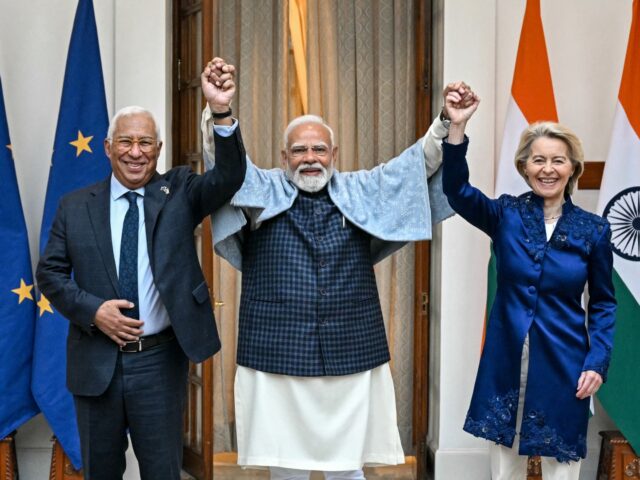
The European Union has agreed to open its borders to mass immigration from India as it signed the bloc’s largest free trade agreement.
EU Commission President Ursula von der Leyen said in a press conference in New Delhi alongside Prime Minister Narendra Modi on Tuesday that the bloc has agreed to a “mobility” scheme to allow for the influx of “students, researchers, seasonal and highly skilled workers” from India into Europe.
The EU chief also said that Brussels will open a “Legal Gateway Office” in India to help facilitate migrants’ move to Europe.
“This is good for our economies. This is good for the friendship between our people. This openness benefits us all,” von der Leyen said.
Despite the scale of the changes agreed, reports in the legacy media generally ignored or buried the migration aspect of the agreements, reporting heavily on the concomitant trade agreement signed alongside.
India already ranks among the top countries of origin for legal migration into the EU, with Indian nationals receiving the second-most first-time residence permits among any nationality in 2024, at 192,400, only behind Ukraine at 295,600.
According to Indian Prime Minister Narendra Modi, there are currently over 800,000 Indians living in the European Union.
Commission President von der Leyen and Prime Minister Modi were joined at the unveiling by President of the European Council António Costa, who touted his own Indian citizenship through his father and therefore said that the agreement had a “very special meaning” to him.
“I am very proud of my roots in Goa, where my father’s family came from. The connection between Europe and India is something personal to me,” the Portugal-born politician said.
The decision to import more Indian labour comes despite the EU having a youth unemployment rate of 14.8 per cent, with 2.866 million people under the age of 25 being out of work as of September. The bloc also has a relatively high overall unemployment rate of 6 per cent, compared to 4.4 per cent in the United States and 5.1 per cent in Britain.
Indian immigration has become increasingly controversial in the United States, with critics of the H1-B visa programme claiming that it has enabled Indian workers to undercut the wages of their American-born counterparts. Accusations of nepotistic business practices that exclude non-Indian workers have also been levied at Indian dominated businesses.
The signing of the mobility agreement came alongside Brussels and New Delhi signing a Free Trade Agreement this week, which will see European tariffs reduced on 99.5 per cent of Indian goods and on nearly 97 per cent of EU exports to the subcontinent.
The agreement is expected to save European businesses around 4 billion euros in tariff costs per year and to double the volume of EU goods exported to India by 2032.
However, given the massive disparity between the average wages and working conditions in India compared to Europe, it is likely that more industries will offshore to the subcontinent to take advantage of the cheap labour while retaining essentially tariff-free access to the European Single Market.
The signing of the agreement came just days after Brussels also inked a long-awaited deal with the South American Mercosur countries, which farmers in countries like France have warned will result in them being driven out of business by the importation of foodstuffs produced with much less regulation and with cheap foreign labour.
COMMENTS
Please let us know if you're having issues with commenting.