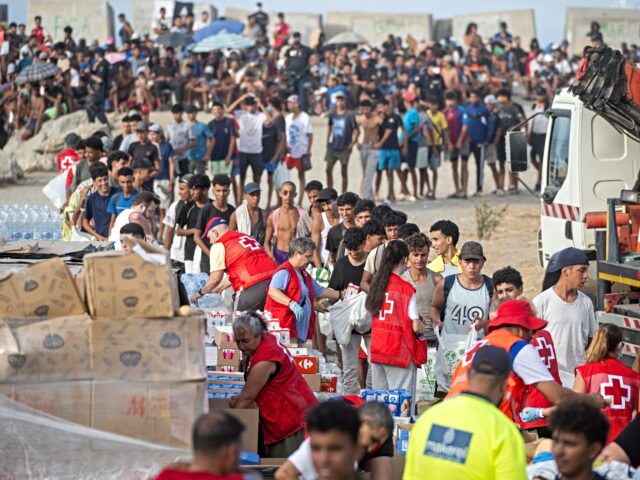

Healthcare authorities in Ceuta have confirmed five known Human Immunodeficiency Virus (HIV) cases among the thousands of illegal migrants that invaded the city in July, a report published on Friday states.
As is the case with most of the exclave’s infrastructure and services, the mass migrant invasion caused a significant pressure to Ceuta’s healthcare facilities that remains largely unresolved three months later.
Since the invasion began in late July, the city’s Technical Committee for Public Health Coordination maintains an ongoing epidemiological monitoring in response to assess the possible health consequences derived from he crisis.
El Pueblo de Ceuta, citing information from the Committee’s latest report, states that authorities have so far confirmed five known HIV cases among the invading migrants as of October 27, as well as two known cases of Hepatitis C and one known case of Hepatitis B.
The document was reportedly submitted by Julián Domínguez, the head of Preventive Medicine at the Ceuta University Hospital, the city’s largest healthcare facility.
According to the report, which sources its data from the city’s public health surveillance system, none of the five known HIV cases were confirmed during the week of October 21-27. El Pueblo de Ceuta, however, emphasized that the report clearly distinguishes between cases detected among illegal migrants and legal residents.
RELATED: Lefty Jayapal Praises Socialist Spain for Allowing Illegal Immigrant Invasion of Ceuta
Since the late July invasion, no new HIV cases among local residents have been documented by the Technical Committee, in contrast to the now-confirmed five cases among the invading migrants.
During the first days of the invasion, the Spanish central socialist government’s Health Minister Mónica Garía claimed that affirming that the invading migrants brought diseases with them would be a “xenophobic” act. She did, however, acknowledge at the time that there were confirmed cases of Tuberculosis among the migrants.
According to the information contained in the latest report from the Technical Committee, there are 13 documented cases of Tuberculosis among the illegal migrants that invaded the city in late July — two of which were confirmed this week. An additional six known cases have been documented outside the non-migrant population, one of which was also confirmed over the past days.
“The list of reportable diseases also includes 13 cases of chickenpox and one case of monkeypox (mpox), all associated with the same phenomenon,” El Pueblo de Ceuta wrote. “In the latter case, the report does not record any new positive cases during the week under review.”
The ongoing and unresolved migrant invasion of Ceuta continues to incur in a dramatic strain of the nation’s healthcare resources, oversaturated, facilities, and overworked personnel — leading to what Rosa María Fuentes, the head of the Ceuta College of Nursing, reportedly described last week as a situation of “structural exhaustion.”
Indeed, El Pueblo de Ceuta detailed that, as of October 27, the Ceuta University Hospital has received 25,971 visits to its emergency ever since the invasion began in late July, of which 5,667 presented at least one identified syndrome. During the most recent week analyzed in the report, 1,784 visits were recorded at the hospital’s emergency rooms, of which 365 had at least one identified syndrome.
Other healthcare facilities in Ceuta outside of hospital emergency rooms and private care clinics have reportedly handled over 13,300 visits since the mass migrant invasion began in late July — further straining the exclave’s already strained healthcare resources.
COMMENTS
Please let us know if you're having issues with commenting.