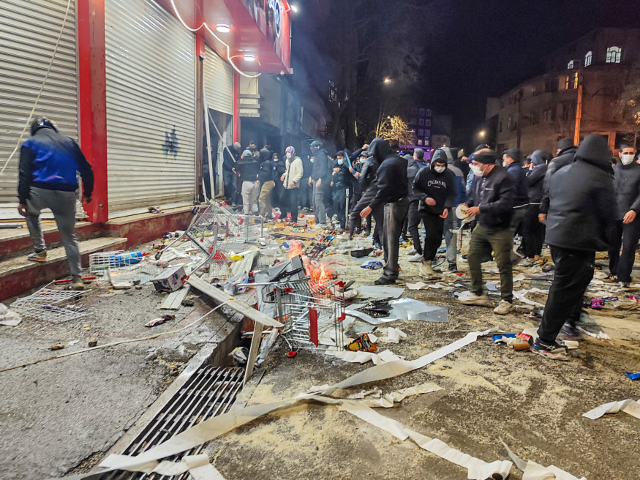
Worldwide network monitors said Iran was plunged into a nationwide Internet blackout on Thursday, an ominous sign that the panicked regime is preparing to use greater violence to suppress protests that have entered their second week.
According to the NetBlocks traffic monitoring group, Internet traffic in Iran fell to nearly zero on Thursday night, shortly before a round of mass demonstrations was scheduled to begin. NetBlocks saw the blackout as “an attempt to suppress sweeping protests while covering up reports of regime brutality.”
The nationwide blackout was presaged by dramatic losses of connectivity in the capital of Tehran and other cities, a detail confirmed by Ali Safavi of the National Council of Resistance of Iran (NCRI).
“Around 1 p.m. local time, the Internet traffic dropped,” Safavi told Fox News Digital. “The internet was cut off in Lordegan, Chaharmahal, and Bakhtiari provinces as battles erupted.”
The NCRI said at least seven people were killed in those cities on Wednesday by “direct fire from the criminal Revolutionary Guards and the suppressive forces loyal to the regime’s Supreme Leader Ali Khamenei.”
“This brings the number of confirmed martyrs killed on the path to freedom to 44,” the NCRI said.
“Millions of Iranians from north to south and east to west have been out in the streets until nighttime. Over the past 12 days, more young people have laid down their lives to free Iran,” Safavi said.
CBS News and the Associated Press (AP) quoted sources in Tehran who confirmed Internet access was shut down across the city on Thursday, even as crowds of “unprecedented” size massed on the streets. The source in question became unreachable shortly after delivering this report, leading CBS to conclude the communications blackout had been extended even further.
The AP added that international telephone networks also appear to have been cut off on Thursday, including both landlines and mobile phone services. “Such outages have in the past been followed by intense government crackdowns,” the AP observed.
The trigger for the intensified crackdown and communications blackout appears to have been a call for mass demonstrations by Crown Prince Reza Pahlavi, son of the late shah who was deposed and driven into exile by the 1979 Islamic revolution. Some of the protest chants include praise for the shah and calls for the monarchy to return, sentiments that are technically punishable by death under the Ayatollah’s regime.
“Millions of Iranians demanded their freedom tonight. In response, the regime in Iran has cut all lines of communication. It has shut down the Internet. It has cut landlines. It may even attempt to jam satellite signals,” Pahlavi said on Thursday.
“I want to thank the leader of the free world, President Trump, for reiterating his promise to hold the regime to account. It is time for others, including European leaders, to follow his lead, break their silence, and act more decisively in support of the people of Iran,” he said.
On Friday, Pahlavi made an “urgent and immediate call” to President Donald Trump for him to protect the demonstrators.
“Last night you saw the millions of brave Iranians in the streets facing down live bullets. Today, they are facing not just bullets but a total communications blackout. No Internet. No landlines,” he said.
“Ali Khamenei, fearing the end of his criminal regime at the hands of the people and with the help of your powerful promise to support the protesters, has threatened the people on the streets with a brutal crackdown. And he wants to use this blackout to murder these young heroes,” he said.
Pahlavi told Trump that his threat to take action if the protesters were harmed has “kept the regime’s thugs at bay,” but the blackout was a sign that the regime felt threatened enough to proceed with a crackdown.
On Friday, Iran’s Supreme National Security Council (SNSC) said it would show “no leniency towards saboteurs,” and its forces have been deployed to “neutralize the destabilization plans of the Zionist regime and its godfather, the United States.”
The SNSC condemned the demonstrators for burning regime flags and toppling statues of designated “martyr” Qassem Soleimani, the Iranian terror mastermind liquidated by an airstrike in Baghdad on President Trump’s orders in January 2020.
Ayatollah Ali Khamenei dismissed Trump’s warnings on Friday, claiming the president’s hands are “stained with the blood of Iranians,” and condemned the protesters for “ruining their own streets” to “please the President of the United States.”
Iranian state media on Friday began ominously referring to the demonstrators as “terrorists,” while judiciary chief Gholamhossein Mohseni-Ejei warned their punishment would be “decisive, maximum, and without any legal leniency.”
During an interview with radio host Hugh Hewitt on Thursday, President Trump repeated his warning to the Iranian regime.
“I have let them know that if they start killing people, which they tend to do during their riots… we’re going to hit them very hard,” said Trump.
Trump said some of the deaths in the protests so far might have been accidents, such as people getting crushed by stampedes, and he was “not sure I can reasonably hold somebody responsible for that.”
Trump repeated that he has told the Iranian regime “very strongly” that if they begin murdering protesters on a massive scale, “they’re going to have to pay hell.”
COMMENTS
Please let us know if you're having issues with commenting.