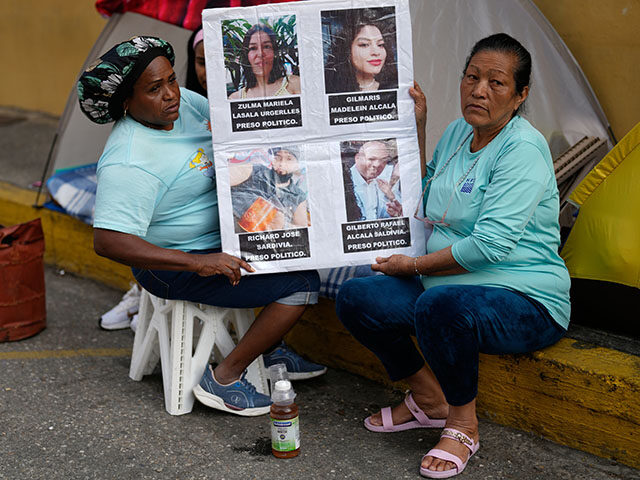

The Venezuelan non-government organization Foro Penal on Monday announced that, based on information confirmed by the group, Venezuela’s socialist regime still holds 777 political prisoners as of Monday night.
The information, Foro Penal detailed, confirms that, since January 8, the Venezuelan regime has only released 143 political prisoners out of the 863 confirmed by the end of 2025.
“7:00 p.m. (Caracas). So far, Foro Penal has verified the release of one hundred and forty-three (143) political prisoners in Venezuela since January 8, 2026, when the president of the National Assembly announced significant releases,” Foro Penal wrote on social media on Monday.
In a post on Instagram on Monday night, Foro Penal’s President Alfredo Romero confirmed that there are 777 political prisoners remaining in Venezuela through a video published on Monday night, where he detailed no new releases had taken place since Saturday.
“We continue to wait for the total release of political prisoners. I say total release because the number of releases does not imply freedom for these people, as they remain subject to restrictive measures,” Romero said, and added that some of the restrictive measures on the Venezuelan political prisoners released so far include a travel ban out of the country and “in many other cases, a ban on speaking to the media.”
Speaking to reporters at the Organization of American States (OAS) in Washington on Tuesday morning, anti-socialist Venezuelan opposition leader and Nobel Peace Prize Laureate María Corina Machado denounced that the Venezuelan regime has not released the majority of the political prisoners.
Machado called not just for the release of the political prisoners, but that they are all granted full freedom without any post-release restrictions imposed on them. She also called for the dismantlement of the Venezuelan regime’s repressive apparatus and the shutdown of all torture centers in the country.
“Let the truth be known, the regime has obviously manipulated the situation. It is not true that they have released most of the political prisoners. It is not right that this is being handled in such a cruel manner, announcing that they are going to release some prisoners and then not doing so,” Machado said.
“I have spoken with relatives of political prisoners who are living through this anguish and daily torture because they are standing in front of centers of repression waiting for their relatives to be released,” she continued. “So, if there is one thing this institution [the OAS] must do, it is precisely to address what has just been said. The complete dismantling of the repressive system, which in the end is the only thing left to the regime in power.”
President Donald Trump revealed in a Truth Social post this month that he canceled a second wave of attacks in Venezuela after the ruling socialists had agreed to release a “large number” of political prisoners.
Since then, the Venezuelan socialist regime has only released a fraction of the 863 known political prisoners, having freed some in small batches from January 8 onwards. The rogue socialists have also started claiming that the releases are not part of any agreement with President Trump — but rather, that these “ex-incarcerations” are part of a purported order issued by Nicolás Maduro hours before he was deposed and captured by U.S. forces in a January 3 law enforcement operation in Caracas. The Venezuelan regime does not refer to any of the released or still imprisoned individuals as “political prisoners.”
According to socialist strongman — and long suspected drug lord — Diosdado Cabello, Maduro allegedly issued the order to “review of cases of people who were detained for acts of violence, for attacking the Venezuelan people themselves” at some point during late December.
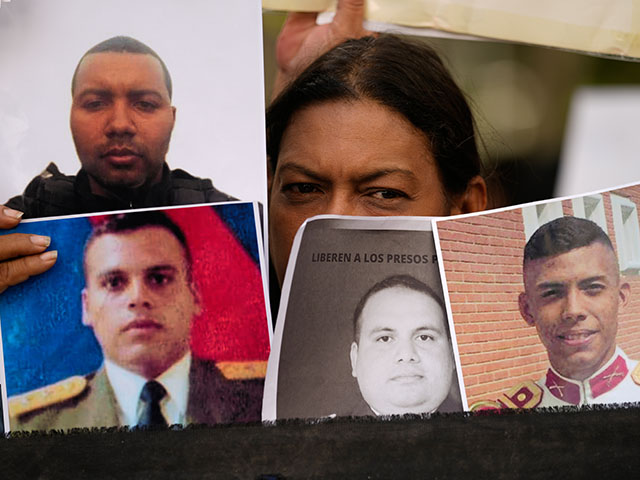
Relatives and human rights activists rally outside the Attorney General’s Office in Caracas, Venezuela, on Tuesday, January 20, 2026, calling for the release of people they consider to be detained for political reasons. (AP Photo/Ariana Cubillos)
“What sectors of the opposition have called political prisoners are not really political prisoners. They are irresponsible people who do not care at all about harming people, institutions, or destroying the infrastructure of the state for political purposes. That is something else. But they are not political prisoners. Political prisoners have other characteristics,” Cabello said last week during a broadcast of his socialist show Con el Mazo Dando (“Hitting with the Mallet”).
Similarly, Venezuelan “acting President” Delcy Rodríguez claimed, both through remarks at the Miraflores Presidential Palace and on social media, that the releases were part of a purported order from Maduro. At the time, Rodríguez claimed that the Venezuelan regime had released “406” individuals but did not refer to them as political prisoners.
Some of the released political prisoners so far include Venezuelan nationals, dual nationals, and foreigners such as Italian citizens Alberto Trentini and Mario Burlò, the latter of whom described his harrowing imprisonment as “worse than Alcatraz” and noting that he and Trentini spent “14 months sleeping on the floor, with cockroaches.”
On Monday, 41-year-old French yoga instructor Camilo Pierre Castro, who the Venezuelan regime unjustly detained in June 2025 and kept as a political prisoner until November, denounced that the Venezuelan regime subjected him to sexual torture and other inhumane and cruel treatment during the five months he remained unjustly detained under conditions of forced disappearance.
In addition to being sexually abused, Castro denounced that his head was covered and his hands cuffed, before being drugged with an unknown substance and subjected to psychological and physical torture during his detention at the Rodeo I prison in Venezuela. During the transfer to Rodeo I, he recounted being sexually assaulted while he was physically restrained and had his hair pulled, and his head forced against his knees while obscene comments were whispered to him while loud music was played.
Castro detailed that he spent a full week in a basement, handcuffed and hooded, eating only once a day, unable to bathe, change clothes, or wash himself. During that time, he was interrogated intermittently and subjected to “temporary manipulation,” with false times repeatedly given to him to disorient him.
Castro denounced that he was taken under false pretenses and led to believe that he would be “transferred to an airport” when in reality he was being sent to Rodeo I, where upon entering, his cellmates told him, “Don’t worry, we are all innocent here, just like you. There are no criminals here, this is political. We were all kidnapped.”
In addition to the unsanitary and crammed conditions of the cells in Rodeo I, other forms of torture an inhumane treatment denounced by Castro include the use of “white torture” to isolate prisoners from basic stimuli and gradually break them down and forcing hooded and handcuffed prisoners to remain under the sun for hours, causing them to faint.
Most harrowingly, Castro denounced in his testimony that on the basement of the prison there is a “gas chamber” in which officials throw tear gas at the prisoners, and the “peak room,” where prisoners are subjected to brutal beatings.
Christian K. Caruzo is a Venezuelan writer and documents life under socialism. You can follow him on Twitter here.
COMMENTS
Please let us know if you're having issues with commenting.