
U.S. President Donald Trump was right about the deep state controlling the federal government; the same problem exists in the United Kingdom, and “profoundly deep structural change to the system” is required to make democracy democratic, Reform UK has said.
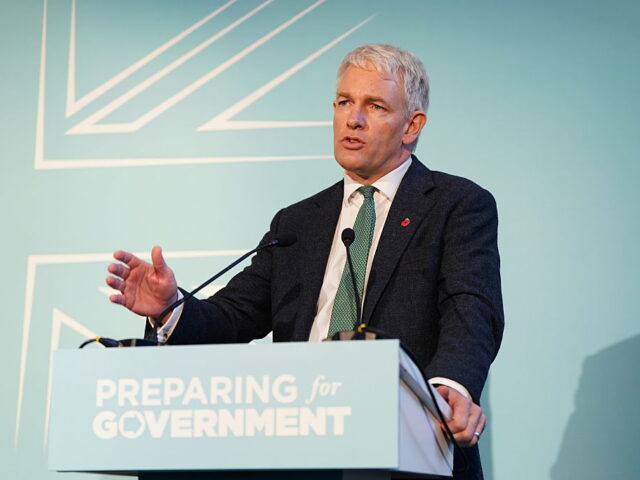
“Nothing works properly” in the United Kingdom because decades of government action taken against the will of the British people, not with it, and what might be termed a permanent deep state of the Civil Service means the elected government “aren’t properly in charge”, says Danny Kruger. The former Conservative who is now a Member of Parliament for Nigel Farage’s Reform UK and leading their department for preparing for government, announced his basic programme of first-priority reforms that would allow the rest of a theoretical future Farage-led government’s project to be delivered.
The fundamentals are that any given elected government of the day is not truly in charge of the levers of state, because the Civil Service and arms-length government bodies have accrued vast power over the past 30 years and aren’t, in practice, answerable to elected politicians representing the will of the people, Kruger said on Tuesday. In order to get a “government of national preference, preferring the ideas, the institutions, and the people of the United Kingdom over… the citizens of elsewhere”, Kruger said Reform ministers would have to “grip the civil service itself”.
He said:
It is simply not acceptable, and Reform UK will not accept, that ministers have to take advice from and trust the execution of their decisions to officials who answer to different bosses to them, and they cannot when they need to quickly remove… we will reform the Civil Service code to ensure that officials at the top of the Civil Service, and certainly those at the centre of government, are directly answerable to politicians, including for their jobs. And let me be very clear, the growth of the civil service will be reversed.
Democracy is seriously imperilled if it continues to be the case that the British people endorse a manifesto or platform, and when a party commands parliament, it finds the Civil Service works with enthusiasm behind the scenes to prevent it from being realised. Having happened in the aftermath of the Brexit vote, a failure to tackle this problem could lead to a serious and continuing collapse in trust in democratic principles and institutions.
Kruger asked: “What was Brexit for? What are our elections for, If not to establish and empower our sovereign parliament? Reform UK will restore parliamentary government” and stated that: “Nigel Farage will not allow established conventions or vested interests or bogus appeals to higher authorities than the will of parliament get in the way of the plan that has been accepted by the public in a general election.
“We want to restore the proper basis of our democracy whereby public servants answer to ministers who answer to parliament.”
Some of these changes will be historic, but Kruger insisted they would be done intelligently, sensitively, and while respecting the honourable institutions that have long defined Britain like the “the armed forces, the police, the church, the judiciary”. But these bodies have to serve and uphold the law apolitically, he said, not interpret it according to their own prejudices or attempt to fashion new ideas without the direction of Parliament.
Kruger said: “We don’t come with a chainsaw or a wrecking ball. We respect the institutions of the country… we’re not Leninists, we don’t want to wreck the British state, we want to make it work, make it functional”.
While Kruger said the Reform approach would be essentially British and would not take on the style of Milei in Argentina or Trump in America, he said the U.S. President was absolutely right in his diagnosis of the deep state disease and that he’s already well ahead of the UK on curing it. He said: “On Trump, in a nutshell… he came into government with exactly the same analysis that we have, which is that the federal government wasn’t under the control of the administration, and he has taken deliberate steps to bring it back under control.”
“Profoundly deep structural change to the system” is needed, he said.
Looking at how to reform the Civil Service, Kruger pointed to the Civil Service Code, which governs and defines the values and standards of the service, saying it allows the theoretical political neutrality of the organisation to be easily circumvented. These loopholes allow “the shibboleths of the lanyard class who really govern Britain” to dominate, including “internationalism, identitarianism – that are alien to the instincts and wishes of the British people”.
Kruger said of these intended changes: “The definition of impartiality is too narrow in the civil service code.
“It’s defined as simply being party political… but there is a whole range of other political affiliations or commitments that civil servants can have and introduce through their work, which might not have a party political label but which is nevertheless essentially political.
“The whole DEI woke agenda, which has infected so much of Whitehall, will be in contravention of the Civil Service code that we introduce. So socially controversial political positions will not be acceptable in the Civil Service”.
Kruger ended his address much in the way he did his last speech for Reform UK — when he announced his defection from the Conservative Party to run Farage’s department for preparing for government — with an appeal to experienced insiders tired of the country being mismanaged to privately get in touch to share their knowledge and ideas.
Reform UK is setting up “a series of advisory groups and sounding boards” to get these individuals into places where they can make a difference to fix the ship of state, he said. Underlining the importance of fixing the UK, should the British public give Nigel Farage a chance, Kruger said: “In 2016 with Brexit, and in 2019 with Boris Johnson, people voted for change, but they got chaos and stasis: crisis and drift. The current government came into office promising change – and everything has carried on as before, only worse.
“I’m not sure our democracy can stand another government promising change and delivering failure. I know Nigel Farage is determined to be different. But to help him be the Prime Minister the country so badly needs him to be, we need the country’s help. Step up.”
COMMENTS
Please let us know if you're having issues with commenting.