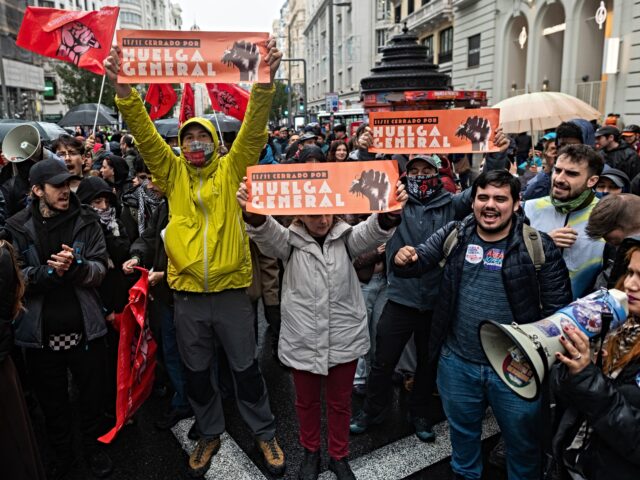

The “general strike” day in Spain ended Wednesday with chaotic riots and clashes between violent protesters and law enforcement agents in Madrid and Barcelona, leading to dozens detained and several police officers injured.
Spain experienced its first day of general strike in 14 years on November 11. On Wednesday, numerous individuals marched through the streets of Madrid and other cities to demand better wages and a solution to Spain’s severe housing crisis, as well as worsening affordability problems.
The country’s two largest trade union confederations in the country, the CCOO and the UGT, had also call upon its members to participate in the strike in what El Español described as a move “pushed” by the Spanish socialist movement.
The socialist government led by Pedro Sánchez, which has been in power for eight years, appeared to have given some degree of support to the strike. Per the public broadcaster RTVE, the government and other Spanish leftist parties defended the strike, deeming the causes behind it to be “just.” Per the broadcaster, the anti-mass migration VOX party criticized the strike as a “general circus organized by the government” as the nation is weeks away from holding a snap election called by Sánchez.
Similarly, the center-right People’s Party (PP) argued that the strike held “electoral” connotations.
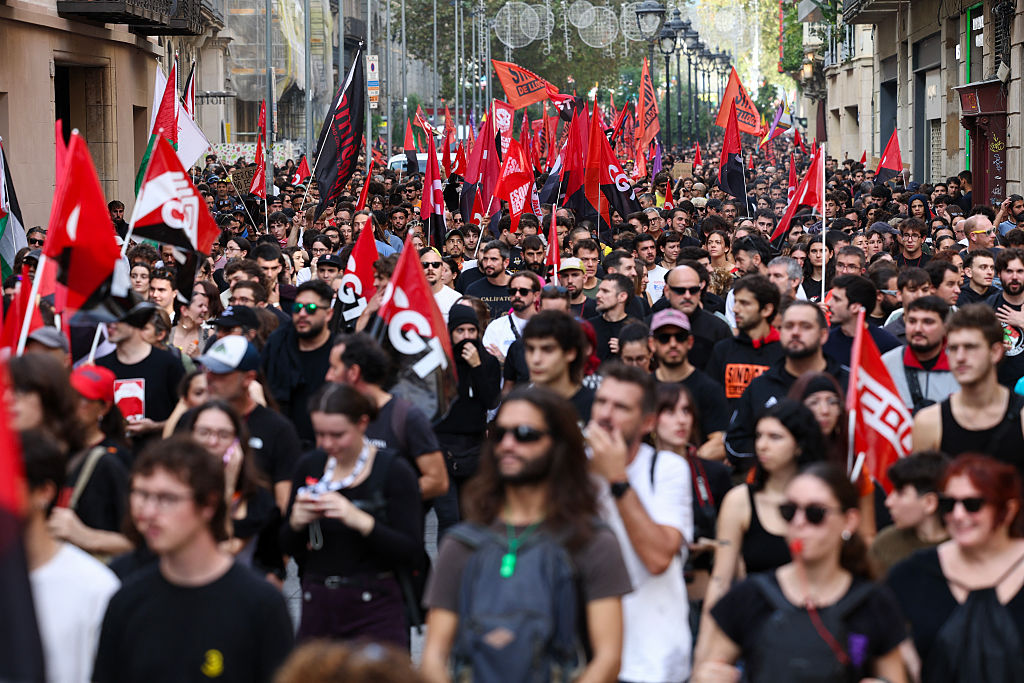
Trade union members walk in a protest during a nationwide general strike over Spain’s housing crisis, with workers also demanding greater purchasing power ahead of a snap general election at the end of the month, in Barcelona on November 11, 2026. (Josep LAGO / AFP via Getty Images)
Although Wednesday’s marches and demonstrations called by the strike’s organizers across Spanish cities largely occurred with normalcy outside of some reported minor altercations, violent riots broke out in the night hours at Barcelona once the strike had officially ended. Spanish outlets detailed that numerous hooded individuals dressed in black clothing broke the windows of several commercial establishments, set fire to garbage containers, and threw fireworks against the Catalonian Mossos d’Esquadra police force. The rioters also harassed tourists and forced open stores to close their doors under threat of violence.
The Catalan police officers responded to the rioters with rubber bullets. The protesters reacted by erecting burning barricades as they continued to clash with the law enforcement agents. The newspaper ABC observed that the rioters appeared to have been more interest in “repeating” the violent October protests in Barcelona than in the housing and affordability demands behind Wednesday’s strike. Per the newspaper, some of the rioters were seen posing next to the burning barricades to “presume” on social media.
The violent events in Barcelona reportedly concluded with at least 52 detained as of Thursday morning — six of which wrestled minors. 36 law enforcement agents were left injured during the violent events, and several stores were left with significant damages, including an Apple Store in Passeig de Gràcia, which rioters set fire to its entrance. A Lego store in the same area was also heavily vandalized by the rioters, El Español noted.
A similar chaotic and violent situation was experienced in Madrid during the night hours of Wednesday, prompting the local police to fire rubber bullets and use pepper spray to disperse the rioters, some of which set garbage containers on fire and smashed shop windows.
Per Telemadrid, the events at the Spanish capital left at least four detained for throwing objects against the police. Nine police officers injured.
Prior to the Wednesday night riots, at least 20 individuals had already been detained at the Spanish capital for engaging in violent actions and attacks against law enforcement.
Claims of the purported “success” — or apparent lack thereof — of Wednesday’s general strike appears to be the subject of widespread speculation in Spain in the immediate hours after the event.
According to Spanish outlets, the CEOE, another Spanish trade union, estimated a less than five percent of its members participated in the strike. The UGT, for its part, has reportedly abstained from disclosing estimates on grounds by alleging that it would be “boring” to do so. CCOO has instead reportedly affirmed that it will disclose participation details “in the coming days.”
El Español, citing data from the nation’s power grid operator, reports that electric consumption only decreased by 3.9 percent during the strike — an amount much lower than the 13.5 percent decrease documented during the 2012 general strike. At Spanish industries, the strike led to a 25 percent reduction in power consumption during Wednesday — far bellow from the 80-90 percent documented in past general strikes in Spain.
Prime Minister Pedro Sánchez has not publicly commented on the events of Wednesday’s strike and riots at press time.
COMMENTS
Please let us know if you're having issues with commenting.