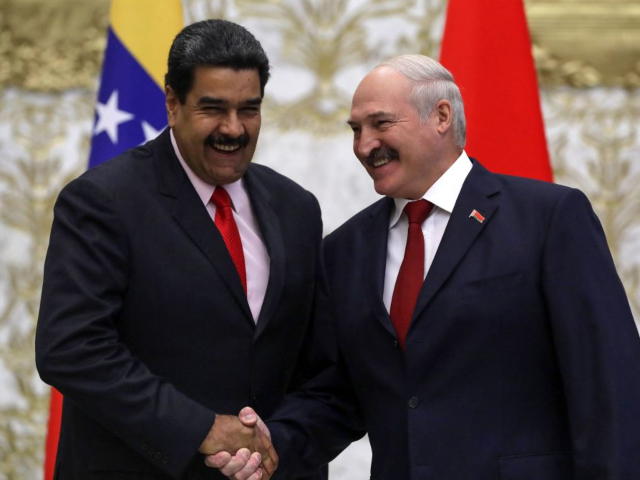

Communist dictator Aleksandr Lukashenko of Belarus suggested in an interview published on Tuesday that his country would happily welcome his Venezuelan counterpart Nicolás Maduro to live there should he have to flee his country.
Lukashenko sat down for an interview with the American conservative outlet Newsmax in which he commented extensively on Venezuela, whose socialist narco-regime has maintained friendly ties to Minsk and even closer relations with Lukashenko’s patrons in Moscow. Lukashenko repeatedly insisted that an American invasion of Venezuela, which the administration of President Donald Trump has not indicated any interest in, would be a disaster for America. He also falsely described Maduro as a legitimate leader, comparing the 2024 sham “election” in Venezuela to the fraught 2020 presidential election in America that Trump lost.
While assuring that his country would accept Maduro as a resident, Lukashenko insisted that Maduro had never indicated to him that he was interested in fleeing his country.
“Maduro has never been our enemy or adversary. Never. If he wanted to come to Belarus, our doors are always open for him,” Lukashenko said, according to a transcript of his remarks on the Belarusian presidential government website. “But frankly speaking, we’ve never talked about it. Maduro is not the kind of man to leave everything and flee. He is a strong person of the Hugo Chavez variety. He is a strong man, a decent and sensible person one can talk to and come to terms with.”
“We’ve never talked about it with Maduro,” he repeated. “To be honest, we talk to Americans about Venezuela more than we do with Maduro about his retirement and some actions. He is a heroic man.”
The tensions between the Trump administration and Maduro stem from the fact that Maduro’s regime is a violent, illegitimate narco-terrorist organization. The Venezuelan regime regularly imprisons, tortures, and kills political prisoners and is deeply intertwined with the drug trade. The United States identifies Maduro as a key operational figure in the Cartel of the Suns, a multinational cocaine-trafficking organization run through the Venezuelan military, and is offering a $15 million reward for information leading to his capture. Maduro is also believed to have close ties to terrorist organizations such as the Revolutionary Armed Forces of Colombia (FARC), the Tren de Aragua, and Hezbollah.
Lukashenko did not address these concerns in his comments, however, framing the situation mostly as needless warmongering by the United States. He did give President Trump credit for his concern regarding drug trafficking, but claimed that the solution to the global drug trade was “systemic” and could not involve the use of force.
“I am absolutely convinced that all issues, all wishes of the United States of America can be resolved today in an absolutely peaceful way,” Lukashenko offered vaguely.
The Belarusian “president” — who, as the Communist Party of Great Britain noted, enjoyed a “triumphant re-election… on 26 January, with a whopping 86 percent of the vote” — also dismissed the overwhelming evidence that the 2024 presidential “election” in Venezuela was fraudulent.
“The fact that you did not recognize the elections in Venezuela — well, so be it. Venezuela didn’t hold elections for the Americans,” Lukashenko asserted. “Venezuelans held elections for their own people, for themselves. And the results are known. There are no other results.”
In reality, there are other results showing that Maduro lost the election overwhelmingly even after banning every legitimate opposition candidate in the race, including the most popular politician in the country, former lawmaker and Nobel Peace Prize winner María Corina Machado. Machado won the prize for organizing a team to add up voter tallies in local voting stations to reveal the true results of the election, which showed that opposition candidate Edmundo González won the race with 67 percent of the vote.
The Maduro regime forced González to flee the country after Machado’s team revealed that he had won the election in a landslide. Machado was forced into hiding, which she escaped last week to travel to Oslo, Norway, following the Nobel Prize festivities.
Lukashenko did not address the true results of the election or the violence inflicted on Machado and González. Instead, he claimed the election was a “50/50 situation” comparable to the 2020 election in the United States, which former President Joe Biden narrowly won against Trump.
“It’s just like in the USA there: a 50/50 situation, with Maduro having a slight edge. If you want all Venezuelans to rally around Maduro (Americans probably don’t want that, and Trump doesn’t either), then you will start a war against Venezuela. This must not be done under any circumstances,” he claimed.
Maduro’s top election authority never published detailed results of the election. It is not clear what data Lukashenko was citing to claim that Maduro narrowly won, given the only publicly available results are those published by Machado, which show Maduro losing by a wide margin.
Lukashenko teased that he would soon discuss the matter with President Donald Trump and claimed that he discusses Venezuela with Trump’s envoys more than he does with representatives of the Maduro regime.
The Belarusian dictator’s interview follows a recent meeting between himself and Trump’s special envoy for Belarus John Coale, in which the Venezuela crisis was reportedly prominently featured. Coale told reporters following a meeting with Lukashenko on Saturday that discussions resulted in the dictator releasing some political prisoners in exchange for U.S. sanctions relief. Like Maduro, Lukashenko’s regime is notorious for abusing political dissidents.
“We’re lifting sanctions, releasing prisoners. We´re constantly talking to each other,” Coale updated.
COMMENTS
Please let us know if you're having issues with commenting.