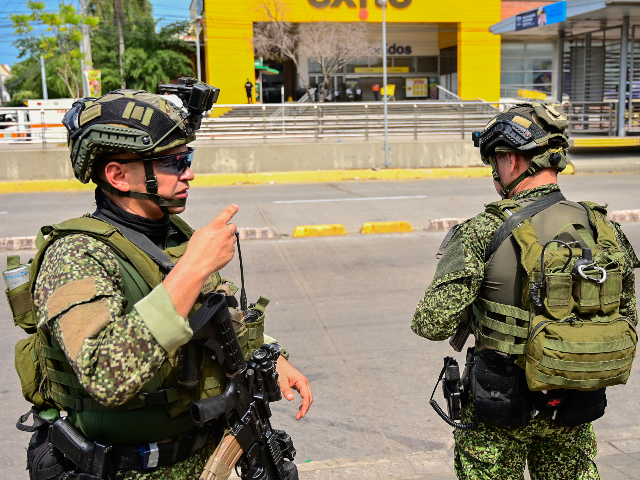

- Colombia marked ten years since the 2016 “Peace Deal” with the Marxist FARC terror group.
- Despite the “peace deal,” the terrorist group has maintained an active presence in Colombia.
- Conservative President Abelardo de la Espriella condemned the deal as a “fiasco.”
Colombia this week marked the tenth anniversary of the government “peace deal” with the FARC Marxist terror group — with the nation not having experienced any actual peace over the past ten years.
The anniversary occurred just hours after a new terrorist attack attributed to FARC left nearly two dozen injured.
On November 24, 2016, following a convoluted four-year negotiation period, the Revolutionary Armed Forces of Colombia and the administration of former President Juan Manuel Santos signed a “peace deal” in Havana, Cuba, that allegedly brought an end to more than five decades of armed conflict between the Marxist terrorist and Colombian forces, which claimed the lives of hundreds of thousands.
Santos, who left office in 2018, represented the Colombian state while Rodrigo Londoño, also known by the alias “Timochenko,” represented the Marxist terrorists. The agreement was signed despite the rejection of a majority of Colombians just weeks before the signing ceremony in a national referendum. Santos was awarded the 2016 Nobel Peace Prize for brokering the “peace deal” with FARC.
The FARC, which sometimes attaches the suffix “People’s Army” to its name (FARC-EP), was granted an extensive list of generous benefits including, but not limited to, immunity for its top leaders and ten uncontested seats in both chambers of the Colombian Congress, five in the Lower House, and five in the Senate.
Colombia continued to experience FARC’s terror in the past decade despite the nominal document stating otherwise. Its still active branches, such as the Segunda Marquetalia and the 33rd Front, have been responsible for numerous terrorist attacks, drug trafficking activities, and the mass recruitment of minors — now availing themselves of social media to intensify their recruitment efforts. Mainstream media and past Colombian governments have repeatedly claimed that the active FARC forces are “dissident” factions and that the “true” FARC is the demobilized leadership.
Just hours before the tenth year anniversary, a car bomb detonated outside the Meta Department’s governor offices on Monday, leaving at least 23 injured. Colombian authorities have reportedly attributed the attack to the FARC. On Tuesday, the day of the tenth year anniversary of the “peace deal,” former President Santos referred to the attack during his participation at a conference. Per Infobae, Santos dismissed claims that the “peace deal” had failed and instead affirmed that the attacks stem from a “failure to fully implement what was agreed upon and to weaknesses in security policy over the past eight years.”
“Events of this magnitude have not been seen in the country for more than two decades. Many attribute this type of violence to the Peace Agreement; it is quite the opposite,” Santos reportedly said in the conference.
Colombian investigators determined this year that members of FARC’s Segunda Marquetalia branch were actively involved in the assassination of conservative Senator and then-presidential frontrunner Miguel Uribe Turbay. According to the investigations, the Segunda Marquetalia’s leader, Iván Márquez, and other members of the group hired local hitmen in Bogotá to murder the senator.
Colombia’s current conservative President Abelardo de la Espriella commemorated the tenth year anniversary of the “peace deal” by condemning “the fiasco that was the Havana Agreement with the FARC narco-terrorists” in a social media post.
De la Espriella provided a detailed breakdown of how much the “false peace” has cost Colombians and explained that the nation paid 178.59 trillion Colombian pesos ($50.78 billion) for the “peace deal,” of which some $31 billion were allocated between 2023 and 2026. The Special Jurisdiction for Peace (JEP) transitional justice courts, de la Espriella also detailed, received $1.28 billion over the past ten years.
“And what are the results?” De la Espriella asked, an continued, “More than 350,000 hectares of coca. More than 28,000 members of armed groups. The recruitment of minors rose from 130 cases in 2016 to 625 in 2024.”
Additionally, de la Espriella stated that only 36.9 percent of the PDET — projects to restore rural areas affected by the armed conflict — have been completed.
“With that much money, Colombia could have made much greater progress toward providing comprehensive reparations to victims and considerably reducing the fiscal deficit we face today,” President de la Espriella affirmed. “False peace, the squandering of public resources, and corruption scandals during [Gustavo] Petro’s administration are what have brought Colombia to ruin.”
“Colombians deserve to know how every peso was spent and who should be held accountable for any irregularities found,” he continued. “Peace is measured by results, not speeches or bureaucracy.”
De la Espriella has vowed to crack down on Colombia’s transnational drug traffickers and terrorist organizations, including FARC.
The ten uncontested Congressional seats were first provided to the FARC through a party once known as the Common Alternative Revolutionary Force — a name that shared the Marxist terror group’s acronym. The FARC party renamed itself Comunes (“Commons”) once it was officially founded in 2017. As per the terms of the agreement, Comunes was able to maintain its ten uncontested seats through the 2026 legislative elections, regardless of how many votes it actually obtained in the 2018 and 2022 elections.
From that point onward, according to Colombia’s electoral laws, the FARC-founded party needed to win Congressional seats by competing under the same rules as every other political party in Colombia. Additionally, the party also needed to obtain a minimum of three percent of the votes in the 2026 elections if it wanted to retain is legal status as a political party.
Comunes obtained less than one percent support in the March 2026 legislative elections. Colombia’s National Electoral Council (CNE) confirmed in October that Comunes is no longer a legitimate political party after it failed to meet the vote threshold.
Christian K. Caruzo is a Venezuelan writer and documents life under socialism. You can follow him on Twitter here.
COMMENTS
Please let us know if you're having issues with commenting.