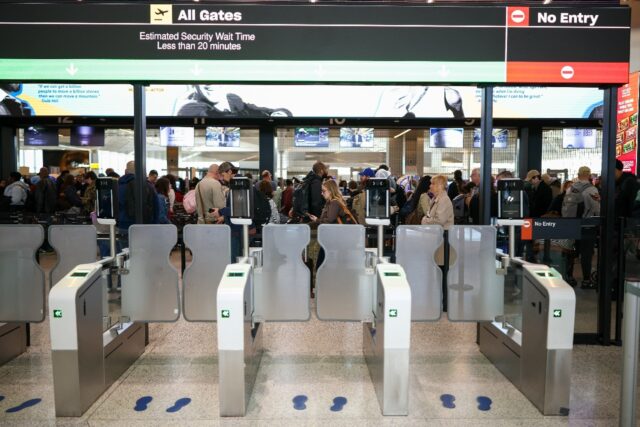

A sudden spate of disruptive tech breakdowns in the United States has triggered widespread public unease and compelled top officials to counter rampant speculation about everything from malicious actors to unchecked AI.
Flights were grounded, ATMs stopped working, and people couldn’t check emails on Outlook or access photos on Apple iCloud. For many, it felt like the whole system was glitching at once.
But experts say the main causes are old, overly complicated systems, and the rush by companies and the government to protect them from new threats created by artificial intelligence (AI).
Secretary of State Marco Rubio took time out of a foreign trip Wednesday to declare there is no proof the problems were connected, and no sign of a cyberattack. US intelligence chief Jay Clayton later echoed the remarks.
Instead, almost all of the outages were traced back to routine maintenance work on the systems, or to software errors known as “bugs.”
Senator Mark Warner, a Democrat and a top member of the Senate Intelligence Committee, said powerful AI tools can now find weak spots in computer systems faster than ever.
That is creating “enormous pressure on companies and government agencies to patch those vulnerabilities immediately, often all at once,” he said, which puts “tremendous strain on systems that weren’t built to handle that pace of change.”
“While we still need to get to the bottom of these incidents, the evidence so far points toward legitimate efforts to secure our systems, not malicious activity,” Warner added.
Steven Jackson, a professor of information science at Cornell University, said these systems combine software with physical equipment. “So correcting something like that, without accidentally breaking something else, is actually a challenging task,” he said.
That is especially true, he said, “when you’re doing it under duress, under time pressure, under significant anxiety and threat.”
‘Hard to justify’
Another problem is the cloud — vast, outsourced networks of computers used by companies to store data and run programs instead of on in-house machines.
Today, only a few large companies can provide such large computing power. So when one has a problem, even a small one, millions of people can be affected right away, as happened with Microsoft’s Outlook.
Researchers at the research firm Forrester said in a report that it is time to deal with the problem of so much power sitting with so few companies.
Kalle Lyytinen, a professor at Case Western Reserve University, said companies are also cutting the number of workers who maintain their systems.
Running these systems “requires very deep technical knowledge about the software architectures, the code,” he said, so that when something goes wrong, someone can find the defect and fix it.
Some of these workers are being replaced by AI. But Lyytinen said AI-written code doesn’t understand how the whole system fits together, and fewer and fewer people really understand what the code is doing.
Jackson also said the US tends to spend too little on keeping its basic infrastructure in good shape, because of the country’s struggles over public spending and taxes.
“It’s hard to justify spending on something until it breaks,” he said.
Climate change adds to the strain, Jackson said, because more extreme weather puts more stress on equipment.
At the same time, systems such as air traffic control, the power grid and cybersecurity haven’t been updated enough, even as demand keeps growing. There are more flights, more data centers and more tasks done by computers.
“Systems are always on and operating at full tilt,” Jackson said, “which makes it harder to do the kind of more orderly and planned upgrade… that a sustainable infrastructure might need.”
COMMENTS
Please let us know if you're having issues with commenting.