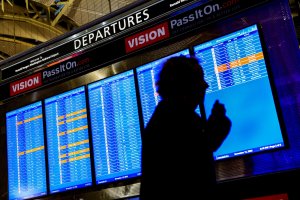

Nov. 25 (UPI) — A router in Arkansas has been blamed for grinding air travel in the United States to a halt, highlighting the challenges of maintaining and upgrading aging infrastructure while keeping flights moving.
The Federal Aviation Administration’s preliminary findings over the Nov. 13 incident said work on installing a new router at a site in El Dorado, Ark., flooded its data systems, causing a precautionary shutdown.
“When these inconsistencies in the data happened, L3 Harris blocked those two locations and the network stabilized,” the FAA said. “The broadcasting function was also disabled on all the new routers as a precaution.”
L3Harris is contracted by the FAA to upgrade the air traffic telecommunication infrastructure. The new router L3Harris was installing, called a pseudowire router, is part of that effort.
Dave Spero, national president of the Professional Aviation Safety Specialists, explained to UPI that the router converts high-bandwidth fiber signals back to individual wire pairs, allowing communication with older equipment like the radios air traffic controllers already use.
Fiberoptic cables carry groups of 12 fibers in individual tubes, sometimes dozens of tubes in a cable. This allows a single cable to carry hundreds of fiber connections.
“L3Harris has been modernizing the communications infrastructure supporting the National Airspace System in close coordination with the FAA,” L3Harris said in a statement.
“With safety and reliability as our highest priorities, L3Harris, together with its telco partners and the FAA, has completed more than 70% of the planned airspace communications conversion from legacy copper wires to a fiber optic system. We are supporting the FAA in its investigation to understand the conditions that led to the Nov. 13 ground stop of our nation’s air travel.”
In the case of this incident, FAA technicians were not able to see the outage happen live, Spero said.
“The controllers were reporting problems with their voice systems, with their frequencies, talking to aircrafts,” Spero said. “Getting it at various air traffic control centers, our technicians would then check out those audio lines to see if in fact there was either static or data not coming in. Then what they would do is isolate it to make sure that it wasn’t any equipment that we would be taking care of at the centers.”
“In this case, when it leaves the building out in Arkansas and then arrives at the center, our only ability to determine if there’s something wrong with it is on the inside of the center and then the inside of the building in Arkansas,” he continued. “Everything else in between is what the contractor was responsible for.”
Typically when a service provider or construction crew needs to perform heavy maintenance on a fiber optic network or part of a network that could result in even temporary outages, it will do so in the middle of the night, minimizing the service disruption. This is also true for commercial fiber networks, such as those providing internet access to neighborhoods around the country.
The work that L3Harris did resulting in the Nov. 13 outage was done on a Friday afternoon.
“The contractor scheduled the time and told us where to be and when to be there,” Spero said. “We didn’t have any control over that. If we did, it would have been a very significant objection and it would have to go to higher levels in the FAA to refuse that.”
Spero added that when he started his career nearly 40 years ago, controllers were not allowed to do this type of work on equipment outside of a midnight shift.
“That’s obviously changed over time, and in this particular case, we didn’t have the ability to actually say, ‘Well, we’re not going to do that on a Friday afternoon,” Spero said. “All we did was let them in the door. That’s our job, to let them in the facility.”
In March 2025, the FAA changed its contractor oversight policy to allow contractors like L3Harris to do their work without requiring advanced approval. The policy change was made to allow contractors to work faster by eliminating so-called “red tape.”
“It’s important to realize that the FAA changed that process about 18 months ago to facilitate the ability for L3Harris to do this kind of work,” Spero said. “FAA has flat out said that. It’s hard for them to object to the fact that they directed that to happen.”
As disruptive as the Nov. 13 outage was for travelers across the country, American Airlines pilot Dennis Tajer told UPI Transportation Secretary Sean Duffy made the right call grounding planes. Tajer is the spokesperson for the Allied Pilots Association.
“A single point of failure is unacceptable in the aviation business,” Tajer said. “It clearly sounds like, though risk management was done on this, they didn’t think it would create such a tidal wave, a cascading effect of failures throughout the system. It happened, so we’re going to want to hear the results of the investigation, not only to seek accountability but to also make sure this never happens again.”
The decision to ground flights across the country was one that had to be made quickly, considering little margin for error, Tajer said. Trying to push through communication issues could have otherwise ended in tragedy.
Tajer said ultimately the shutdown or air travel, from the pilots’ perspective, was “really quite uneventful.”
“Some aircraft had to divert,” he said. “That’s not an uneventful activity but it’s something that we managed.”
Tajer explained what happens when pilots are unable to communicate with air traffic control during flight.
It is common for pilots to experience communication problems, particularly when flying over the ocean, though Tajer said there are rarely deeper issues and pilots are trained on protocols to continue to their destination while working to establish communication.
“We would fly our last sign to include vectors we are expecting to fly next, and finally the flight plan you were filed for” Tajer said. “It gives you a pathway to your destination and so once you have that established, you go into com procedures, none of which had to happen in this case. We also have multiple frequencies. We can transmit to other aircraft and say air traffic control is not able to hear us. We have a backup frequency called GUARD and that’s for emergencies.”
The air travel outage highlighted the challenge the industry faces in updating an aging system but it also emphasized the need for funding and forward thinking at the federal level. Tajer said funding upkeep and innovation are only part of the battle.
“There are waves and waves of upgrades coming, with current funding and future funding, which we’re in support of,” Tajer said. “This can’t be ‘build the airplane while it flies.’ So answers will be given and procedures must change. We fly the airplane so we don’t have the forensic understanding of how these systems link together but we sure do know when they fail.”
COMMENTS
Please let us know if you're having issues with commenting.