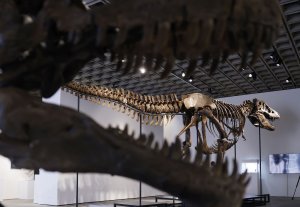

July 14 (UPI) — A massive Tyrannosaurus rex sold for $50.1 million at Sotheby’s in New York to a phone bidder making it the most expensive dinosaur fossil sold at auction.
The dinosaur was nicknamed Gus after the owner of the land in South Dakota where the bones were found.
Sotheby’s did not name the buyer.
The pre-sale estimate was $20 to $30 million.
Gus was found on the ranch in Harding County, S.D., owned by Gary Licking, whose nickname was Gus. He had been finding bones on his 6,500-acre property for years, so he enlisted the help of commercial paleontologists. They began excavating in 2021, but Licking died in 2022.
It took three summers for paleontologist Thomas Heitkamp and his team to excavate the dinosaur, then several years more of lab work. Sotheby’s said there were 183 bones found, and other bones had to be reconstructed. Gus is expected to be about 67 million years old, and he’s about 12.5 feet tall and 38 feet long.
There are no complete T. rex skeletons. Scientists estimate there would be about 300 bones in a complete skeleton.
“This result has been years in the making,” said Cassandra Hatton, Sotheby’s vice-chair and global head of science and natural history. “Gus is not only an exceptional find, but a specimen that’s been excavated, documented, prepared and cared for with real excellence. The market responds when great specimens are taken care of in the right way.”
But academic paleontologists are unhappy with the commercial dinosaur bones market. Another dinosaur, Stan, was sold for $31.8 million in 2020 and was put into the Natural History Museum in Abu Dhabi, United Arab Emirates. Since then, dinosaurs have been selling for astronomical amounts, to the chagrin of academics.
“It’s a new world,” Peter Larson, a commercial paleontologist from South Dakota, told The New York Times. “People are just now realizing their real value.”
Larson sold a T. rex leg on Tuesday for $1.8 million. He cited the years of work it takes to excavate and prepare the bones for sale.
Academics lament the lack of availability of the specimens for scientific study.
“The auction houses are in a competitive race to sell the most expensive dinosaur ever,” said Thomas Carr, a paleontologist at Carthage College in Wisconsin. “No museum could afford this.”
Thomas R. Holtz Jr., a vertebrate paleontologist with the University of Maryland, told The Times after the sale that Gus’ price underscored how much research could be accomplished with that money. For a thousandth of the price, he said, a small institution could fund two seasons of searching for fossils.
“For sincere fans of dinosaurs and paleontology more broadly, there are other ways of getting your name out there than having a fancy fossil on display,” Holtz said.
COMMENTS
Please let us know if you're having issues with commenting.