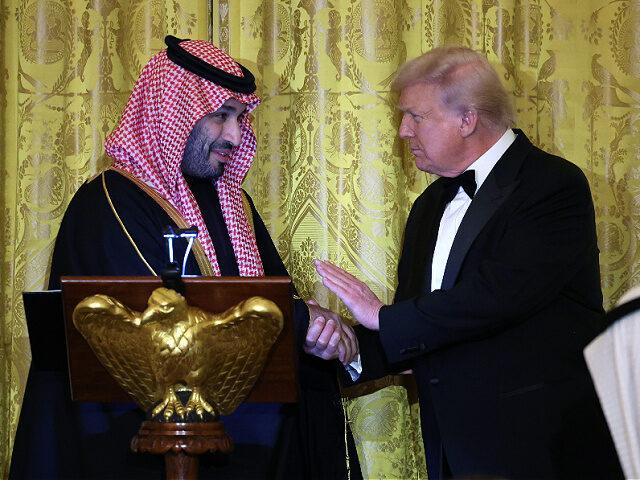
U.S. President Donald Trump said Saudi Arabia “should get top of the line” F-35 fighter jets “pretty similar” to Israel’s during an Oval Office meeting with Crown Prince Mohammed bin Salman, adding that Jerusalem is “aware” of the emerging deal and “is going to be very happy” as the two also discussed Riyadh potentially joining the Abraham Accords.
Sitting alongside the crown prince, Trump noted that both Israel and Saudi Arabia are “great allies,” and he confirmed that Washington plans to proceed with a major F-35 package for the kingdom, a shift that would give Riyadh access to the same fifth-generation stealth platform Israel alone currently fields in the region.
Trump acknowledged Israeli discomfort with the Saudi request.
“I know they’d like you to get planes of reduced caliber,” he told bin Salman — adding with a smile, “I don’t think that makes you too happy.”
“As far as I’m concerned, I think they are both at a level where they should get top of the line,” Trump added, referring to Israel and Saudi Arabia. “We’re going to have a deal. They’re going to purchase F-35s.”
Asked if Israel had urged him to tie the sale to Saudi normalization, Trump avoided describing any formal condition, saying only that “Israel is aware, and they’re going to be very happy,” leaving open how directly the jets and a diplomatic breakthrough are connected.
Israel remains the only Middle Eastern country flying the F-35 — with dozens already delivered and more on order — and maintaining its qualitative military edge is written into U.S. law. Israeli officials have indicated they would not automatically oppose a Saudi purchase so long as the final arrangement safeguards Israel’s advantage through basing and capability restrictions.
Bin Salman used the Oval Office appearance to reiterate that normalization with Israel is possible, but only if paired with a political path for the Palestinians.
“We want to be part of the Abraham Accords, but we want also to be sure that we secure a clear path to a two-state solution,” the crown prince said, describing his discussion with Trump as “healthy.”
“We’re going to work on that to be sure that we can prepare the right situation as soon as possible,” he noted, while stopping short of announcing any commitment to join the framework.
Trump said he believed he received a “positive response” from bin Salman but did not want to oversell the moment. “I don’t want to use the word commitment,” he said, “but we’ve had a very good talk on the Abraham Accords.”
He added that the two reviewed different paths for resolving the Israeli–Palestinian conflict — “We talked about one state and two state” — without elaborating on the “one-state” reference.
On Gaza reconstruction, the crown prince said Saudi Arabia will “definitely help” fund rebuilding after the Trump-brokered ceasefire that ended the recent war, although he said an exact figure has not yet been determined.
“It’ll be a lot,” Trump declared, adding that “the Palestinians are doing very well” and emphasizing that his administration is “working very closely with a lot of people that make everybody happy, including Israel, the Palestinians and everybody.”
The leaders also touched on civil nuclear cooperation — Trump said he could “see” a civilian nuclear arrangement with Saudi Arabia materializing at some point, even as he noted the kingdom’s extensive energy resources and said there was no urgent need.
Bin Salman used the visit to highlight Saudi Arabia’s expanding investment footprint in the United States — raising the kingdom’s commitment from roughly $600 billion to nearly $1 trillion.
He described the increase as “real investment, and real opportunity,” calling the United States under Trump “the hottest country on the planet,” and stressing that the kingdom wants to be deeply positioned in sectors such as artificial intelligence and emerging technologies.
Trump welcomed the pledge — and his own push to see it raised. “If you didn’t see potential in the U.S., you wouldn’t be doing it,” he said. “You don’t want to lose money.”
Senior U.S. officials said the visit is expected to finalize multibillion-dollar Saudi investment in American AI infrastructure, deepen cooperation on civil nuclear energy, and advance additional defense arrangements, all as part of a broader U.S.–Saudi security framework.
The Oval Office meeting — bin Salman’s first visit to the White House in more than seven years — featured a South Lawn welcome and an F-35/F-15 flyover, underscoring the centrality of defense ties to the relationship.
It also reflected how sharply the bilateral dynamic has shifted since former U.S. president Joe Biden called the crown prince a “pariah” over the 2018 killing of Washington Post columnist Jamal Khashoggi — before later appealing to Riyadh for oil relief during energy price spikes.
During Tuesday’s joint appearance, Trump defended bin Salman when an ABC News reporter raised the Khashoggi case — blasting the question as “fake news” and pivoting sharply.
“As far as this gentleman is concerned, he’s done a phenomenal job,” Trump said. He called Khashoggi “extremely controversial” and added, “Whether you like him or didn’t like him, things happen,” insisting that the crown prince “knew nothing about it.”
Bin Salman said it is “really painful to hear” about anyone losing his life “for no real purpose or not in a legal way,” calling the murder a “huge mistake” and saying the kingdom had taken corrective steps to ensure “nothing happens like that” again, vowing, “we are doing our best that this doesn’t happen again.”
Relations, strained during the Biden years, have since been reset under Trump following his energetic May visit to Saudi Arabia, when bin Salman initially pledged $600 billion in U.S. investments — a figure the crown prince has now pushed toward $1 trillion as Washington, Riyadh, and Jerusalem weigh how to align a Saudi F-35 sale, a broadened U.S.-Saudi security framework, and a potential Saudi entry into the Abraham Accords.
Joshua Klein is a reporter for Breitbart News. Email him at jklein@breitbart.com. Follow him on Twitter @JoshuaKlein.
COMMENTS
Please let us know if you're having issues with commenting.