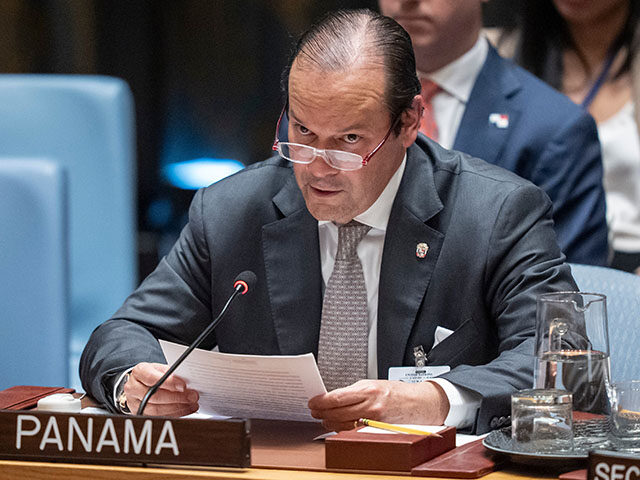
Foreign Minister of Panama Javier Martínez-Acha said on Monday that the Panama-flagged oil tanker recently interdicted by the United States failed to comply with the country’s maritime rules.
Martínez-Acha stressed that Panamanian authorities are acting on clear and verifiable alerts regarding the vessels intercepted by the United States in the Caribbean, including oil tankers flying the Panamanian flag reported for alleged irregularities and links to illegal activities.
On Saturday, the U.S. Coast Guard, in a joint operation with the Department of War, seized an oil tanker last docked in Venezuela. The U.S. Coast Guard identified the tanker as the Panama-flagged Centuries, and suggested it was bound for Asia, presumptively towards China.
Similarly, reports published on Sunday indicated that the U.S. Coast Guard is actively in pursuit of the Bella 1 Panama-flagged oil tanker sanctioned by the United States in 2024 due to its links to a Hezbollah-linked company in support of the Islamic Revolutionary Guard Corps-Qods Force (IRGC-QF).
“The United States Coast Guard is in active pursuit of a sanctioned ‘dark fleet’ vessel that is part of Venezuela’s illegal sanctions evasion,” an unnamed U.S. official told Reuters. “It is flying a false flag and under a judicial seizure order.”
President Donald Trump confirmed in remarks to a CNN reporter on Monday evening that the U.S. remains in active pursuit of the Bella 1 and detailed that the vessel “came from the wrong location, it came out of Venezuela.”
“It’s moving along and we’ll end up getting it,” President Trump said.
Panama’s foreign minister, speaking to local reporters on Monday, detailed that the country’s authorities detected several irregularities and violations of both national and international maritime regulations committed by the two Panamanian-flagged vessels.
Some of the irregularities detected, Martínez-Acha explained, include the deliberate disconnection of tracking devices, name changes, and discrepancies in crew records — all of which constitute “red flags” for the Panamanian Merchant Marine.
“This situation requires great care. What we can make public now is the following. The vessels under suspicion disconnected the tracking device, this is a serious warning sign. The vessels under suspicion had a name change, which is another warning sign, the vessels under suspicion apparently had issues with the names of the crew,” Martínez-Acha said.
“All these variables lead us to believe that our flag is not being used responsibly. And we have acted in accordance with maritime law. Nothing more, we continue to investigate and demand not only that these particular ships be investigated, but that all ships flying our flag respect our laws, maritime law, and above all, maritime justice,” he continued.
View this post on Instagram
Dimitris Ampatzidis, senior risk and compliance analyst at Kpler, suggested to CNBC on Monday that the seizure of the Centuries may have been conducted under the 2002 Salas-Becker agreement, which allows U.S. authorities to board Panamanian-flagged vessels with just two hours’ notice.
“The most interesting part of the Centuries seizure is the suggestion of the U.S. likely relying on its prior boarding agreement with the Panama Maritime Authority,” Ampatzidis said.
Last week, President Trump ordered a “total and complete” blockade of all sanctioned oil tankers entering or leaving Venezuela as part of his maximum pressure campaign on the socialist Maduro regime and its dictator, Nicolás Maduro, who is actively wanted by U.S. authorities on multiple narco-terrorism charges.
Saturday’s interdiction of the Centuries comes days after the United States seized the Skipper, a sanctioned oil tanker linked to illicit Iranian oil smuggling, which reportedly carried a “false flag of nationality” at the time it was seized.
The Maduro regime has fiercely condemned the interdiction of tankers. Socialist dictator Nicolás Maduro first compared the seizure of the Skipper this month to the film series Pirates of the Caribbean.
On Monday, Venezuelan Foreign Minister Yván Gil revealed the contents of a six-page letter allegedly sent by Maduro to international heads of state and to the United Nations in which the Venezuelan dictator, referring to the blockade, condemned the “escalation of hostilities” by the United States and the acts of “state piracy” allegedly committed through the interdiction of both tankers.
Throughout the missive, Maduro also condemned the ongoing military strikes against drug trafficking vessels in Caribbean and Pacific international waters which, according to him, have allegedly resulted in “extrajudicial execution of 104 people, many of whom were shipwrecked.”
“These are not isolated incidents, but rather a systematic practice of lethal use of force outside any international legal framework and even outside the constitutional framework of the United States of America, where an intense debate is currently taking place, both in Congress and among the general public, which overwhelmingly condemns such actions,” Maduro’s letter read in part.
Christian K. Caruzo is a Venezuelan writer and documents life under socialism. You can follow him on Twitter here.
COMMENTS
Please let us know if you're having issues with commenting.