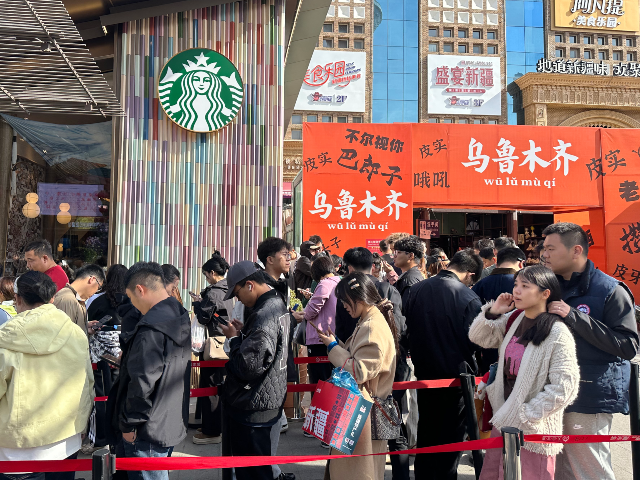

The Chinese Foreign Ministry defended the coffeehouse giant Starbucks this weekend after its decision to expand business into occupied East Turkistan, a region known for the ongoing Chinese Communist Party (CCP) genocide of its indigenous communities, prompted global outrage.
The Foreign Ministry was responding to a statement by the U.S. Select Committee on China, a congressional body which urged Starbucks last week to reconsider opening shops in East Turkistan and generating funding for the local government which has imprisoned as many as 3 million people in concentration camps and engaged in forced sterilization, the separation of families, slavery, organ harvesting, and other atrocities. The victims of these crimes have mostly been members of the indigenous Uyghur population, as well as Kazakh and Kyrgyz communities, whose populations have been decimated and replaced with Han settlers encouraged to move there by Beijing.
The Select Committee statement on the matter was published on Thursday featuring condemnations from members of Congress who urged Starbucks to reconsider.
“This is a shocking and morally bankrupt decision by a company that prides itself on social responsibility,” Rep. John Moolenaar (R-MI), the chairman of the Select Committee, said. “There is no justifiable reason for an American company to do business in a region where the CCP has detained more than a million Uyghurs and is stripping them of their faith, language, and culture.”
“Every cup sold in these stores ties an iconic American brand to the CCP’s brutal campaign against the Uyghurs. Starbucks should immediately reverse course and close its stores in Xinjiang,” he added. The “Xinjiang Uyghur Autonomous Region,” or XUAR, is the Chinese Communist Party’s official name for East Turkistan.
Human rights groups, particularly Uyghur advocacy groups, responded positively to the Select Committee’s statement, condemning Starbucks for choosing to do business in the region. The World Uyghur Congress (WUC), for example, published a statement calling for Starbucks “to close these stores and stand on the right side of history.”
“Companies should not contribute to an economy where state-imposed forced labour remains a serious concern, nor normalize business as usual amid ongoing human rights abuses against Uyghurs,” the organization declared.
The Chinese Foreign Ministry held a special briefing on Saturday, as this past week marked the founding of the “people’s republic,” or communist China, on Thursday. Spokesman Guo Jiakun condemned the Select Committee, denying the ample evidence of genocidal activities in East Turkistan.
“The so-called ‘genocide’ in Xinjiang is a blatant lie,” Guo claimed. “This U.S. group [the Select Committee] is known for vilifying China out of political motives and has absolutely no credibility to speak of.”
“Today’s Xinjiang enjoys social stability, economic prosperity, ethnic unity, and religious harmony. As for foreign businesses, China will continue to expand high-standard opening up and provide more opportunities for them to invest and thrive in China,” Guo added.
The precipitating event triggering the outrage was the opening of two Starbucks stores on September 29 in Urumqi, the capital of occupied East Turkistan. The Chinese government advertised the opening extensively as a critical cultural moment in Chinese-American relations and claimed the larger of the two stores incorporated “local flavors” and “ethnic instruments.”
The opening featured dancers in what appeared to be traditional Uyghur garb, which Chinese state media used to claim that the local culture remained alive and unencumbered by communist repression.
Starbucks has indicated it is planning to expand significantly in China.
“Entering Xinjiang not only marks a further expansion of our store network, but also allows us to engage deeply with this vibrant market and build sincere, lasting connections with our customers there,” Molly Liu, Starbucks China CEO, said in a statement shared by the flagship Chinese state media outlet Xinhua.
The announcement followed the revelation in April that Starbucks had finalized the process to enter a joint venture with the Chinese company Boyu Capital, which Starbucks declared would help “unlock sustainable, disciplined growth in China.”
“This partnership strengthens our long-term commitment to China and enables us to grow with greater speed, efficiency, and focus,” Brady Brewer, chief executive officer of Starbucks International, said in the April announcement. “With Boyu as our partner, we have an operating model designed to accelerate expansion, enhance profitability, and deliver the Starbucks experience to more communities across China.”
Xinhua observed that China is now Starbucks’s second-largest market after America and that its expansion plans follow the announcement that the company would shut down 250 locations in North America, an attempt at “restructuring.”
Breitbart News reached out to Starbucks for comment on the issue, but has not received a response at press time. Starbucks has also apparently not responded in an official capacity to criticism from the U.S. Select Committee or human rights groups.
Starbucks is far from the only Western company with business in East Turkistan. Disney, for example, filmed its 2020 live-action remake of the film Mulan in occupied East Turkistan and added a note of gratitude to communist repressive forces in the region for their aid in the production of the film. Disney corporate officers later defended the decision to work there and thank Communist Party repressors by declaring it a standard industry practice in acknowledgements. Tesla, the American electric vehicle company owned by Elon Musk, has maintained a presence in Urumqi for years, including a state-of-the-art showroom. Outside of East Turkistan, landmark human rights study Uyghurs for Sale by the Australian Strategic Policy Institute (ASPI) found evidence linking over 80 international companies with Chinese suppliers buying Uyghur slaves and using them to manufacture in their factories.
COMMENTS
Please let us know if you're having issues with commenting.