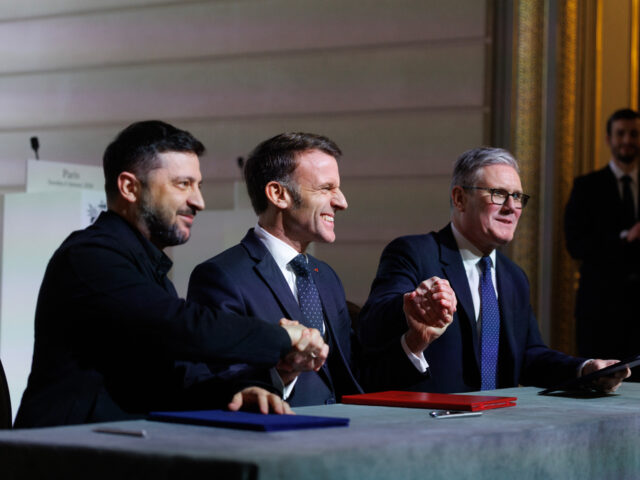
British Prime Minister Sir Keir Starmer said that while he signed a declaration of intent on Tuesday to deploy UK troops into Ukraine following a potential peace deal with Russia, Members of Parliament will be given the opportunity to vote on the matter before any soldiers are sent to the war-torn country.
In a meeting of the so-called “coalition of the willing” in Paris on Tuesday, Prime Minister Starmer, French President Emmanuel Macron, and Ukrainian President Volodymyr Zelensky agreed that British and French soldiers would be sent as a peacekeeping force in Ukraine, with the United States providing a backup insurance force should they come under attack, as a part of the security guarantees sought by Kyiv before inking any armistice agreement with Moscow.
While firm details on the scope and scale of the operation were not made public, President Macron said that the Anglo-Franco force would number in the “thousands”, providing a deterrence against further Russian aggression and protection for “military hubs” to house defensive stockpiles of weapons and equipment in case of another incursion.
During Prime Minister’s Questions in the House of Commons on Wednesday, Prime Minister Starmer vowed to put the matter of troop deployments before MPs for a vote.
However, according to the BBC, a Downing Street spokesman refused to comment on whether such a vote would be binding, given that the Prime Minister does not require parliamentary approval for military actions. Indeed, the public broadcaster noted that Starmer has previously authorised the use of the Royal Air Force to target Houthi terrorists in Yemen without a vote from Parliament.
The head of the opposition Conservative Party, Kemi Badenoch, accused the Prime Minister of a “lack of respect” for parliamentarians by failing to give a full briefing to the House of Commons on the deployment of British troops.
The potential for British troops to be sent on the ground in Ukraine — in addition to the UK Special Forces apparently already operating in the country — has been floated since last March.
However, there have been questions about Britain’s ability to project military force in Ukraine, given the years of neglect and underfunding of its Armed Forces. Indeed, last year, the number of active British Army troops fell below 73,000 for the first time since the Napoleonic era.
Brexit’s Nigel Farage reacted with incredulity to the plan on Wednesday afternoon, asking of the boots-on-the-ground plan at a time where Britain’s military is contracting: “what boots? What equipment?”. He compared the idea to the previous British occupation of mainland Europe, the British Army of the Rhine (BAOR), which existed at a time when well-north of five per cent of GDP was spent on defence and just the deployed force was the size of the whole British Army today.
On top of the chronic underfunding of the military — as Britain and other European allies became increasingly reliant on the United States to underwrite their defence as they ploughed money into domestic welfare schemes — the UK has also been facing a major recruiting crisis to replenish its forces.
There have been suggestions that many young people in Britain are souring on the notion of putting their lives on the line for a country which is apparently intent on demographically displacing them, with white Britons set to become a minority in their homeland by the 2060s amid the desperate drive from the establishment towards multiculturalism through mass migration.
At the same time, the military has had a number of significant public relations blunders, including in 2023 when it was revealed that Royal Air Force staff were reportedly told to focus on recruiting more ethnic minorities and women instead of “useless white male pilots”, who have been traditionally the largest cohort within the British force.
A poll in June found that nearly half of Britons (48 per cent) would not take up arms for their country under any circumstances, compared to 35 per cent who say they would.
COMMENTS
Please let us know if you're having issues with commenting.