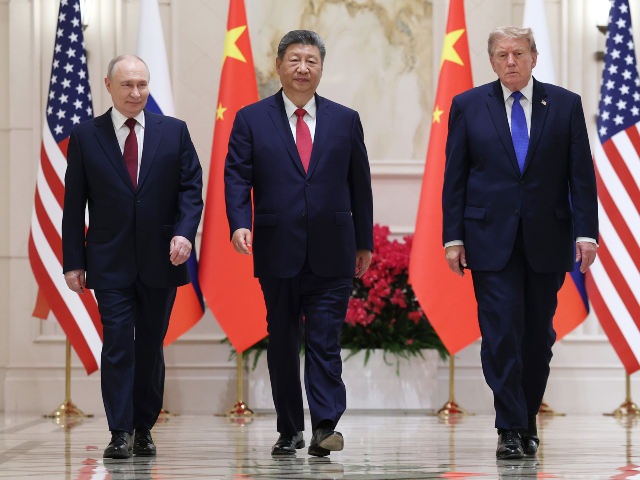

- President Trump and the leaders of China and Russia signed a joint declaration after a historic trilateral meeting calling for an end to the global nuclear threat and free flows of oil.
- The topics chosen for the brief statement appear to target the priorities of the Iranian terror regime, nominally a friend of China and Russia.
- As the largest buyer of Middle Eastern oil, the Chinese government has been particularly vocal against Iran’s attacks in the Strait of Hormuz.
President Donald Trump, alongside Russian strongman Vladimir Putin and Chinese host Xi Jinping, signed a joint declaration on Thursday calling for an end to nuclear proliferation and unencumbered “stable energy flows” — subtly targeting Iran’s top geopolitical priorities.
Shenzhen, China, hosted the unprecedented trilateral summit on the sidelines of the Asia-Pacific Economic Cooperation (APEC) summit, an event bringing together the heads of state of the countries that encircle the Pacific Ocean. Xi held meetings throughout much of Wednesday with leaders from southeast Asian countries as well as the conservative heads of state of Chile and Peru, among others, discussing how to enhance trade and address mutual concerns.
The Trump-Putin-Xi summit was different in that the countries publicly stated the objective was to discuss “world peace” and how to use their leverage as some of the world’s most powerful governments to stabilize the world.
The specifics of those conversations were the object of much speculation since the three countries confirmed the summit this week. Suggestions on what issues would arise ranged from the wars in Iran and Ukraine to artificial intelligence and nuclear nonproliferation, the latter a top concern for President Trump since his first term in office. The president has repeatedly insisted that previously existing nuclear frameworks, such as the now-defunct START treaty, were not useful if they only bound America and Russia to limit their stockpiles. Trump has emphatically demanded that any reboot of START include China, which Beijing has vehemently rejected.
The leaders issued a joint declaration indeed discussing nuclear proliferation, but not in any way that suggests a China-inclusive START reboot was on the way. Instead, it indicated that the three countries were especially concerned about other parties seeking nuclear weapons or expanding arsenals. The statement did not mention Iran, but the context of Iran being embroiled in an ongoing conflict due to its insistence on enriching large stockpiles of uranium cannot be ignored.
“The three heads of state reaffirmed that a nuclear war cannot be won and must never be fought,” the text of the statement read. “The three countries will conduct a dialogue on reducing nuclear risks and preventing the proliferation of nuclear weapons.”
The joint statement also subtly addressed the oil shipment chaos that Iran has caused in the Strait of Hormuz, where the terrorist wing of its military, the Islamic Revolutionary Guard Corps (IRGC), has laid sea mines and bombed commercial ships.
“The three countries plan to increase the production and supply of refined petroleum products for the benefit of all nations. They reaffirmed the importance of stable energy flows,” the text of the statement read.
Elsewhere in the relatively brief text, the declaration opposed the International Criminal Court’s (ICC) attempts to impose itself on nations that had not signed the international legal documents to join it — an issue especially relevant to Putin, for whom the court has issued an arrest warrant. The declaration also stated that the countries would support United Nations agency reforms “so that the U.N. can respond more effectively to global challenges and conform to its fundamental mission of international peace and security.”
The statement on energy flows is of particular significance because it addresses Russian concerns — it allows for the countries involved to increase their oil production, which can help Russia corner more of the market despite sanctions in the context of Middle Eastern shipping disturbances — while also addressing China’s palpable annoyance with Iran’s Hormuz blockade. China is the world’s largest consumer of oil coming from the Middle East, not just from Iran but from fossil fuel heavyweights such as Saudi Arabia and the United Arab Emirates (UAE). The Gulf states have contended not only with IRGC attacks on commercial shipping but with a piracy campaign by the Houthis of Yemen, a Shiite terrorist organization supported by Iran. The Houthis have intentionally and repeatedly attacked Saudi oil infrastructure, escalating attacks in the past three months and jeopardizing oil flows that feed the Chinese market.
Xi Jinping personally demanded that Iran stop interfering in regional shipping in April, early in the conflict with the United States. Speaking on the phone with Saudi Crown Prince Mohammed bin Salman, Xi said, according to the Chinese Foreign Ministry, that “the Strait of Hormuz should maintain normal passage, as this serves the common interests of regional countries and the international community.” Xi also demanded an “immediate” ceasefire and an “end to the disturbances blocking commercial traffic.” The Foreign Ministry readout did not mention Iran, but Iran’s behavior is the precise threat to Chinese oil shipments; the American blockade in the Strait of Hormuz only affects Iranian ships and does not affect other routes such as, for example, the Bab el-Mandeb Strait, where the Houthis have made safe passage nearly impossible.
Xi put an exclamation point on his disapproval of Iranian terrorism in the region in September, when he appeared to have been ambushed by Iranian President Masoud Pezeshkian at the Shanghai Cooperation Organization (SCO) summit in Kyrgyzstan. Photos of the pair showed Xi looking at Pezeshkian with apparent disdain in a hallway, an encounter Iranian state media touted as a “sideline meeting” to make it appear that China continued to support the country.
In contrast, Xi welcomed President Trump to Shenzhen with a rare hug on the tarmac, where the Chinese dictator rarely greets visiting heads of state.
China has continued to support the Iran at the United Nations Security Council, but otherwise kept its distance. Russia has been more supportive, going as far as to sign new agreements to help Iran expand its civilian nuclear program, so its inclusion in a statement boldly rejecting the idea of nuclear proliferation, even without explicit mention of Iran, suggested that China joined American pressure to restrict illicit Iranian activities in the sector. Regarding the Strait of Hormuz, Russia has kept a distance from the conflict — and from the Middle East generally since the collapse of the Iran-backed Bashar Assad regime in Syria — but its commitment to add more oil to the market weakens the influence Iran can have by acting to restrict access to Middle Eastern oil.
Iran appears to have gotten the message from the joint declaration, even without being explicitly mentioned. Iranian Foreign Minister Abbas Araghchi issued a statement on Thursday insisting that Tehran opposes all “foreign interference” in the Middle East. Of particular note in the Iranian state media coverage is that Araghchi didn’t single out the United States in particular, but rather all non-Middle Eastern nations.
“We had constructive discussions in this regard. Across the region, there is a growing belief, stronger than ever before, that security must be ensured from within the region itself, without interference from foreign powers,” Araghchi was quoted as saying.
COMMENTS
Please let us know if you're having issues with commenting.