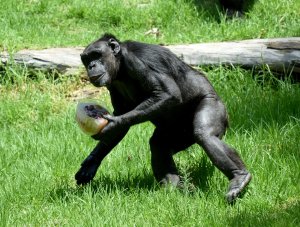

Nov. 18 (UPI) — The U.S. National Institutes of Health announced Wednesday that it will relocate the last government-owned chimpanzees to a sanctuary in Louisiana next year.
The government will move the chimpanzees from the Keeling Center for Comparative Medicine and Research in Bastrop, Texas, to Chimp Haven, a 200-acre federal sanctuary, said Jay Bhattacharya, NIH director.
“These are the last NIH-owned chimpanzees awaiting transfer to the federal sanctuary program,” Bhattacharya said in a release. “Completing their transfers will fulfill NIH’s commitment, announced in November 2015, to retire all NIH-owned chimpanzees to sanctuary.”
A federal law that went into effect in 2000 requires the U.S. government to send retired or surplus chimpanzees to a sanctuary. The NIH ended invasive research on the animals in 2015 and said it would move the government-owned chimps to the sanctuary.
More than 150 chimps have been moved since then, from both the Keeling Center and the Alamogordo Primate Facility in New Mexico, said Humane World for Animals, a nonprofit organization that worked for the animals’ freedom.
However, in 2019, the NIH said it would not move the remaining chimpanzees at Alamogordo because they were too frail or had health conditions. In 2021, it said the remaining chimps at the Keeling Center would also remain there.
In 2022, in response to a lawsuit filed by HWA, a federal judge ruled that the NIH decisions violated the 2000 law. The NIH moved the remaining Alamogordo chimpanzees to the sanctuary by spring 2025.
The announcement Wednesday means the final 33 chimpanzees, which are in their 30s to late 50s, will move to the sanctuary as well, HWA said.
“It’s an absolutely incredible thing to see chimps who were locked in laboratories for most of their lives finally get to experience life in a sanctuary,” the group said in a statement. “We cannot wait for these chimps to see their new home.”
The transfers are expected to start in early 2027, the NIH said.
“Relocating chimpanzees is a complex process that requires careful consideration of each animal’s needs,” Bhattacharya said in the release. “The health conditions of these chimpanzees increase the risk of adverse events during transport and adjustment to life at the sanctuary. NIH will plan and carry out these transfers with the chimpanzees’ health and welfare at the forefront of every decision.”
COMMENTS
Please let us know if you're having issues with commenting.