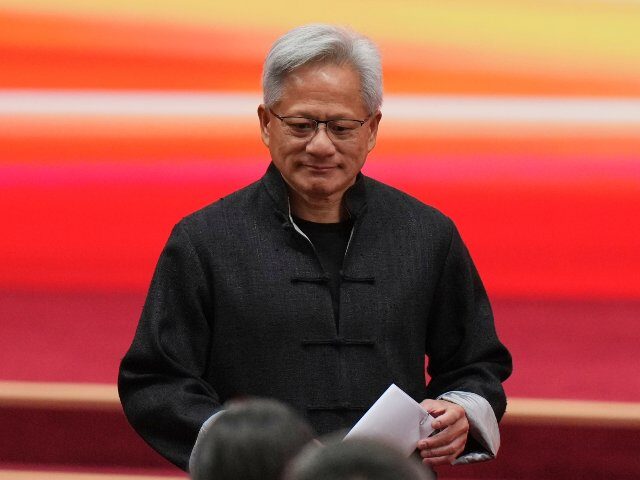

- China’s Global Times celebrated Jensen Huang’s return as Nvidia CEO, portraying espionage allegations against him as a fabricated political witch hunt by American media and politicians.
- The Communist Party paper argued Huang’s reinstatement showed that U.S. political battles and chip export controls are damaging the A.I. industry.
- U.S. lawmakers and former officials instead said the episode could strengthen bipartisan support for export restrictions, and raised concerns about Washington influencing Nvidia’s board decisions.
China’s state-run Global Times on Thursday was ecstatic over Jensen Huang returning as CEO of Nvidia, savoring the affair as a defeat for “certain American media outlets and politicians” who “turned the episode into a Hollywood-style spectacle, complete with gossip, conspiracy theories, and political maneuvering.”
The Chinese Communist Party paper’s tone was giddy over Huang surviving allegations that he was romantically involved with a Chinese espionage agent:
Some Western media outlets spent weeks digging up dirt on him, branding him a “spy,” and portraying him as a deeply troubled figure — both personally and professionally. They may be having a hard time explaining what happened next. There he was: Jensen Huang, strolling back into Nvidia headquarters in a dark blue jacket, greeted by cheering employees, a forest of raised phones, and thunderous applause.
The Financial Times struck a sour note, casting Huang’s return as “a triumph of money over morals.”
But is that really what happened? Huang’s fate was never simply a matter of personal conduct. His future became a pawn in a much bigger game – one involving elections, political infighting, semiconductors, and geopolitics. He made his way back because, after all the political maneuvering and calculations, one thing became clear: The so-called spy allegations, entirely fabricated out of thin air, are nothing more than a political witch hunt; Nvidia and US AI industry still need him.
Alluding to Huang’s opposition to export controls on chip technology, the Global Times pontificated that his return to the CEO’s office proved that America’s “political witch hunts” and “never-ending expansion of export controls” are doomed.
“In America, the fate of tech companies is never determined by market forces and technological prowess alone. It is deeply intertwined with politics, making even the biggest companies vulnerable to partisan battles, geopolitical rivalries, and political maneuvering,” huffed the house organ of a brutal totalitarian government that crushes tech executives like bugs when they dissent from Communist Party dogma.
Contrary to the exuberant tone of the Global Times, the outcome of the Jensen Huang saga could be more of the security reviews and export controls that Beijing despises, at least when they aren’t the ones doing the reviewing and controlling.
Republican strategist Brendan Steinhauser told The Hill on Tuesday that the “momentum has clearly shifted” in favor of stronger export controls, with both parties coming into alignment on the issue after the Huang debacle.
RELATED: GAME ON — Markets Rocked, Trump vs Democrats Set for Big Tech Fight as Jensen Huang Returns to Nvidia
The incoming Democrat majority is especially eager to slap chipmakers around as a rebuke to President Donald Trump, who was outspokenly in favor of reinstalling Huang as Nvidia CEO. Republicans are still deeply suspicious of Chinese espionage, and cross with Huang for jeopardizing America’s high-tech advantage with his personal peccadillos.
Leading figures in both parties are much less willing than the Global Times to treat Huang’s reinstatement as a clean bill of espionage health for his alleged mistress Alice Huang and her company Megaspeed.
Sen. Dave McCormick (R-PA) said on Tuesday that the Huang affair “absolutely reinforces what I and a number of other members of the Senate have been saying, which is we need more legislation to restrict the export of these most advanced chips.”
McCormick said he was also uneasy about the executive branch “getting involved” in corporate board decisions, as Trump did with Nvidia. John Ullyot, National Security Council (NSC) spokesman during the first Trump administration, compared the situation to how the Chinese Communist government handles its corporations.
“We also need to watch out whenever Washington starts telling companies how to run their business. That sounds a lot more like China than America,” Ullyot said.
COMMENTS
Please let us know if you're having issues with commenting.