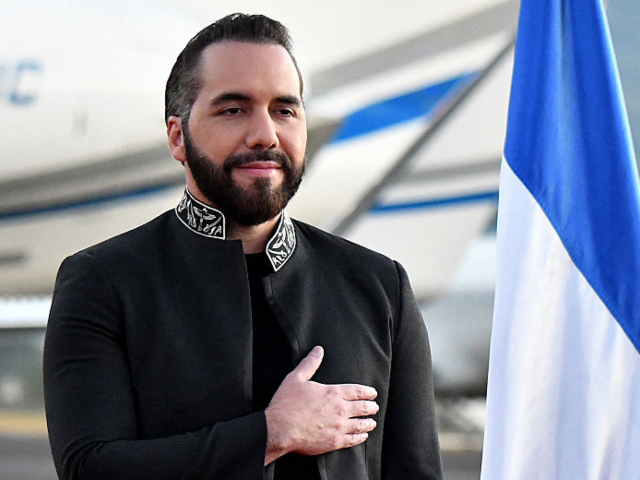

- El Salvador President Bukele and Vice President Félix Ulloa are seeking a third consecutive term in the February 2027 elections.
- The highly-popular president is slated to run against four other candidates.
- The pro-Bukele majority in Congress eliminated presidential term limits, allowing Bukele to run in 2027 without the need for legal loopholes.
President of El Salvador Nayib Bukele on Thursday officially registered his candidacy for the 2027 presidential election, seeking to be reelected for an unprecedented third consecutive term.
The Salvadoran newspaper El Mundo detailed that President Bukele and Vice President Félix Ulloa arrived at the headquarters of the Supreme Electoral Tribunal (TSE) on Thursday night to present their candidacies under the New Ideas (NI) party for the February 28, 2027, presidential election. Bukele and Ulloa registered their presidential formula just hours before the end of November 19, the last day of the candidacy registry period established by the TSE.
Bukele, who first became elected in 2019, boasts a high approval rating among Salvadorans that has consistently hovered around 90 percent over the past years. His high approval ratings have been largely attributed to Bukele’s crackdown campaign against El Salvador’s deadly gangs such as MS-13 and 18th Street.
The New Ideas party published footage of Bukele’s arrival at the TSE while a group of his followers awaited outside the building. The party also published photos of Bukele and Ulloa’s meeting with TSE authorities after they registered NI’s presidential formula.
Xavier Zablah Bukele, the head of the New Ideas party and President Bukele’s cousin, published a photo of himself, President Bukele, and Vice President Ulloa at the headquarters of the TSE.
“Six more years! We are ready, Mr. President!” Zablah Bukele wrote.
Speaking to reporters and followers outside the TSE, Bukele reportedly rejected international criticism of the country’s electoral conditions and the state of Salvadoran democracy. Bukele affirmed, “Now there really is democracy, and everyone can participate, all political parties. There are 11 political parties, and all of them can field candidates for whatever positions they want.”
The Salvadoran president also called for representatives of international organizations such as the United Nations, the Organization of American States (OAS), and the European Union to observe the elections. The Salvadoran president affirmed that his administration has not repressed a single protest in the seven years that he has been in power.
“The only thing we have told them, and the only thing we have told all those international organizations, the UN, the OAS, the European Union, the media, and the globalists, is that the doors are wide open for you to see, verify, review, observe, and ensure that there is total, complete, and open democracy in El Salvador, and that anyone who wants to run for elected office can do so,” Bukele said.
President Bukele will reportedly run on February 28 against four other candidates: Mayteé Iraheta of the center-right Alianza Republicana Nacionalista (ARENA) party; Rafael Aguirre of the left-wing Farabundo Marti National Liberation Front (FMLN); Orlando Del Cid of the Salvadoran Patriotic Fraternity (FPS) party; and Alirio García Flamenco of the National Coalition Party (PCN). Bukele was a member of the FMLN until the leftist party expelled him in 2017 for “violating” party principles.
While Bukele is reportedly expected to win given his high popularity ratings and polling, the Salvadoran president stressed to his followers that they should not rely on polling and nevertheless vote en masse for him.
“Polls are nice; they tell us we’re going to win by a historic landslide,” Bukele said, per Infobae. “But no one wins based on polls.”
Although El Salvador’s constitution contained a set of clauses introduced over a century ago that explicitly forbade presidential reelections and heavily punished anyone who attempted to implement them, President Bukele successfully ran for reelection in 2024 by availing himself of a legal loophole. The loophole was the result of a Supreme Court interpretation of one of the articles in the constitution that forbade presidential reelections. Bukele’s New Ideas party had replaced the entirety of the Supreme Court in 2021. As part of the loophole, Bukele “resigned” from his position in late 2023, six months before the end of his first term, which allowed him to bypass the one-term limit that existed in the country at the time, as he did not “finish” his first five year terms.
Bukele, however, no longer needs to exploit a loophole to run for reelection next year after the Salvadoran Congress — controlled by an overwhelming majority of NI lawmakers — amended the nation’s constitution in 2025 and eliminated presidential term limits in El Salvador.
The amendment also extended the duration of presidential terms from five to six years. However, as part of a transitory term, Bukele’s second five-year term was cut short and is set to prematurely end in 2027 instead of 2029. The measure was decided by the Salvadoran lawmakers with the goal of aligning Salvadoran presidential elections with legislative and municipal ones. In addition to voting for president and vice president on February 28, 2027, the Salvadoran electorate will also choose 60 new members of Congress and new members for the country’s 44 municipal councils.
Christian K. Caruzo is a Venezuelan writer and documents life under socialism. You can follow him on Twitter here.
COMMENTS
Please let us know if you're having issues with commenting.