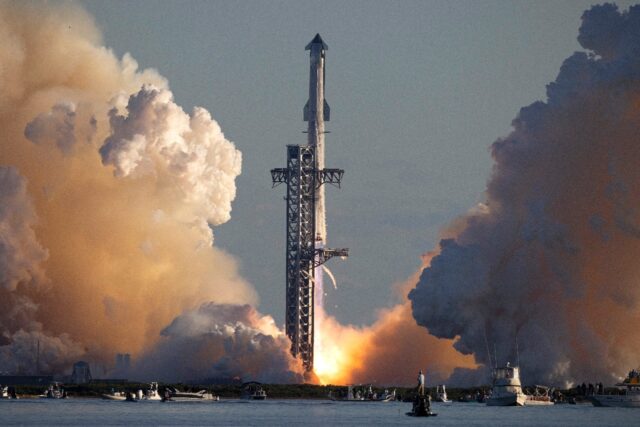

The Trump administration authorized Elon Musk’s SpaceX on Wednesday to launch up to one million satellites as part of its plan to build data centers in space, raising concerns from some experts.
The US Federal Communications Commission (FCC) said SpaceX’s Starmind constellation would “process massive amounts of data to be used back here on Earth.”
The company’s authorization runs until 2040, according to a document published on the FCC’s website.
“America is leading the world into the era of super intelligence,” FCC Chairman Brendan Carr said in a statement, using Trump’s moniker for artificial intelligence.
He added that data centers would be “essential to sustaining America’s leadership in SI.”
Projects for orbiting data centers have multiplied over the past year.
Alongside SpaceX and its Starmind constellation, Google is pursuing its own initiative under the codename “Suncatcher,” while Jeff Bezos’s Blue Origin has submitted an application to the FCC for its “Project Sunrise.”
Several startups are also in the race, including Starcloud, which successfully operated an advanced processor known as a GPU aboard a satellite in late 2025. Google also reached that milestone in October.
SpaceX has the advantage of having its own rockets that have already completed hundreds of missions.
In August, Musk promised a first SpaceX satellite launch into orbit in the fourth quarter of 2027 and a ramp-up in 2028.
The company has struck a deal with Nvidia, which will supply its latest-generation Vera Rubin processors, specially designed to operate in space.
‘Disheartened and dismayed’
Most space-based data center projects have a similar architecture: a constellation of satellites in low Earth orbit (LEO), positioned close together to ensure reliable connections between them.
Starmind’s satellites will communicate with those already in orbit as part of SpaceX’s Starlink satellite internet network, which will then relay the data to Earth.
Other competing networks plan to receive data directly from Earth and send it back using lasers.
But experts have warned of technical obstacles, as well as environmental concerns.
Unresolved technical challenges include processors’ ability to withstand the high levels of radiation in space.
Observers also point to the difficulty of withstanding extreme temperatures or avoiding damage from space debris and micrometeorites.
The American Astronomical Society (AAS) said it was “disheartened and dismayed” by Wednesday’s decision.
“The proposed constellation would significantly undermine decades of federal investment in astronomical facilities and the ability of astronomers and the public to enjoy and study the night sky,” the AAS said in a statement.
It noted that the constellation “involves larger (and therefore brighter) and more numerous objects,” meaning the satellites would “be visible as extremely bright objects for longer periods in the night sky.”
“Drastically expanding satellites in space has a direct impact on people’s everyday lives as well as the future of our planet,” Jan Hasselman, a senior attorney at the nonprofit group Earthjustice, said in a statement.
There are, however, numerous advantages to locating a data center in space over building one on Earth.
Among those, a satellite in what is known as a sun-synchronous orbit can capture solar energy continuously and with eight times the efficiency of its ground-based equivalent.
SpaceX made its stock market debut in June, raising about $85.7 billion.
COMMENTS
Please let us know if you're having issues with commenting.