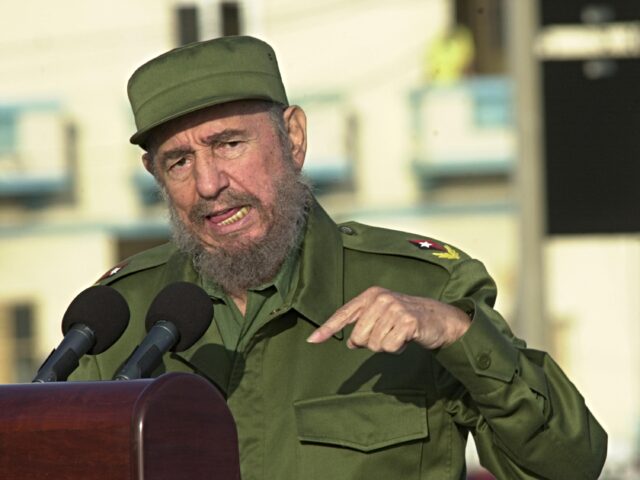

- Cubans around the world mark ten years since the announcement of Fidel Castro’s death this week.
- Castro led a ruthless and widely hated communist regime that remains in power today through his brother, Raúl.
- While the regime firmly holds on to authority, it has lost many of its most strategic friends around the world, most notably the socialist regime in Venezuela.
The millions of victims of communist dictator Fidel Castro celebrated the tenth anniversary of the announcement of his death on Wednesday.
While the island itself remains mired in poverty, oppression, and misery – the direct result of Castro’s vision for his people – the Communist Party attempted to put on a brave face to its current international situation, in which it finds itself with fewer potent allies than ever and facing down a growing number of states in the free world willing to speak up against the Party’s horrors. A decade later, the loss of former Venezuelan dictator Nicolás Maduro to a Brooklyn prison has left Cuba without a critical lifeline of free or highly discounted oil to fuel the generators that masked its inability to maintain a functional power grid.
Russia and China, the Castro regime’s most formidable allies, have failed to step into the Venezuela void, leaving Cuba to fend for itself while they struggle to address their own challenges at home. Leftist celebrities such as the Code Pink leadership and video game personality Hasan Piker cared enough about Cuba to vacation there – and not much else. Even Congressional Democrats scolded Cuba this week for its woeful human rights abuses, rather than sticking to their usual approach of condemning Americans who notice the human rights abuses.
At the United Nations, an annual vote to condemn the United States for choosing not to do business with Cuba received less support than ever and countries such as Ukraine have stepped up to support Cuban dissidents and the exile community.
Fidel Castro seized power in Cuba in a coup in January 1959, at age 32, after the island’s legitimate ruler Fulgenio Batista decided to abandon it. He had never before won and election and, due to banning any democratic activity on the island, would go on to never win an election in his life. He died in disgrace, remembered for his mass killings, his mass imprisonment and enslavement of Christians and gay people, his support of anti-American terrorists around the world, and his lavish estate, estimated to have been worth around $900 million at the time of his death.
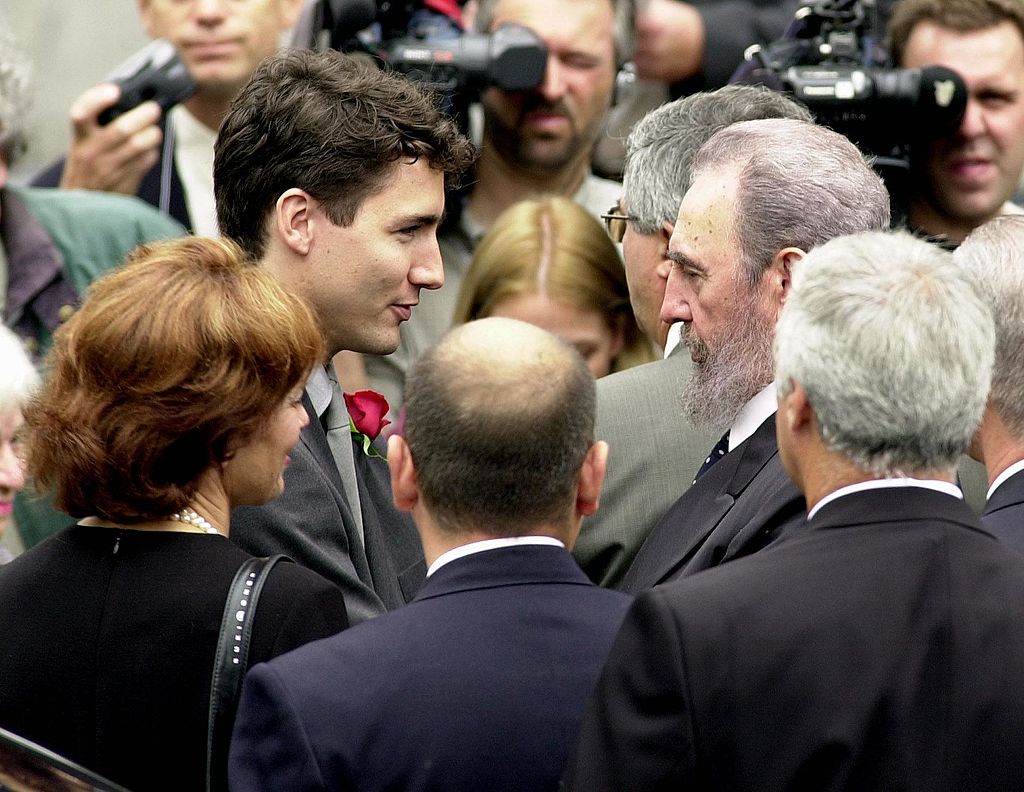
Cuban President Fidel Castro (2ndR) greets Justin Trudeau (2ndL), the son of former Canadian Prime Minister Pierre Trudeau, after arriving at the Notre Dame Basilica for Trudeau’s state funeral 03 October 2000. (ROBERTO SCHMIDT/AFP via Getty Images)
Despite the widespread disgust with Castro and his communist rule on the island, in 2016, none dared challenge the state-mandated mourning status imposed on the populace. Only one person on the island – the graphic artist Danilo “El Sexto” Maldonado Machado, took the streets on the night of the 26th to celebrate, encouraging passersby to cheer Fidel’s death and leaving graffiti in Havana reading, simply, “he left.” El Sexto was arrested almost immediately while streaming his celebrations on Facebook Live and went on to serve two months in one of Cuba’s most notorious prisons for the outburst. He then went on to seek asylum in the United States, where he has continued his artistic career.
“El Sexto” is one of potentially nearly 3 million Cubans to chose to seek his future elsewhere in the aftermath of Castro’s death. Estimates of the true size of the exodus remain unclear due to the secretive nature of the regime but, according to the Council on Foreign Relations, between 1.6 to 2.75 million Cubans left the island from 2020 to 2026 alone. The island they left behind looks very much today like it did during Fidel Castro’s time. His family still maintains a stranglehold on power, even after Raúl Castro’s 2018 head-fake “retirement.”
Some of what were once the most iconic buildings in the national capital have either collapsed or are in the process of doing so, threatening the lives of their unfortunate residents, with no significant government action to save them. Outside the capital, any access to electricity is a luxury. The destitute Cuban healthcare system is in shambles, as it has been for decades, but international leftists are now actually admitting it rather than holding it up as an example to the world.
The Castro regime was able to hide the country’s impoverished state from those who did not wish to see for decades thanks in large part to its friends in high places: allies such as Maduro and other leftists in the region, fair-weather friends such as Russia and China, European countries whose residents enjoyed cheap tropical vacations, and the bureaucrats at the United Nations. Post-Fidel, the international panorama has changed dramatically. The European Union, for example, has limited its previously cozy relationship with Havana as Ukraine documented evidence of a mass recruitment effort on Russia’s behalf to ship as many as 20,000 Cuban mercenaries to the front lines of the ongoing invasion. Ukraine itself was once home to a Cuban embassy and is now a reliable voice against the regime at the U.N.
In the General Assembly, the Castro regime suffered its worst diplomatic loss in years in October, when only 130 supported a resolution to condemn the alleged American “embargo.” For comparison, that number in 2025 was 165 countries, and a year prior up to 187. The number of countries that voted against the resolution, rather than merely abstaining from the vote, also increased, including Latin American such as Argentina and Colombia that previously supported the effort. The list of abstaining countries was even larger.
Castro’s family itself has not escaped scrutiny. Raúl Castro was indicted on murder charges in Florida in October for his role in the Brothers to the Rescue murders, in which four Americans were killed trying to save drowning refugees in 1995. Just two days ago, Chile approved a measure to establish an international court to prosecute the Castro regime for crimes against humanity, an infraction considered so heinous that it merits universal jurisdiction, meaning any court can process it.
Cuban exile activists and dissidents in the country have asserted throughout this year that the Castro regime is closer to falling than ever. Whether that is true remains to be seen, and the persistence of regimes such as those in China, Zimbabwe, and Cameroon offer little hope. But what is true is that the international pillars that supported Fidel Castro have failed to support Raúl and the bloody family business has fewer friends than ever.
COMMENTS
Please let us know if you're having issues with commenting.