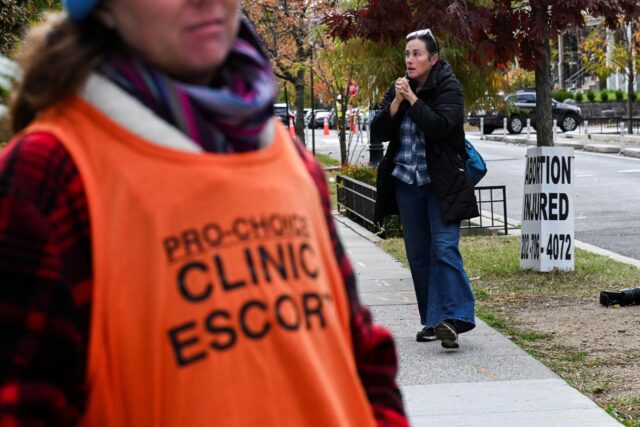

Just steps from the coffee shops of Union Market, one of the US capital’s trendiest neighborhoods, two Americas faced off on a stretch of sidewalk.
On one side, volunteers escorted patients to a clinic that performs abortions. On the other, conservative activists tried to persuade them to turn back.
The sidewalk standoff represents a microcosm of America’s bitter battle over abortion, which has only heightened since the Supreme Court’s 2022 decision overturning the nationwide right to the procedure.
On this chilly November afternoon, Robyn Swirling, 40, scanned the street leading to the Carol Whitehill Moses Planned Parenthood clinic. Her orange vest read: “clinic escort.”
“Patients often arrive anxious, sometimes after a long drive,” said Swirling, her knit hat pulled down over her ears and a thermos in hand.
“Our role is to provide a peaceful and reassuring presence and help them safely enter healthcare clinics without being delayed, intimidated or harassed by anti-choice protesters.”
The organization, which has around 70 volunteers, works at the request of clinics outside seven facilities in Washington, Maryland and Virginia. Similar groups exist across the country.
Since the Supreme Court struck down buffer zones protecting the areas around clinics on free speech grounds in 2014, the two sides have stood shoulder to shoulder, even in the famously liberal US capital.
Joseph, a 40-year-old who only provided a first name, came from Virginia specifically to protest against abortion.
“There’s still time to change your mind!” he yelled from the sidewalk toward a partly open clinic window.
Shoulder to shoulder
A young woman suddenly stepped out of a car, her scarf pulled up to her nose.
“May I pray for you?” called out William Campbell, a 24-year-old Christian missionary holding an anti-abortion leaflet.
“You’re killing a child!” shouted a woman in her 30s, as around 20 activists sang mournful hymns, rosaries in hand.
“Stay behind me. I’ll walk with you,” a volunteer said quietly, immediately stepping in to shield her.
Without a word, her eyes glistening, the young woman disappeared through the clinic’s glass doors. Everyone returned to their place, waiting for the next patient.
Such interactions generally last only a few seconds, but can be harrowing for both the women and volunteers.
Richard Huffman, an abortion advocate who has been volunteering for 16 years, said he had a vivid memory a young woman who “came out and was crying and said, ‘I can’t do this.’ And that was her decision.”
“I didn’t know what questions to ask. I tried to help her as best I could… I mean, I was in tears too after she left,” he said.
Huffman said he had given up debating with abortion opponents after hearing the same arguments for years. His organization advises members to avoid confrontation, but tensions regularly mount between the two opposing camps.
Swirling said she had seen applications flood in when the Supreme Court ended federal protections for abortion rights in 2022, leaving the decision to each state.
“For two years, we had more volunteers than we needed,” she said.
“”In a city like Washington, it’s important to be boots on the ground and in direct contact with the people these policies actually concern,” she added.
Standing outside the clinic door, Nora, 35, said she hoped sweeping Democratic victories in the November midterm elections will translate into more protections for abortion rights.
Her mother escorted patients outside clinics in North Carolina in the 1980s.
“It’s been 40 years and we’re doing the same volunteer job, and not much has changed,” she said.
COMMENTS
Please let us know if you're having issues with commenting.