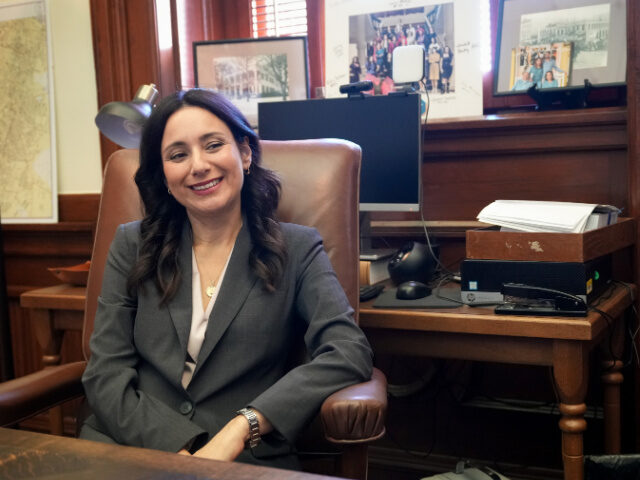

Texas Governor-elect Gina Hinojosa (D) is seeking to eliminate the state’s $1 billion school voucher program and reverse several education policies enacted under outgoing Republican Gov. Greg Abbott, despite warnings from national education researchers that dismantling certain reforms could undermine efforts to improve student achievement.
According to a November 18 report from the Marshall News Messenger, the Houston Chronicle interviewed eight national education researchers, most of whom cautioned against repealing or significantly restricting many of the education policies implemented during Abbott’s administration, including measures related to academic accountability and teacher compensation. Researchers offered mixed assessments of state intervention in struggling school districts.
“What’s making people nervous, I think, is whether that commitment to student outcomes is going to stay,” Marguerite Roza, director of Georgetown University’s Edunomics Lab, told the Chronicle.
Hinojosa has pledged to pause Texas’s A-F school accountability ratings, which evaluate the academic performance of schools and districts, although existing state law appears to prevent her from doing so.
Lori Taylor, a Texas A&M University professor, acknowledged flaws in the grading methodology but emphasized the importance of measuring student achievement.
“You can’t cure the patient if you’re taking away the thermometers,” Taylor said. “You have to have some measure of achievement.”
Hinojosa has also called for ending the State of Texas Assessments of Academic Readiness (STAAR), the annual standardized testing system used to evaluate students. Although Texas lawmakers passed legislation last year to replace the tests, Hinojosa opposed that replacement and has said she wants a “fairer” assessment system without specifying precisely how it would operate.
“I think that it would be a major mistake to substantially uproot statewide testing without a clear plan of how we are going to efficiently and accurately assess what students know and are able to do,” Matthew Kraft, an education professor at Brown University, told the Chronicle.
Researchers also praised the Teacher Incentive Allotment, an Abbott-backed initiative that provides funding to increase compensation for effective and high-performing teachers, with additional incentives for educators working in schools serving lower-income communities.
Texas Tech University professor Jacob Kirksey, who has studied the initiative, pointed to its results in participating school districts.
“It’s improved student achievement statewide for those participating districts,” Kirksey said.
Hinojosa, however, has advocated broader teacher raises rather than tying compensation to student performance.
“We need teacher compensation, real teacher compensation, not just more money into a performance pay program that requires our teachers jump through more hoops to get more pay,” Hinojosa told the Chronicle. “Teachers do a lot. Teachers do too much, actually.”
The governor-elect has also pledged to end state takeovers of struggling school districts. Under existing Texas law, the state must assume control of a district or close a failing school when a campus receives five consecutive failing accountability ratings.
Morath has described the state’s 2023 takeover of Houston Independent School District as one of the greatest turnarounds in American history, citing an increase from 39 percent to 51 percent in the share of the district’s approximately 170,000 students meeting grade-level expectations in reading and mathematics.
Researchers said the district’s emphasis on struggling schools and higher teacher compensation appeared to be producing improvements, although it remains too early to draw definitive conclusions about the intervention’s effectiveness.
Some Houston-area Democrat lawmakers, including incoming Texas House Speaker Senfronia Thompson, have also acknowledged improvements in schools following the takeover.
However, the researchers’ assessments were not uniformly supportive of Abbott’s policies.
Dominique Baker, an associate professor at the University of Delaware, pointed to more than 1,000 teachers who resigned or retired from Fort Worth ISD this year following the announcement of a state takeover.
“I don’t know that that would be considered a success,” Baker said.
David DeMatthews, a University of Texas professor and former school administrator, argued that changes to the state’s accountability system made it difficult to determine whether Morath’s policies were improving student outcomes. He also cited broader challenges, including approximately 42,000 uncertified teachers working in Texas classrooms.
“If we want to have a high-quality system, it’s not about the little boutique programs or some incentives,” DeMatthews said. “It’s about broad, sustainable long-term investment, and Texas hasn’t done it.”
Several researchers acknowledged mixed evidence regarding the long-term effectiveness of state takeovers, while others did not weigh in on school vouchers or Christian-related content in public school curricula.
“I think it will be tremendously interesting to follow what happens in Texas,” said Dan Goldhaber, a professor at the University of Washington. “There’s no other state that I know of that is intervening the way that Texas is intervening in the way schools and districts operate.”
As Breitbart News reported November 7, Hinojosa’s plans to reverse Abbott’s education agenda include eliminating the state’s $1 billion school voucher program, which the Republican governor established through legislation signed in May 2025.
“Gone are the days that families are limited to only the school assigned by government. The day has arrived that empowers parents to chose the school that is best for their child,” Abbott said when signing the legislation.
According to ProPublica, the program launched this year, allowing approximately 110,000 of Texas’s more than five million schoolchildren to use taxpayer dollars toward private education.
According to ProPublica, State Rep. Diego Bernal (D-San Antonio), vice chair of the Texas House education committee, said some Republican colleagues had privately expressed reservations about the voucher program but were limited in what they could do because of pressure from leaders who have since been ousted.
“I guarantee that program is not going to be untouched, and it will be probably unrecognizable, if not extinct, by the time we’re done with it,” Bernal said.
ProPublica also reported that Hinojosa intends to remove Morath as Texas education commissioner.
A January 2025 poll found dissatisfaction with the existing education system and support for parental empowerment and school choice. According to The Heritage Foundation, the number of K-12 students benefiting from private school choice nationwide more than doubled between 2020 and 2025, rising from fewer than 600,000 to 1.2 million. Interest in school choice also increased following the COVID-19 pandemic amid concerns over academic performance, curriculum content, and parental involvement. President Donald Trump signed an executive order supporting school choice and parental empowerment in January 2025.
Hinojosa defeated Abbott in the November 3 gubernatorial election, marking the first time Texas will have a Democrat administration since 1995. The Associated Press called the race shortly after 9:15 p.m. Central Time, and NBC News reported Hinojosa leading with more than 56 percent of the vote compared with Abbott’s 42 percent, with nearly 70 percent of ballots counted. Abbott, who has served as governor for more than a decade, conceded the election and pledged to assist Hinojosa’s transition, while Hinojosa promised to earn the responsibility of serving all Texans, regardless of whether they supported her candidacy.
COMMENTS
Please let us know if you're having issues with commenting.