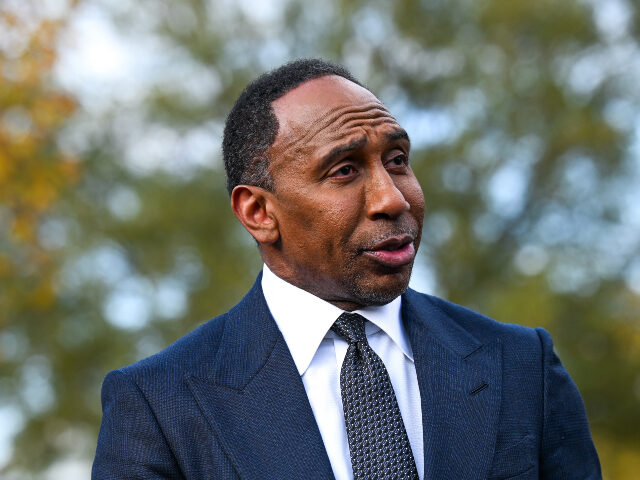

Black Americans must realize they may be sidelined by the growing clout of confident Latinos in the Democrat coalition, sports journalist Stephen Smith told an audience in a D.C. barbershop.
“I’m worried about the same arrogance from the Democratic Party that I saw in the past,” Smith said, addressing the Democratic Party:
We won the House. We won the Senate. We’re in control. Okay. So you’re gonna address affordability? You’re gonna address inflation? You’re going to address the economy? You’re going to address employment? You’re going to address safety in the streets? You’re going to do all of that? What are we going to do about stuff like that?
Oh, by the way, I’m on the record. I firmly believe immigration is about securing a voting bloc.
Democrats — including likely House Speaker Rep. Hakeem Jeffries (D-NY) — are now undermining their affordability promises as they push to award amnesty to millions of wage-cutting Latino migrants. The push could also import many more “cheap labor” Latinos via worker pipelines.
The sports personality continued:
You [Democrats] secure that [Latino] voting bloc, you don’t need the black vote because you got enough Latinos, you got enough Hispanics in this world where you’re securing the vote. What are you going to need from us? You’ll take our vote, 13.6 percent of the population. But in the end, if you don’t need us, hell, you wasn’t giving us enough when you did need us!
So what you gonna do if more migrants cross the border illegally, but you enable them to be able to vote?
In the 2027 Congress, Latino activists expect the Hispanic caucus on Capitol Hill to be larger than 50 members, up from 43 in 2025. The black caucus will grow from 62 in 2026 to 69 in 2027.
Black Americans lost wages and political power under President Joe Biden’s migration-fueled economic strategy. But they gained wages and cheaper housing under President Donald Trump’s lower-migration policies.
In 2032, after the 2030 census, the growing Latino population will also almost surely win more congressional seats, including several now held by black politicians. This pending shift is marked by the growing Latino populations in what were once majority-black districts.
“There’s an issue called apportionment in government,” Smith told his audience in the barber shop on November 18:
When the Census Bureau comes, and they take numbers, what they do is they count the number of bodies in their state. That dictates how much money you get from the government, and how many seats you occupy in the House of Representatives. That’s why California has more electoral votes than, say Texas, than, say New York, than, say Chicago.
The point that I’m trying to make is that if you see that, it comes down to a simple issue: follow the money … The more people that come in, the more money that you get. The more money you get, the more seats you get. So not only you getting money, you getting power because you’re able to have more votes.
Well, if you got that going on, and it’s coming courtesy of migrants crossing the border, how much you gonna need us? And if you don’t need us, how much are you gonna cater to us? If you’re not gonna cater to us, what do we get? …
For many years, the Congressional Black Caucus has kept a very low profile on immigration debates, likely to avoid public conflicts with black Americans and private conflicts with the Tri-Caucus of black, Latino and Asian legislators.
But in 2022, Rep. Yvette Clarke (D-NY), chair of the Black Caucus immigration task force, helped sink a huge white-collar migration bill, though she provided minimal explanation. “I cannot support efforts that would perpetuate the current inequities in our immigration system,” she wrote.
Black legislators have a quiet incentive to welcome more migrant blacks — including Haitians — to bulk up their districts amid the influx of Latinos to other districts. “I need more people in my district, just for redistricting purposes and those members could clearly fit here,” Clarke said in 2021.
A few polls — and many videos — show that many working-class black Americans — like many other Americans — can be generally hostile to migration — including the refugee inflow — and also towards migrants for ordinary economic reasons. The conflicts are often sharpest in workplaces.
The suspicion of Latinos does not necessarily mean sympathy with white Americans.
In the run-up to the Senate election in Michigan, there was much coverage of potential splits between black voters and Abdulrahman Mohamed Al-Sayed. But he won roughly 87 percent of the black vote, despite his support for more migration.
Nationwide, 87 percent of black men and 93 percent of black women voted for Democrat candidates amid intense pressure from black leaders, including former President Barack Obama.
Some black Americans are declaring solidarity with other Americans rather than non-white minorities:
Smith has been slammed by the Democrats’ black leadership for speaking sympathetically about Trump’s low-migration agenda — and for questioning the party’s use of migration to expand its power.
His response:
What’s wrong with us asking? They’re getting on me for asking, and I’m looking at brothers and sisters, and I’m like, when have we had a problem asking a question?
Let somebody walk up to any of y’all right now and tell y’all y’all can’t ask a question, and let me see how y’all act towards them.
“That’s what they’re trying to do to me, and I ain’t going for it — and that’s what it’s all about,” he added.
COMMENTS
Please let us know if you're having issues with commenting.