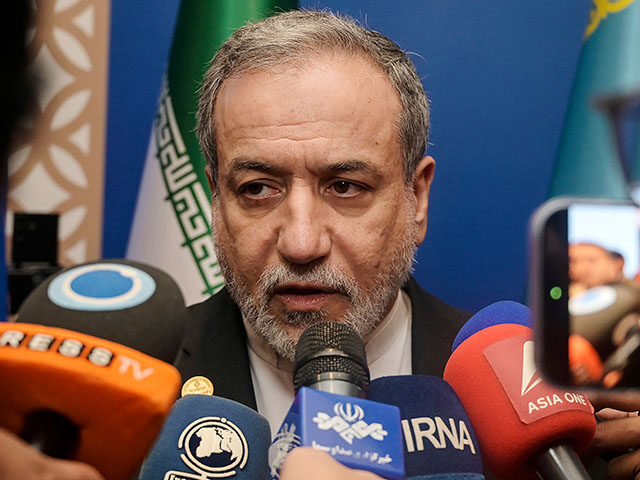

- Iranian Foreign Minister Abbas Araghchi condemned “foreign interference” in the Middle East in discussions with Oman.
- While interpreted to be a comment against the U.S. presence in the region, the timing followed a meeting between President Donald Trump, Chinese dictator Xi Jinping, and Russian strongman Vladimir Putin.
- China, Russia, and America signed a joint declaration calling for stable oil flows and nuclear nonproliferation, targeting Iranian interests.
The foreign minister of Iran issued an aggrieved condemnation of “foreign interference” Thursday as the leaders of China, Russia, and America concluded a historic trilateral meeting addressing some of Iran’s top foreign policy concerns.
Foreign Minister Abbas Araghchi made his comments in the context of a visit to neighboring Oman, with whom Tehran shares control of the vital Strait of Hormuz maritime passageway. He did not mention the trilateral summit in Shenzhen, China, or specifically condemn American interference in the Middle East. President Donald Trump, Chinese dictator Xi Jinping, and Russian strongman Vladimir Putin used their meeting to address their opposition to nuclear proliferation and support for “stable” energy flows, but also omitted any direct mention of Iran or the conflict between Iran and the United States, which has severely disrupted commercial shipping in the Strait of Hormuz, a major oil and natural gas transit corridor. The timing of Araghchi’s statement, however, suggested it is directed not just at Washington, but at Iran’s nominal allies in Beijing and Moscow.
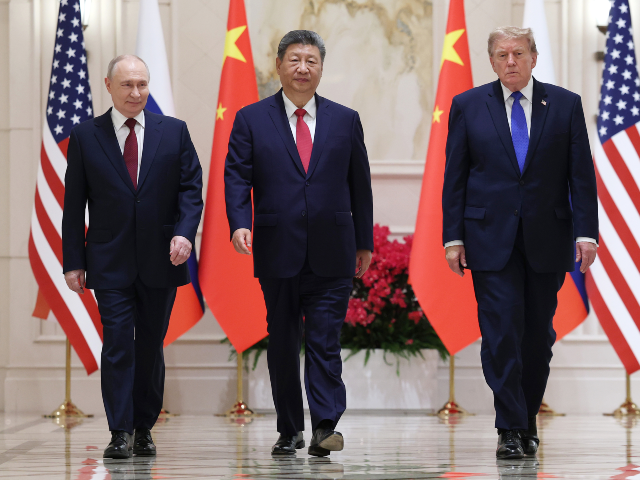
President Donald Trump, right, Chinese leader Xi Jinping, center, and Russian leader Vladimir Putin arrive for a trilateral meeting at Kylin Villa Thursday, November 19, 2026, in Shenzhen, China. (Win McNamee/Pool Photo via AP)
The meeting in Shenzhen occurred on the sidelines of the Asia-Pacific Economic Cooperation (APEC) summit, which brings together Pacific Ocean countries to primarily discuss trade. It was the first time that the heads of state of China, Russia, and America met in such a context. While their joint declaration did not contain any concrete commitments or calls to action, it created a framework for cooperation among three countries that rarely openly embrace aligned interests.
Araghchi’s diplomacy in Oman, according to the state-run Islamic Republic News Agency (IRNA), was intended to strengthen ties with its U.S.-friendly neighbor. Araghchi did condemn the United States, claiming in local media that he discussed with Omani diplomats the danger of “American aggression,” but those comments appeared to address a separate topic than alleged “foreign interference.”
“We had constructive discussions in this regard. Across the region, there is a growing belief, stronger than ever before, that security must be ensured from within the region itself, without interference from foreign powers,” Araghchi was quoted as saying.
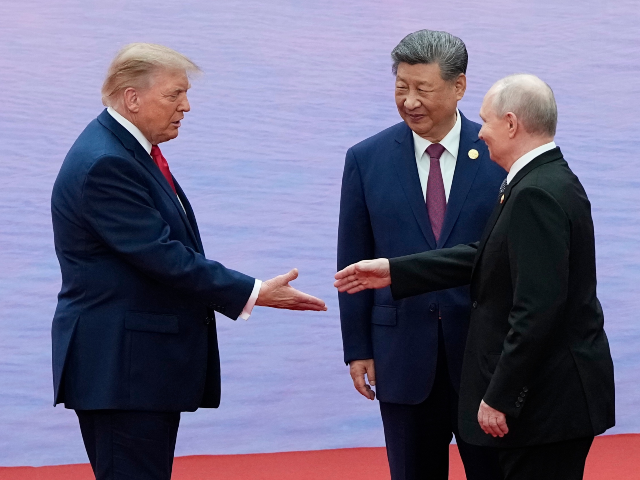
China’s Xi Jinping stands as U.S. President Donald Trump, left, and Russia’s Vladimir Putin shake hands before the welcome banquet at the Asia-Pacific Economic Cooperation (APEC) summit in Shenzhen, Guangdong province, China, on Wednesday November 18, 2026. (Iori Sagisawa/Pool via AP)
IRNA added that Araghchi used his time in Oman to try to convince that government to help Iranian efforts to “establish a new and independent security framework” in the Middle East.
Iran-friendly media appear to be downplaying the significance of the trilateral summit following the issuance of the joint declaration Thursday. The pro-Iran Al Mayadeen outlet, for example, emphasized the outcome of the American midterm elections in its coverage of the APEC summit, claiming that Trump entered the talks “weakened.”
“While presidents have greater room to maneuver in foreign policy, Trump will still need congressional support on domestic priorities,” Al Mayadeen suggested.
The regime-friendly Tasnim News Agency chose instead to highlight on Sunday China’s and Russia’s apparent support at the International Atomic Energy Agency (IAEA), the United Nations nuclear body. The Russian and Chinese representatives at the forum reportedly proclaimed their support for Iran’s stance against IAEA inspections of its nuclear sites before a definitive end to conflict with the United States, which is currently fueled by the American need to target Iranian missile launchers and drones to prevent ongoing attacks on neighbors such as Bahrain and Qatar.
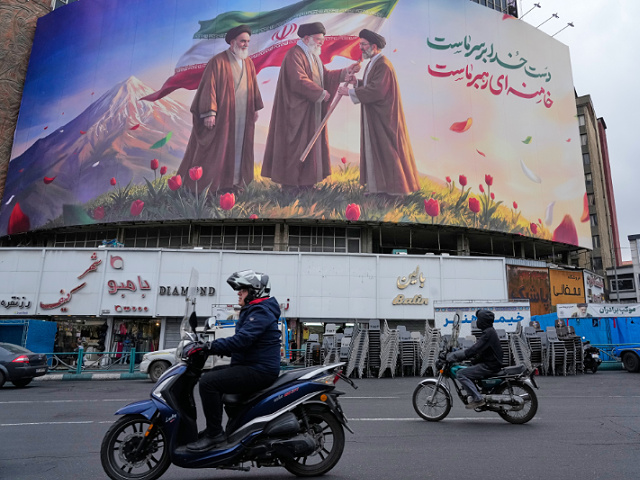
Motorbikes drive past a billboard depicting Iran’s late Supreme Leader Ayatollah Ali Khamenei, center, handing the country’s flag to his son and successor, Ayatollah Mojtaba Khamenei, right, as the late revolutionary founder Ayatollah Ruhollah Khomeini stands at left, in a square in downtown Tehran, Iran, March 10, 2026. (AP Photo/Vahid Salemi)
“Unconditional insistence on normal implementation of safeguards at those facilities (Iran’s nuclear installations), without due regard for the objective impediments arising from the acts of aggression and persisting threat of the use of force, is not conducive to the full resumption of agency’s verification activities in Iran,” the Russia-China-Iran IAEA statement reportedly read.
The IAEA action does not contradict the text in the American-Chinese-Russian joint declaration, however, and notably was not the product of direct collaboration among the countries’ three heads of state. The Shenzhen joint declaration issues a categorical rejection of nuclear proliferation.
“The three heads of state reaffirmed that a nuclear war cannot be won and must never be fought. The three countries will conduct a dialogue on reducing nuclear risks and preventing the proliferation of nuclear weapons,” the declaration read.
On the issue of disruptions of oil flows, the parties agreed: “The three countries plan to increase the production and supply of refined petroleum products for the benefit of all nations. They reaffirmed the importance of stable energy flows.”
The choice to address those two issues highlights not just Washington’s disputes with Iran, but China’s repeated opposition to the Strait of Hormuz disruptions. Xi himself has used his voice to oppose Iranian interference in oil flows, as China is the largest buyer of Middle Eastern oil. In a call with Saudi Crown Prince Mohammed bin Salman in April, Xi reportedly asserted that “the Strait of Hormuz should maintain normal passage, as this serves the common interests of regional countries and the international community.”
COMMENTS
Please let us know if you're having issues with commenting.