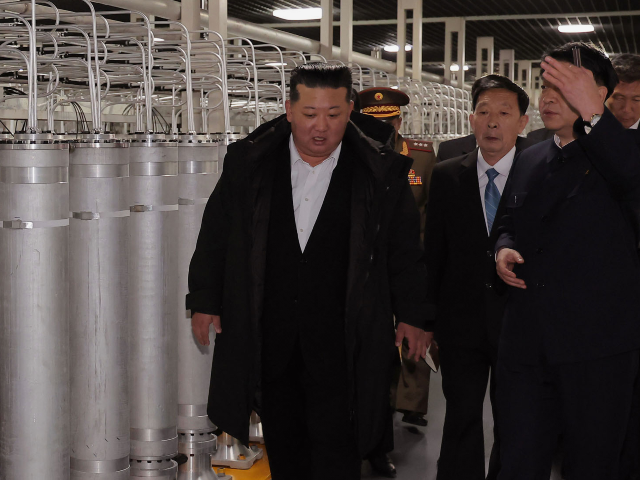

- Kim Jong-un visited an allegedly new nuclear materials production factory on Wednesday, North Korean state media reported.
- The report did not reveal which site he had toured, but recent reports suggest North Korea has expanded facilities at the Yongbyon nuclear complex.
- Kim emphasized that his country will continue to build nuclear weapons, but will not “abuse” them.
North Korean state media reported on Thursday that communist dictator Kim Jong-un had spent the prior day overseeing the production of material for nuclear weapons, stating that he emphasized the need for his country to generate more nuclear weapons.
The regime-run Korean Central News Agency (KCNA) described Kim as visiting a nuclear material production facility and a “nuclear weapons institute.” The reporting did not state which facility in the country Kim had visited or exactly what kind of nuclear material was being produced there. The report, however, followed the publication of satellite images showing an expansion of facilities at the Yongbyon Nuclear Complex, which North Korea uses to enrich uranium, and expressions of concern from the head of the U.N. nuclear oversight agency about North Korea’s development. International Atomic Energy Agency (IAEA) Director-General Rafael Grossi lamented that the communist regime appeared to be expanding the production of fissile material for explicitly military purposes, violating international law.
According to KCNA, Kim ordered his underlings to “consolidate the nuclear posture of the country in every way by further accelerating the exponential updating of the self-defensive nuclear capabilities.” He insisted this was necessary due to “the enemy” — presumably America, South Korea, and Japan — posing a growing threat to Pyongyang. He did not substantiate exactly how the current American foreign policy, which has been largely focused on the Middle East, has prompted the alleged need for more nuclear weapons.
“Referring to the recent intolerable moves of the enemy states which are highly developing the nuclear capabilities,” KCNA shared, “he [Kim] noted that our military leadership is taking a serious note of the fact that the U.S. has incited its vassal states in the vicinity of our country to the possession of nuclear-powered submarines.” Kim reportedly complained in particular about negotiations with Australia through “AUKUS,” the trilateral coalition also including Britain.
Kim also declared it a “reality” that “the international nuclear non-proliferation system has collapsed” and that “the danger of using nukes is increasing day by day due to the enemies’ moves to gradually facilitate the nuclear technology transfer and access to nuclear weapons.” North Korea, the dictator insisted, faced “a greave threat” through this alleged collapse.
The dictator reportedly celebrated the opening of a “newly-built important materials production factory” and promised to continue down the path of rogue nuclear weapons development.
“Strengthening our capability for defending the national sovereignty, interests and people cannot constitute a provocation, and abusing it as a provocation by the enemy states is a real provocation and a major threat that should be countered and eliminated at any cost,” Kim reportedly said, adding a promise to “never abuse” nuclear state status.
The reporting did not mention Yongbyon, but the site is a likely candidate for the development of a “newly-built important materials production factory.” On November 19, the Institute for Science and International Security (ISIS) published satellite images of Yongbyon revealing the construction of new facilities. The institute’s experts suggested the new facilities were meant to either produce low-grade enriched uranium for civilian energy use, or weapons-grade uranium. ISIS argued that the latter appeared more possible as North Korea had already invested in the construction of large sites for low-grade enriched uranium.
IAEA chief Grossi warned in remarks to the IAEA Board of Governors on November 18 that his agency was aware of the Yongbyon expansion but unable to fully assess the situation there.
“Since mid-September 2026, a further extension to the original Yongbyon enrichment facility has been under construction with the new extension externally complete by late-October 2026,” Grossi explained. “The ongoing expansion of the DPRK’s uranium enrichment programme remains a cause for serious concern.”
Kim has been unapologetic, as have his predecessors, about building nuclear weapons, even as the United Nations and international legal institutions call for an end to the proliferation of such weapons. While entertaining the notion of “denuclearization” in theory during President Donald Trump’s first term, by 2023, Kim was loudly calling for North Korea to “exponentially” increase the size of its nuclear weapons arsenal.
“Now that the south [sic] Korean puppet forces who designated the DPRK [North Korea] as their ‘principal army’ and openly trumpet about ‘preparations for war’ have assumed our undoubted enemy,” Kim was quoted as saying at the time, “it highlights the importance and necessity of a mass-producing of tactical nuclear weapons and calls for an exponential increase of the country’s nuclear arsenal.”
North Korea is believed to currently possess material for about 50 nuclear warheads, though the secrecy of its nuclear program makes confirmation of that estimate impossible.
COMMENTS
Please let us know if you're having issues with commenting.