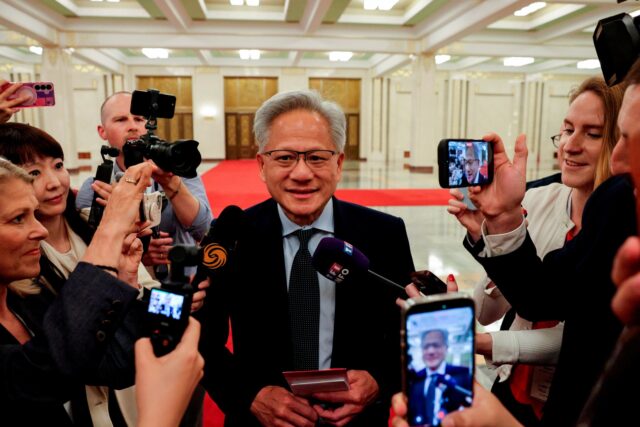

Nvidia CEO Jensen Huang’s reinstatement despite allegations of misconduct is raising concerns about a culture of impunity for the rich and powerful.
NEW YORK (AP) — Just over a year ago, the chief executive officer of an Ohio tech company was forced to resign when he was caught on video embracing an employee at a Coldplay concert. The CEO of McDonald’s was among several pushed out over a consensual relationship at the height of the #MeToo movement.
Now the stunning reinstatement of Nvidia CEO Jensen Huang despite similar allegations of sexual misconduct is fueling fears of a resurgence of impunity for the rich and powerful.
Huang resigned from Nvidia after he admitted to having an extramarital affair with a woman suspected of being a Chinese spy, and following reports that he was involved with a second woman who was his subordinate. Huang has acknowledged that he violated the company’s code of conduct, which warns against personal relationships that may create conflicts of interest.
But in an extraordinary turnaround following a pressure campaign from Huang’s tech allies and President Donald Trump, Nvidia’s board voted unanimously Monday to reinstate him. The board said it had received assurances from the U.S. government that Huang was not a national security concern, but there was no mention of the sexual misconduct allegations at the center of the scandal.
Trump, however, did address Huang’s personal conduct
The president, who has a history of marital infidelity and has faced allegations of sexual assault he says are false, predicted the scandal would only help Huang’s reputation.
“Sex sells, fellas,” Trump declared in an interview on CNBC.
He also posted a doctored image of Huang raising a red bra in triumph, a pose that parodied a famous photograph of Trump himself moments after he survived a 2024 assassination attempt in Butler, Pennsylvania.
The White House did not immediately respond to a request by The Associated Press for comment Wednesday.
‘Horrible message to men everywhere’
Trump’s response reinforces the impression “that there is a class of men who see violence against women, coercion of women as a currency of power,” said Cheyenne Hunt, an attorney who founded the advocacy group Reckoning Action after her role in bringing to light the sexual assault allegations that brought down Democratic Sen. Eric Swalwell and Maine Senate candidate Graham Platner.
“This sends a horrible message to men everywhere that it’s open season on their direct reports,” Hunt said.
Randall Peterson, a professor of organizational behavior at the London Business School, said the #MeToo movement had reinforced the idea that company leaders who engage in relationships with subordinates “are in serious trouble because you cannot rule out coercion. You just cannot.”
Peterson said the messaging now is that “you are at risk, as in the days before #MeToo.”
“I’m sad about that,” he said. “I thought we had moved on from that.”
An apologetic but jubilant comeback
Huang, for his part, apologized to his employees a day after returning to Nvidia, saying he had made mistakes and was in daily therapy, according to a livestreamed meeting reviewed by The New York Times. He also warned that his reinstatement didn’t mean other employees could violate the company’s code of conduct, saying that “sometimes, it’s appropriate to forgive” and “sometimes it’s not.”
He also addressed a report by The Times about his management style that included publicly berating and threatening violence against employees. He acknowledged he had sometimes gone too far and promised that the company’s human resources department would henceforth collect feedback about his conduct.
The saga, however, has “made very clear that Huang is untouchable,” said Ann Lipton, a University of Colorado Boulder law professor who specializes in corporate and securities law.
“It suggests that if you’ve had a certain amount of success, then you should be able to get away with pretty much whatever you want,” Lipton said.
That’s especially true in the male-dominated tech industry, she added, citing Meta founder Mark Zuckerberg’s comment last year that corporate culture needed more “masculine energy.”
The Nvidia scandal has brought scrutiny to the independence of its 10-member board and a corporate culture centered around hero-worshiping its celebrity CEO.
Thousands of people, including former and current employees, had signed a petition calling for Huang’s return. Nvidia’s collapsing stock had fueled fears that the AI bubble would pop and, for Huang supporters, bolstered their argument that his vision, connections and deal-making skills were indispensable to the entire industry.
Nvidia’s shares rocketed up 31.5% upon his reinstatement on Monday — although they have since fallen — and employees chanted Huang’s name as he returned to headquarters. The company did not respond to requests for comment for this story.
Freada Kapor Klein, an investor and activist in equity and access issues around tech, said Nvidia and other successful tech startups “become cult-like. And people get addicted almost to being part of this inside powerful club.”
While America has a history of industries idolizing big names like Henry Ford or Andrew Carnegie, tech culture adds to that by “glorifying geniuses. And so there is something extra special about technological prowess, more than or on top of just business success,” Klein said.
Speaking up in the face of impunity
Women make up just 21% of Nvidia’s global workforce and an even smaller share of its managers and leaders, according to the company’s latest sustainability report, which touts its efforts to achieve gender pay parity as well as establish employee resource groups for women and other groups, and family-supporting policies such as generous paid parental leave.
The company’s code of conduct, meanwhile, says employees “must report” suspected violations and offers extensive guidelines and reassurances about protection against retaliation.
Huang’s triumphant return, however, is exactly the sort of outcome that silences victims of sexual misconduct, said Fatima Goss Graves, president and CEO of the National Women’s Law Center, which runs the Time’s Up Legal Defense Fund, a program to support workers facing sexual harassment.
Still, she said the legacy of the #MeToo movement continues to inspire women to speak out about sexual harassment and misconduct, adding that public scandals like the one at Nvidia sometimes provoke outrage that leads to an uptick in complaints to Time’s Up and other organizations.
Goss Graves noted that on the same day Huang was reinstated, Democratic Rep. Jimmy Gomez of California resigned from Congress after the House Ethics Committee released a report finding “substantial evidence” that he made unwelcome sexual advances toward a House staffer and subjected the staffer to unwanted sexual contact, the latest in a string of lawmakers or candidates brought down by misconduct allegations in recent months.
Meanwhile, Trump’s role in getting Huang’s job back drew immediate bipartisan fire and the CEO is expected to testify next week before the Senate Banking Committee.
“What comes next really matters,” Goss Graves said. “If everybody shrugs their shoulders and says some people are too important to be held accountable, then we will have a problem.”
______
The Associated Press’ women in the workforce coverage receives financial support from Pivotal Ventures. AP is solely responsible for all content. Find AP’s standards for working with philanthropies, a list of supporters and funded coverage areas at AP.org.
COMMENTS
Please let us know if you're having issues with commenting.