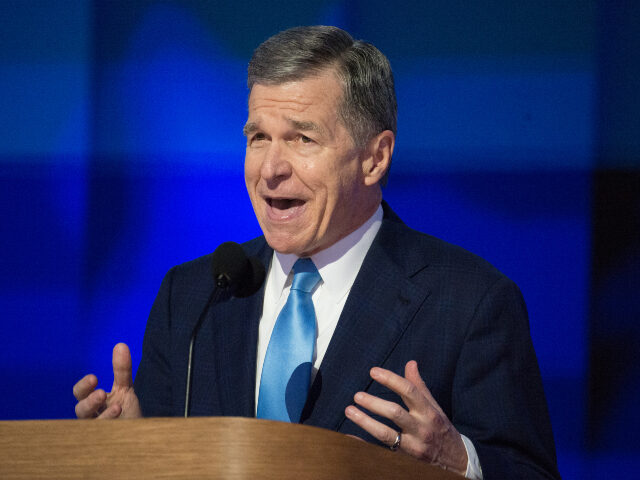

Then-governor of North Carolina Roy Cooper’s administration used around $100 million the state’s legislature intended “to help repair or replace homes damaged by Hurricane Matthew in 2016 or Hurricane Florence in 2018” for affordable housing projects, though hundreds of people affected by those storms were still in temporary homes, according to the New York Post.
According to the Post:
Under Cooper’s watch, the North Carolina Office of Recovery and Resiliency (NCORR) sent $100 million for affordable housing as the $1 billion agency was suffering from a gaping budget shortfall, an analysis by the John Locke Foundation, a free-market think tank in the state, found.
One of the affordable housing projects, Starway Village, was a $9 million 278-unit complex that opened to people earning $45,000 a year, about 12 miles away from the beach. Critically, those affordable housing projects do not require applicants to be hurricane victims.
NCORR is also known as ReBUILD NC.
Meanwhile, the state recovery office defended the program, claiming its funding did not affect recovery for storm victims.
“When determining program needs and funding, NCORR worked in collaboration with HUD [Department of Housing & Urban Development] to determine and prioritize needs in storm-impacted areas,” a NCORR spokesperson told the Post, “while also ensuring full compliance with federal requirements for use of the funds.”
The spokesperson continued, “When making decisions specifically about affordable housing, NCORR also sought and received input from local governments, community organizations, public comment periods and roundtable events.”
The funding issue arose after Hurricane Matthew in 2016 and Hurricane Florence in 2018 wreaked havoc on the state.
In July 2025, the North Carolina House Oversight and Reform Committee issued a report in which they said:
The North Carolina Office of Recovery and Resiliency (NCORR) was created to help repair or replace homes damaged by Hurricane Matthew in 2016 or Hurricane Florence in 2018. Lack of leadership and accountability, starting with Gov. Roy Cooper’s inattention, undermined good intentions.
Even years after those storms, a thousand families were still left without rebuilt or repaired homes, a report by public radio’s WHQR found in 2025. The outlet also reported the recovery office had overrun its budget and was out of money.
Still, the NCORR spokesperson insisted the arrangement of directing over $100 million in disaster relief money to affordable housing projects is normal, saying that states usually incorporate affordable housing into recovery efforts.
“HUD strongly encourages all grantees to have a varied program portfolio, while also requiring a demonstrated need before proposed funding can be approved in an action plan,” the spokesperson said. “Due to the storm impacts experienced by both homeowners and renters, housing availability is considered a key component of community recovery.”
The result, the spokesperson claimed, is that “NCORR’s program has returned 4,240 eastern North Carolina families to safer, more resilient homes.”
Cooper, who is running for a competitive Senate seat against Republican Michael Whatley, received criticism following a state audit that revealed construction of more than 1,100 homes was unfinished by the time he left office at the end of his second term in 2025.
It found that only 3,522 homes were in fact rebuilt, while the governor said he “helped repair” or rebuild more than 14,000 homes.
Neither Cooper nor his team responded to requests for comment on the issue, according to the Post story.
Cooper is widely seen as the frontrunner in his Senate race, partly based on a nine-point edge according to the latest RealClearPolitics aggregate of polling.
Breitbart contributor Lowell Cauffiel is the author of the New York Times true crime best seller House of Secrets and nine other crime novels and nonfiction titles. See lowellcauffiel.com for more.
COMMENTS
Please let us know if you're having issues with commenting.