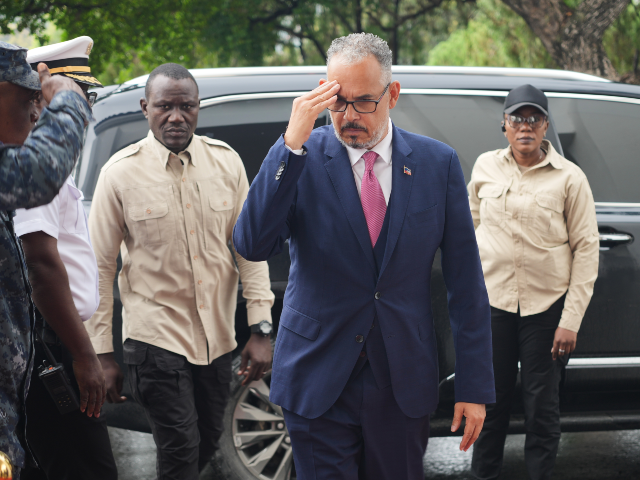

- Amnesty International (AI) questioned Haiti’s security agreement with El Salvador to fight against deadly Haitian gangs.
- Prime Minister Fils-Aimé stressed that human rights should not become a “pretext” for ignoring the rights of Haitians.
- AI called upon Fils-Aimé to disclose the terms of the agreement.
Amnesty International (AI) criticized Haiti’s anti-gang deal with the government of El Salvador this week, prompting a response from Prime Minister Alix Didier Fils-Aimé, who on Tuesday defended his people’s right to security and freedom.
Amnesty International, through one of its Spanish-language social media accounts, stated that the Haitian people have the “right to live free from violence and fear,” but emphasized that the governments of Haiti and El Salvador must ensure that the deployment of “Bukele’s forces” in Haiti respects human rights.
“It is essential to ensure transparency regarding the agreement between the two states, the rules on the use of force, and the oversight and complaint mechanisms,” the text read in part.
AI accompanied the post with a link to a November 9 press release titled, “Haiti: The governments of Haiti and El Salvador must ensure that the Salvadoran military deployment respects human rights.” In the statement, AI’s Americas Director called upon both nations to disclose the terms of the agreement for the deployment of Salvadoran troops in Haitian territory. Pique also urged both governments to “explain” how the deployed troops are being supervised and how Haitians can denounce possible violations to the rules governing the use of force of the deployed forces “without fear of reprisal.”
Haitian Prime Minister Fils-Aimé referred to AI’s remarks in a post published on Tuesday. The prime minister stated that the Haitian people have every right to security, freedom, and respect for their fundamental rights.
“For years, armed groups have held much of the country hostage, subjecting millions of Haitians to daily terror: massacres, kidnappings, rapes, murders, forced displacement, arson, and attacks on public institutions,” Fils-Aimé wrote, recounting that Port-au-Prince was “virtually” paralyzed in 2024.
Fils-Aimé explained that the agreement between Haiti and El Salvador must be viewed in the context of the national security emergency. The prime minister emphasized that respect for human rights and transparency must accompany every operation, “but they must not become a pretext for ignoring Haitians’ right to protection and to regain their freedom.”
“The Haitian people also have the right to a life free from fear, terror, and gang domination,” he concluded.
Hours later, the official account of Amnesty International in the Americas responded to Prime Minister Fils-Aimé, urging him to make public the terms of Haiti’s agreement with El Salvador.
“We share your conviction regarding the importance of security, human rights, and transparency,” the text read in French. “As you are well aware, we have repeatedly documented and condemned the serious violations committed by armed gangs against girls and boys.”
Amnesty further affirmed that it shares Haiti’s aspirations to live in freedom and safety, stressing that the organization has made repeated calls on the Haitian government and the international community to work towards such goals, including with the “use of force by state agents, provided that such force is proportionate and necessary to protect the lives and physical integrity of the population.”
“We once again encourage you to make public the agreement reached with El Salvador and to ensure that all security operations comply with international human rights law, and we remain available to continue the dialogue on all measures likely to bring tangible improvements to the Haitian people,” the text read in part.
Prime Minister Fils-Aimé has not publicly responded to Amnesty International’s latest message at press time. President Nayib Bukele referred to AI’s demands this month by “ratioing” the organization on social media, an online term used when someone’s response post receives more likes or positive engagement than the original poster.
Over 2,500 Salvadoran troops remain deployed in Haiti since October and have engaged in several joint security operations alongside Haitian forces against the nation’s deadly gangs. President Nayib Bukele deployed the troops in response to the ambush and kidnapping of four Salvadoran aircraft technicians. The missing men, whose whereabouts remain unknown at press time, are part of the United Nations Security Council-approved Gang Suppression Force (GSF). Bukele publicly threatened the Haitian gangs with their “destruction” should the four missing men not be returned safely.
The actions of the Salvadoran forces in Haiti over the past weeks have elicited praise from the local population, including thousands of Haitians peacefully marching through the streets off Port-au-Prince and other locations this month to express their gratitude to the soldiers and to President Bukele. On Sunday, President Bukele confirmed that three of the deployed soldiers died in an explosives accident, but did not disclose additional details of the incident. A fourth soldier was left injured and is receiving medical attention at the Dominican Republic.
Last week, the Haitian government announced a partnership agreement with El Salvador that will see the construction of three prisons in Haiti, further deepening the collaboration between both nations. The agreement was announced after Haitian Justice and Public Security Minister Patrick Pelissier returned from an official trip to El Salvador, where he visited the CECOT, the mega prison inaugurated by President Bukele in 2023 which houses numerous gang members imprisoned over the past years by ongoing crackdown on gangs in El Salvador.
Christian K. Caruzo is a Venezuelan writer and documents life under socialism. You can follow him on Twitter here.
COMMENTS
Please let us know if you're having issues with commenting.