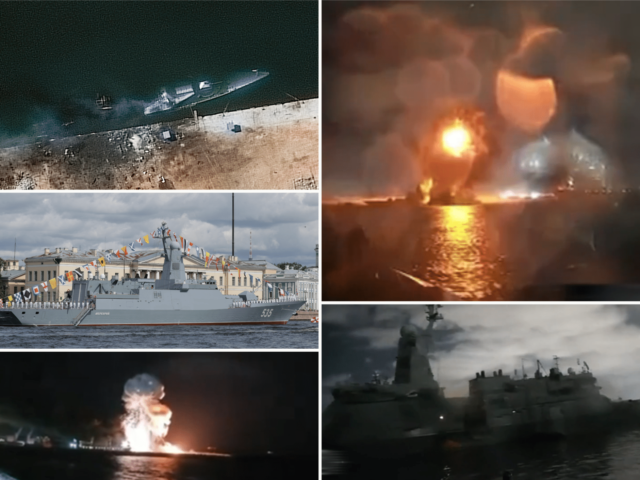

- Ukraine has destroyed one of Russia’s newest warships in a remarkable drone raid over 1,000 miles away from home
- Satellite imagery and attack footage appears to show the Ukrainian strike catching the Russians practically undefended
- It is unclear where the attack was launched from, with strikes launched from a drone mothership, or bases in Western Libya or even Albania claimed
Ukraine has claimed responsibility for the sinking of one of Russia’s most modern warships in the Mediterranean over 1,000 miles away from the front line, stating Moscow is paying for aggressing “even at a strategic distance from Ukraine”.
Ukrainian President Volodymyr Zelensky and his CIA-like national security bureau (SBU) have claimed responsibility for a spectacular, and apparently very long range, drone strike on two Russian ships off the coast of North Africa on Sunday 22nd.
Speaking in a statement confirming his country’s involvement on Monday morning, President Zelensky hailed an “exemplary operation” to sink the Russian Corvette Mercury (Меркурий) in Benghazi harbour in Eastern Libya. The President stated a second attack struck a Russian cargo ship the MV Angara at sea off the coast of Libya resulted in a “target hit”, and published footage of the two strikes recorded by the attack drones themselves.
Ukraine’s state security service, which has taken on much responsibility for special drone strikes against Russian strategic targets over the course of Moscow’s attempted invasion of Ukraine, added further context to the attacks. Calling successful the strike on a very remote Russian warship a “unique special operation”, the SBU noted the corvette Mercury regularly escorted convoys of Russian merchantmen in the Mediterranean.
Protecting the MV Angara was one of the Mercury’s primary concerns, the SBU stated, as they claimed it was part of Russia’s “Syrian Express”, supplying Russian forces in Syria and Libya. The SBU said: “Both vessels were legitimate military targets for Ukraine, as they directly affected the military capabilities of the Russian Federation… Such unique special operations destroy the enemy’s logistical capabilities and force Russia to pay for aggression even at a strategic distance from Ukraine.”
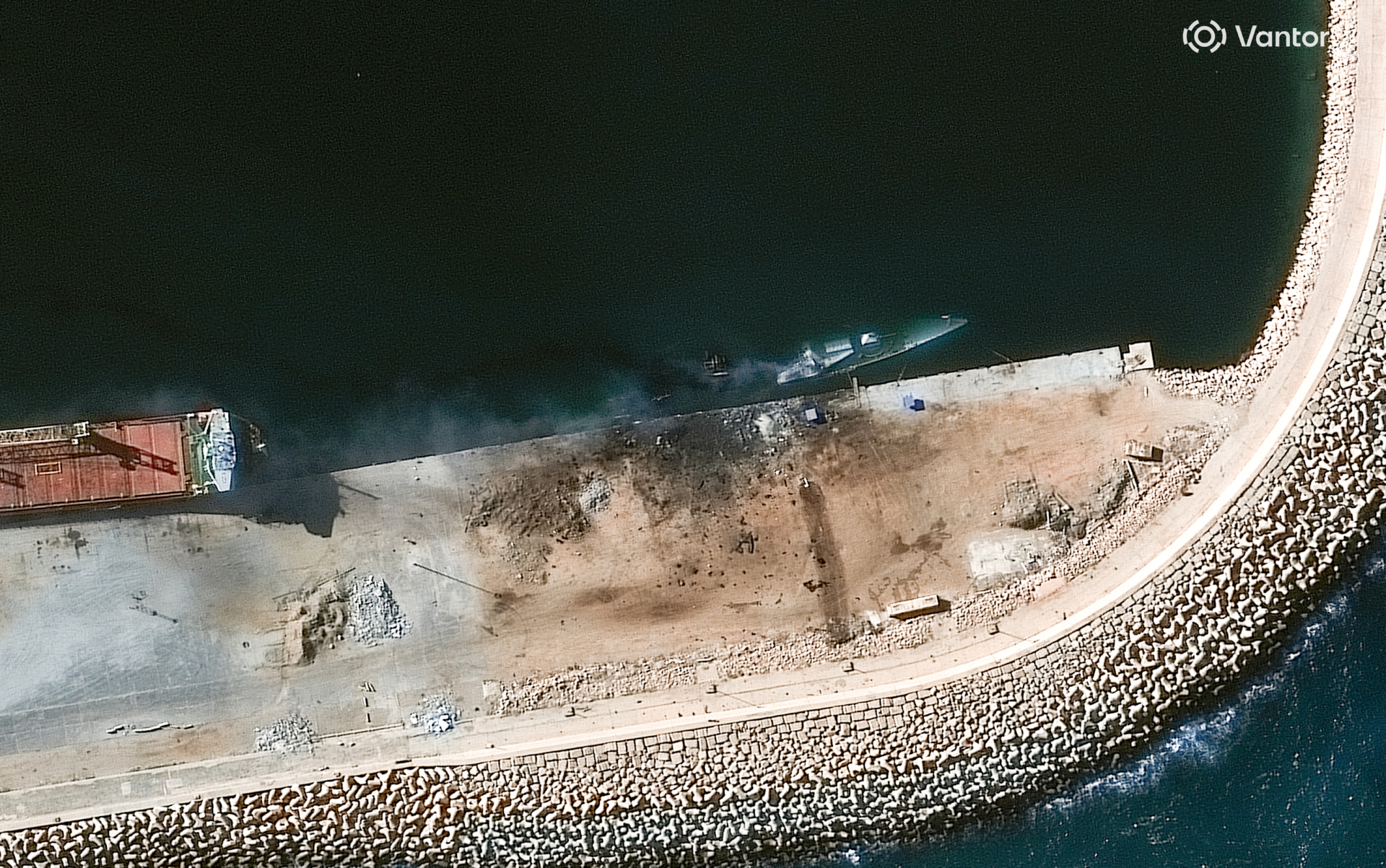
BENGHAZI, LIBYA — NOVEMBER 22, 2026: 05 — Vantor satellite image shows a vessel partly visible in the water beside a pier in Benghazi. Scattered debris and darkened areas are visible along the pier. Please use: Satellite image (c) 2026 Vantor.
One of the Mercury’s sister ships the Brisk (Бойкий) was also said to have been destroyed in another Ukrainian drone strike earlier this year.
Of Sunday morning’s attack, the SBU said it was launched using seven Ukrainian-made attack sea drones — which appear to be semi-autonomous speedboat-type hulls packed with explosives, fuel sensors, and communications equipment — and that an attempt to prevent the attack was unsuccessful. They said: “Despite the enemy’s attempts to destroy the Ukrainian drones from the air, water, and land, the Security Service’s unmanned boats achieved their goal”.
Indeed, in the video clips of the attack shared by the Ukrainian government, in one brief segment a missile or rocket can be seen skipping across the water towards one drone. It appears to have been launched from the shore a considerable distance away from the warship Mercury itself, and passes by the speeding drone without causing serious damage.
A series of drones are seen powering into the side of the Mercury and exploding, appearing to cluster their attacks amidships and astern, possibly to maximise internal damage to the machinery spaces.
The destroyed corvette Mercury of the Steregushchiy-class was commissioned only in 2023, meaning it passed its entire short service life under war conditions. Officially assigned to Russia’s Black Sea Fleet, the closure of the Bosphorus Straits to warships by Turkey under the 1936 Montreux Convention left it unable to return home and it worked instead in the Mediterranean on escort duties.
Before the fall of Syria Russia had access to military facilities in Tartus, but the fall of the Assad regime has made this difficult and warships have been known to use the much more spartan facilities in Libya instead, which may have contributed to the successful strike on Sunday 22nd.
Publicly available satellite imagery now shows the Mercury mostly submerged alongside the mole of Benghazi’s old harbour, a comparatively little-used area earmarked for potential future development as a cruise terminal. Satellite images further appear to reveal there was no boom defence — a physical barrier such as a rope, chain, or net strung across a harbour mouth to ensnare any ship or torpedo attempting to approach a high value target and common in the ports of competently run navies — with an improvised boom made out of small boats only thrown up after the attack.
Between that lack of boom defence and the attack footage showing the Mercury itself not using its CIWS weapons or even pintle guns to defend itself, it appears the Russian ship failed to even take the most modest precautions against attack.
Satellite imagery also suggests the Mercury may only have arrived in port on the 19th. Given such a “unique” or bespoke strike on a warship well over 1,000 miles away from its home port in Crimea may have been impossible for Ukraine to plan and execute in just a few days, it suggests Kyiv had predeployed its drones or had intelligence of the ship heading to Benghazi.
The question of where, exactly, the drones were launched from remains. According to the official Ukrainian government position, they were launched from a ‘mother ship’. Yet the quasi-government of eastern Libya, the Libyan National Army which keeps its capital in Benghazi, claims the drones were launched from a secret Ukrainian sea base in western Libya, where there is a U.N.-recognised government in Tripoli.
The LNA said in a statement, reports The Times: “The Libyan government will not allow Libyan ports, territory or territorial waters to be turned into an arena for settling scores or exporting international conflicts… [Libya is] not a party to the Russian-Ukrainian war”.
The U.N. headquarters in Libya also expressed concern over the strike, called for Libya’s sovereignty to be respected, and stated “Libya cannot afford, and must not become a battleground for foreign conflicts”.
It has also been claimed the attack may have been launched across the Mediterranean, from Albania in the Balkans on the Adriatic Sea. The Albanian government has, however, strongly denied this claim. They said in a statement published to social media: “The reports in question are inaccurate and do not reflect the facts.
“Albania was not involved in this incident, and its territory was neither used nor made available for the launch or facilitation of such an attack… We categorically reject these allegations, which have been presented without verifiable evidence. We call on those responsible for disseminating them to correct the record and to exercise accuracy, due diligence and responsibility when reporting on matters of such sensitivity.”
This suggestion the attack may have originated from the other side of the Mediterranean may rest, to some degree, on the recent phenomenon of allegedly lost Ukrainian sea attack drones turning up in the Ionian Sea, a great distance away from their usual hunting grounds in the Black Sea.
The attack footage released by Kyiv today also showed the final moments of the attack run on the Russian freighter MV Angara, damaged but not destroyed off the Libyan coast. The footage captures the fore part of the attack drone itself, showing in addition to the usual sensors mounted forward to help guide the boat, that it was also fitted with what appears to be four green weapons tubes.
While they are not used in the brief clip showing the drone’s final moments, the Ukraine war has seen a strong trend of repurposing abundant or low-cost lightweight missiles in novel situations, including in strapping small missiles meant for air-launch or man-portable applications to drones. Ukraine has previously shown off sea drones toting small missiles in this way including American Sidewinder missiles, and indigenous RPV-16 thermobaric rocket.
The United Kingdom has previously been reported as assisting Ukraine in its development of its sea drones, and Britain’s Royal Navy has already demonstrated using its lightweight, low-cost Martlet missile in an improvised defensive role at sea.
The two Libyan strikes were not the only attacks on Russian ships this weekend. Sanctioned Russian cargo ship the Sparta II, which is owned by a private logistics company that is contracted by Russian Ministry of Defence, was hit by a suspected drone, this time in international waters in the Baltic very shortly after it departed the Russian zone.
Ukraine has not claimed responsibility for the attack on Saturday but it has been widely suspected they were behind the drone strike on the ship, which was transiting from mainland Russia’s St Petersburg to its northern European exclave Kaliningrad (Konigsberg, Królewiec).
The Kremlin has protested the attack, with President Vladimir Putin’s personal spokesman Dmitry Peskov saying on Monday morning in remarks to journalists that Ukraine is “escalating tensions in the region” by attacking Russian ships in the Baltic. He accused Ukraine of a “terrorist attack” against the ship.
COMMENTS
Please let us know if you're having issues with commenting.