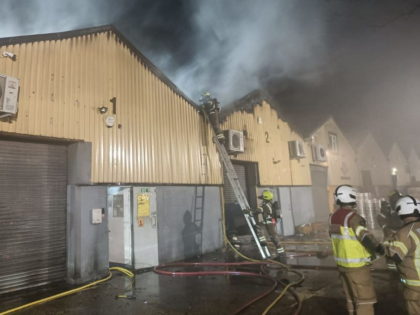
Indian commandos on Friday ended a siege at Mumbai's Trident-Oberoi hotel while explosions and gunfire continued intermittently at the Taj Mahal Hotel, according to reports.
Police said 24 more bodies have been found in the series of attacks that have ripped through Mumbai over the past two days, according to the Associated Press. The new figure brings the death toll in India's commercial and entertainment capital to at least 143.
Among the dead were reportedly as many as four Australians, a Japanese man, an Italian, a Briton and a German.
After a morning of shooting and explosions in Mumbai, the head of one commando unit flushing out militants at the Taj Mahal Hotel said he had seen 12 to 15 bodies in one room among a total of 50 in the hotel, according to Reuters news service.

The commandos found money, ammunition and an identity card from Mauritius that they suspected belonged to the militants, the commander was quoted as telling a news conference.

At least one militant was still thought to be holding two hostages in the luxury Taj Mahal Hotel, an army commander said, according to the report.
But army commander Lt. Gen. N. Thamburaj told reporters almost all guests and staff had been evacuated from the Taj and the operation would be wrapped up in a few hours.
Indian forces also rappelled from helicopters to storm a besieged Jewish center run by the ultra-orthodox Jewish outreach group Chabad Lubavitch.
The assault was punctuated by gunshots and explosions -- and at one point an intense exchange of fire that lasted several minutes -- as forces cleared it floor by floor, according to an Associated Press reporter at the scene. By Friday afternoon, the commandos had control of the top two floors.
Three attackers arrested Thursday night at the Taj Mahal Hotel are Pakistani nationals who are members of the Pakistan-based Lashkar-e- Taiba militant group, the Press Trust of India reported.
India's NDTV quoted a senior army officer as saying that other attackers are also thought to be Pakistanis.
"The terrorists tried to pretend that they were from Hyderabad," the unidentified official said, referring to the capital of India's southern state of Andhra Pradesh.
"(But) intercepts show terrorists speaking in Punjabi," he added, referring to the most common language of Pakistan, India's rival.
In a nationally televised address Thursday, Indian Prime Minister Manmohan Singh suggested the attacks were foreign-inspired, saying, "The well-planned and very orchestrated attacks, probably with external linkages, were intended to create a sense of panic by choosing high-profile targets and indiscriminately killing innocent foreigners."
Indian authorities were reportedly questioning the crew of a ship detained off India's west coast, suspecting the attacks originated from the vessel believed to be from Karachi, Pakistan.
Pakistan's president and prime minister have both strongly condemned the Mumbai attacks.
A little-known group of Islamic militants, calling itself the Deccan Mujahideen, has reportedly claimed responsibility for the attacks.
Indian Prime Minister Manmohan Singh, in an address to the country Thursday, condemned the attacks and said his government would be setting up a federal government agency to coordinate against threats to public safety in India.
A wave of terror attacks has hit Indian cities, including Mumbai, in recent years. Most of them have been blamed on Islamist militants.